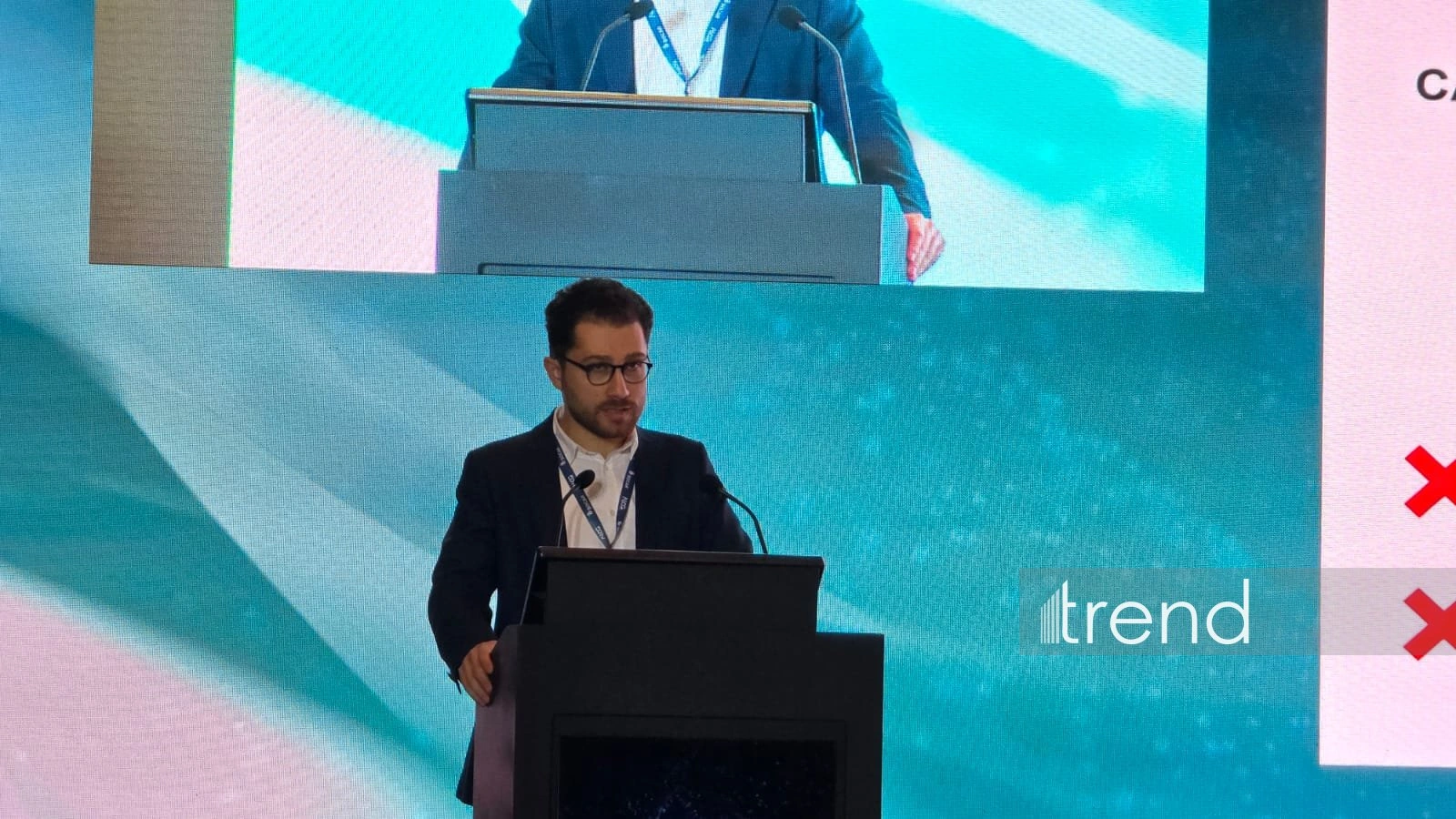
BAKU, Azerbaijan, December 10. Losses due to
corrosion in the oil and gas industry alone exceed $1 billion,
according to the Association for Materials Protection and
Performance (AMPP), Bilgehan Karakuş, Emerson company's security
solutions sales engineer for Azerbaijan and Türkiye, said at the
event "Asset Integrity & Corrosion and Coatings Conference" in Baku
today, Trend
reports.
The company representative briefed on benefits and shortcomings
of current approaches to managing corrosion risks in the oil and
gas industry, noting that it's possible to use more
corrosion-resistant metals within the CAPEX (capital expenditure)
approach.
"From the OPEX (operating expenditure) perspective, various
inhibitors can be used. However, according to the expert, none of
these approaches is a complete solution to the problem. When
corrosion and erosion processes are not monitored, production is
kept below maximum capacity for safety reasons, which leads to
suboptimal process operation.
As a result, unexpected shutdowns occur, which can cost
companies millions of dollars. In some cases, such shutdowns are
repeated, as new leaks are discovered sequentially," he
explained.
The expert also said that an effective solution begins with risk
monitoring.
"In this area, gas leak detection, corrosion probes installed
inside the pipe, and coupons, as well as ER and LPR
(electroresistivity and linear polarization resistance) methods,
can be used. These methods allow determining the level of corrosion
inside the pipeline," Karakus emphasized.
He pointed out that the solution that Emerson considers the most
effective is non-invasive ultrasonic wall thickness measurement
(UT) technology.
"This solution is applied online and wirelessly. Through UT
measurements, the wall thickness of the pipe, the corrosion rate,
and the remaining resource until the end of its service life are
determined.
Besides, existing measurements can be integrated into analytical
platforms, including AspenTech software. This is also supplemented
with data from pH indicators, pressure, temperature, and in-line
corrosion probes. As a result, more extensive analysis and accurate
predictions are obtained.
Analytical results are presented in the form of different
screens and reports for corrosion engineers, maintenance
specialists, process engineers, and plant managers. For example, if
corrosion engineers are mainly interested in technical indicators,
costs, losses, and return on investment, when to stop production
may be more important for plant managers," he stated.
The expert added that this approach allows for real-time
management of corrosion risks, reduction of unplanned shutdowns,
and overall safer and more efficient organization of
production.
Emerson has operated in Azerbaijan since 1997, focusing on
automation technologies for the oil and gas industry. Key
milestones include, in 2012, securing the Main Automation
Contractor role for the Chirag Oil Project; in 2013, expanding
their Baku office; in 2019, completing a $48 million contract for
the Shah Deniz 2 project; in 2020, receiving a contract for the ACE
offshore platform; and in 2025, initiating discussions with SOCAR
on renewable energy, emissions reduction, and digitalization.
Stay up-to-date with more news on Trend News
Agency's WhatsApp channel