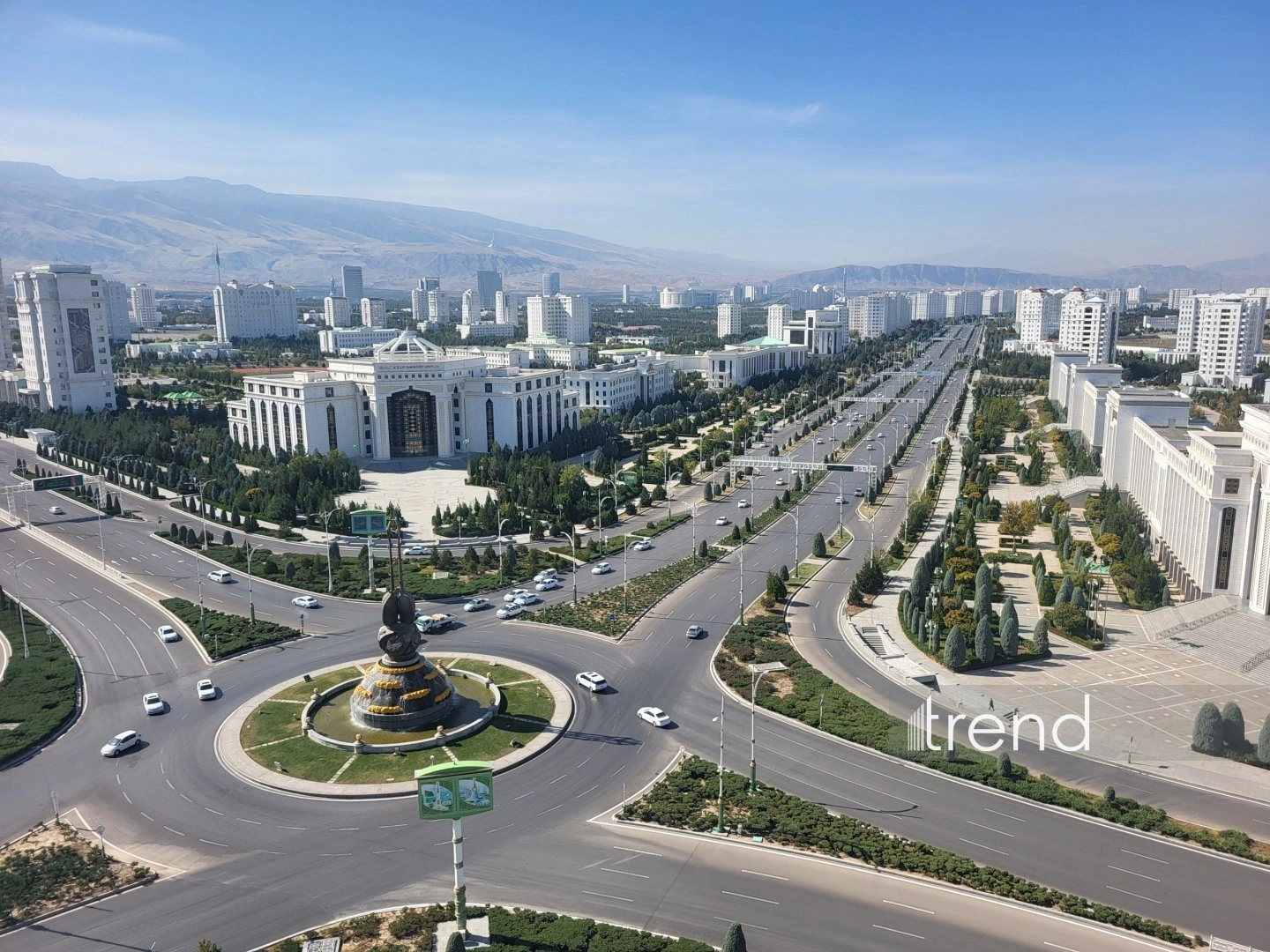
BAKU, Azerbaijan, November 3. The International
Conference and Exhibition on the Development of Construction,
Industrial, Chemical and Energy Sectors of Turkmenistan (CIET 2026) will be
held in Ashgabat on November 3-5. It will bring together more than
800 delegates from over 55 countries, including representatives of
government agencies, international investors, financial
institutions, industrial enterprises and technology companies. The
program includes bilateral B2B and B2G meetings, providing foreign
companies with an opportunity to engage directly with Turkmen
government agencies and enterprises, assess the country's
investment potential and explore prospects for commercial
cooperation.
Against this backdrop, Ashgabat is welcoming representatives of
two countries whose relations are at the center of the
international agenda - Iran and the United States. On November 2,
Iranian Foreign Minister Seyyed Abbas Araghchi arrived in the
Turkmen capital at the head of a delegation comprising diplomatic,
economic and parliamentary representatives. A visit to Ashgabat by
S. Paul Kapur, U.S. Assistant Secretary of State for South and
Central Asian Affairs, is scheduled for the same period. According
to the U.S. side, he will visit Ashgabat and London from November 2
to 9. In Turkmenistan, he is expected to meet with business
representatives to discuss opportunities for expanding U.S.
investment and commercial activity. A practical component of this
engagement will be the U.S.-Turkmenistan Business Council's
business mission, scheduled for November 4-5 and organized in
coordination with the U.S. Department of State alongside the annual
bilateral consultations. Thus, both visits coincide with CIET,
which provides foreign companies with a platform to hold
discussions with Turkmen government agencies and potential business
partners.
The economic dimension of the Iranian visit is reflected not
only in the stated agenda of Araghchi's talks. On October 28, Ahmet
Gurbanov, Deputy Foreign Minister of Turkmenistan, met in Ashgabat
with Hamid Ghanbari, Iran's Deputy Foreign Minister for Economic
Diplomacy. The sides discussed the development of trade and
economic ties, as well as cooperation in energy and industry.
During the meeting between the two foreign ministers on November 2,
they also addressed bilateral cooperation alongside regional and
international issues. For Tehran, Turkmenistan is important as a
neighboring market and a partner in energy and cross-border
logistics, as well as a participant in transport routes linking
Central Asia with Iran and, further, the Persian Gulf.
U.S. engagement with Turkmenistan has also become more
systematic. In May, the Turkmen-American Business Cooperation
Association (TABCA) was established in Washington D.C., and its
first business forum brought together more than 50 companies from
the two countries representing logistics, e-commerce, information
technology, education, consulting and services. That same month, an
event dedicated to Turkmenistan's economic development and
prospects for expanding trade and investment cooperation with the
United States was held at the headquarters of the International
Monetary Fund. It brought together more than 80 participants,
including the ambassadors of both countries, representatives of the
U.S. Department of State and Department of Commerce, the World
Bank, the IMF, business associations and the private sector.
Another notable political signal was the meeting held at the White
House on May 29 between U.S. Secretary of State Marco Rubio and
Turkmen Foreign Minister Rashid Meredov. The sides discussed trade
and economic cooperation, energy, transport connectivity and the
diversification of routes for Turkmen gas exports.
Washington's interest is not limited to its bilateral relations
with Ashgabat. Through the C5+1 format, the United States is
developing cooperation with all five Central Asian countries,
addressing regional issues related to energy, transport
infrastructure, critical minerals, digital technologies and
investment attraction. These areas were included in the agenda of
business sessions held during the meeting of Central Asian foreign
ministers with the U.S. Secretary of State in Samarkand on October
19. In this context, Turkmenistan is important to the United States
as a potential participant in broader regional projects,
particularly in energy, transport connectivity and the
diversification of trade routes.
The coincidence of the Iranian and U.S. visits with CIET 2026
takes on an additional diplomatic dimension amid the ongoing
confrontation between Washington and Tehran and efforts to find
ways to resolve it. Public statements by the leaders of both
countries in recent days indicate that the diplomatic track remains
open, despite harsh rhetoric and the continuing risk of further
escalation. Asked by reporters about the progress of negotiations
with Iran on October 31, U.S. President Donald Trump said: “They're
going fine.” He added, however, that Iran “makes a deal and then
backs out,” before concluding: “They wanna make a deal. We'll see
if they make a deal.” U.S. Secretary of State Marco Rubio also
confirmed that contacts were continuing, stating: “There are
multiple talks; talks have actually never stopped. There's been
active conversations going, both - in some cases directly but often
through intermediaries. And the President's preference in any
challenge around the world is to try to solve it diplomatically and
peacefully, if possible.” Thus, Washington has publicly confirmed
that negotiations are continuing, including through intermediaries,
and expressed a preference for a diplomatic settlement, although
this does not eliminate the differences between the two sides.
On the Iranian side, President Masoud Pezeshkian said on
November 2, during a meeting with governors and mayors of major
cities: “We are trying to resolve the issue through dialogue; in
this matter, the Supreme Leader has also granted the government
certain authorities.” Iranian Foreign Minister Abbas Araghchi,
commenting on diplomatic efforts during his visit to Ashgabat,
reported that intensive contacts were continuing through Qatari and
Pakistani intermediaries. “We have stated our specific conditions
and presented our prepared plan. Now everything depends on how much
political rationality prevails on the American side and whether
there is a willingness to choose the reasonable path of diplomacy,”
the minister said. Thus, both sides have publicly confirmed that
the possibility of a diplomatic settlement remains open, although
their positions on the conditions and sequence of further steps
remain substantially different.
Against this backdrop, Ashgabat finds itself at the center of
coinciding diplomatic activity involving two countries whose
relations remain highly strained. Turkmenistan's status of
permanent neutrality, its geographical location and its accumulated
experience in multilateral diplomatic formats allow the country to
be viewed as a potentially important venue for regional diplomatic
engagement. This role received additional political and legal
recognition in the Ashgabat Declaration, adopted on December 12,
2025, at an international forum marking the 30th anniversary of
Turkmenistan's permanent neutrality. In paragraph 11, the
participants encouraged the effective use of the territories of
neutral states for peace negotiations and conflict resolution, and
also noted Turkmenistan's proposal to establish a Chamber of
Mediation for Peace on its territory under the auspices of the
United Nations. A similar approach is reflected in the third
operative paragraph of UN General Assembly Resolution 79/274 of
March 21, 2025. At the same time, the UN document stipulates that
the proposal to establish such a Chamber remains subject to
consideration by UN member states and the Organization's system.
This provides an international normative basis for Ashgabat's
potential role in mediation. Whether the coincidence of the visits
could lead to any practical diplomatic developments remains an open
question.
The significance of a possible diplomatic settlement extends far
beyond U.S.-Iranian relations. One of the main factors behind the
conflict's global impact is the situation around the Strait of
Hormuz, a key route for oil and liquefied natural gas supplies.
According to the International Energy Agency, an average of around
20 million barrels of oil and oil products passed through the
strait daily in 2025, accounting for approximately one-quarter of
global seaborne oil trade. The strait also carries around 19% of
global LNG supplies. The consequences of disruptions are already
being felt in global energy markets. On November 2, Sultan Ahmed Al
Jaber, CEO of the Abu Dhabi National Oil Company (ADNOC), said that
global oil inventories had fallen by nearly one billion barrels
since the beginning of the crisis, while transportation and
logistics costs had risen from 5% to 30% of the cost of a barrel.
Further escalation could therefore increase pressure not only on
energy markets but also on international trade, supply chains and
inflation, he noted.
Efforts to find diplomatic mechanisms for resolving the crisis
are not limited to Qatar and Pakistan, through which contacts
between Washington and Tehran are currently being maintained. Oman,
which previously hosted direct U.S.-Iranian negotiations, remains
interested in playing a mediating role. At the same time, China's
diplomatic engagement has intensified. On November 2, Chinese
President Xi Jinping discussed the situation with Oman's Sultan
Haitham bin Tariq, while Chinese Foreign Minister Wang Yi held
separate meetings with representatives of Iran and Saudi Arabia,
urging the parties to seek a political solution. Beijing also
announced an upcoming visit by its special envoy to Iran, Oman and
Saudi Arabia. The expansion of diplomatic channels shows that
resolving the crisis is viewed as a task affecting the interests of
a broad range of countries. In this context, Turkmenistan's neutral
status and its readiness to provide a venue for possible peace
talks could represent an additional diplomatic resource.
Thus, the assumption that the coincidence of the U.S. and
Iranian delegations' visits to Ashgabat could have an additional
diplomatic dimension is based on a combination of circumstances:
ongoing contacts between Washington and Tehran through
intermediaries, intensified international efforts to find a way out
of the crisis, and Turkmenistan's role as a neutral state willing
to facilitate peaceful dialogue, as recognized in international
documents. This would not necessarily require a direct meeting
between representatives of the two countries in the Turkmen
capital. Potential contacts could take place through the Turkmen
side or other intermediaries, even if the U.S. and Iranian
delegations are not in Ashgabat at the same time. Of course, there
is currently no confirmation of any such contacts, and the
coincidence of the visits alone does not prove that an arrangement
of this kind exists. Nevertheless, a legitimate question arises:
could Ashgabat, which is welcoming representatives of both
countries amid ongoing diplomatic efforts, become another channel
for seeking ways to de-escalate the U.S.-Iran confrontation?