ASHGABAT, Turkmenistan, October 22.
Turkmenistan has investigated more than a dozen major methane
emission events following satellite alerts from the United Nations'
Methane Alert and Response System (MARS), with eight cases of
emission reductions subsequently confirmed, Monica Bergeron, Head
of Strategic Coordination and Key Initiatives at the International
Methane Emissions Observatory (IMEO), said, Trend's special correspondent
reports.
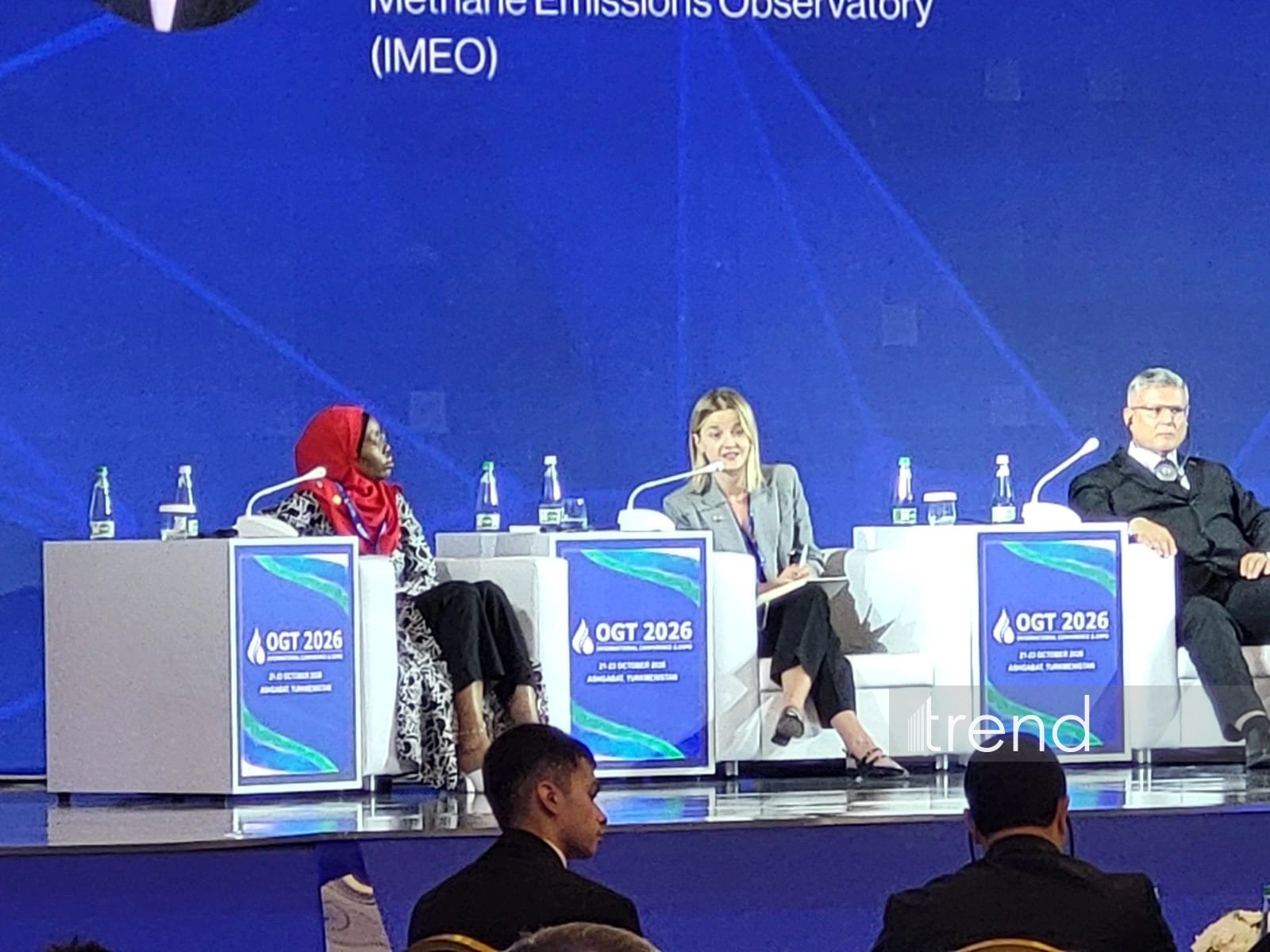
Speaking at the 31st International Conference and Exhibition
"Oil and Gas of Turkmenistan - 2026" (OGT 2026) in Ashgabat,
Bergeron said that the system has been sending alerts to Turkmen
companies and government authorities since 2023.
"The country has designated focal points at the state concerns
Turkmengaz and Turkmennebit, as well as within government
structures, who receive direct notifications from MARS, and we are
really seeing that this approach is working," she said.
According to Bergeron, the experience demonstrates how satellite
detection can serve as a starting point for practical measures to
reduce emissions.
"More than a dozen major emission events have been investigated
in the country, resulting in eight distinct confirmed examples of
methane emission reductions," she said.
Bergeron stressed that identifying a leak is only the first
step. Companies and government authorities must receive alerts,
understand how to verify emission sources and have the capacity to
take corrective action.
"Detection is not the end result, but only the beginning of a
process of direct engagement with government authorities and
operators who can actually do something with the data," she
said.
IMEO is ready to expand its cooperation with Turkmenistan by
training specialists, helping develop response protocols for
satellite alerts and providing on-the-ground support during
investigations, Bergeron added.
She explained that IMEO is an initiative of the United Nations
Environment Programme (UNEP) that combines data from scientific
studies, industry reporting and satellite observations and delivers
it to those able to use the information to reduce emissions.
MARS draws on data from 35 satellite instruments to identify
major methane emission sources worldwide. Since its launch, the
system has analyzed more than one million satellite images,
covering an area equivalent to approximately twice the Earth's
total land area.
Artificial intelligence has helped accelerate the processing of
satellite imagery by a factor of 15 compared with manual analysis,
Bergeron said. However, AI does not replace experts: it helps
identify potential emission events for subsequent verification by
specialists in remote sensing and data analysis.
"The challenge today is no longer access to satellite data on
methane. It is processing the enormous volume of information and
turning it into timely, actionable alerts that companies and
operators can use to take measures," she said.
Bergeron reaffirmed IMEO's readiness to continue working with
Turkmen partners, noting that close coordination among stakeholders
could help translate methane emission reductions into practical
climate benefits.
In an earlier exclusive interview with Trend, UNEP also highlighted the results of its
cooperation with Turkmenistan on methane emission reductions.
The organization said the collaboration had established reliable
communication channels for delivering MARS alerts directly to
government officials and companies capable of addressing emission
sources.
"UNEP estimates that the eight sources in Turkmenistan had
emitted over 27,000 tonnes of methane before they were addressed.
The near-term climate impact of these emissions was equivalent to
the climate impact of over 500,000 passenger vehicles driven for
one year," the organization said.
Meanwhile, the second day of the 31st International Conference
and Exhibition “Oil and Gas of Turkmenistan” (OGT 2026) has begun
in Ashgabat. As part of the event, a session is being held on the
topic “Investment and development opportunities in the Turkmen
sector of the Caspian Sea.” Discussions are focusing on investment
opportunities for developing the Turkmen sector, prospects for
offshore exploration and production of hydrocarbons, and the
development of international partnerships.
The agenda also includes existing and new production-sharing
agreements (PSAs), as well as modern seismic survey programs
designed to help assess resource potential and prepare promising
blocks for development.