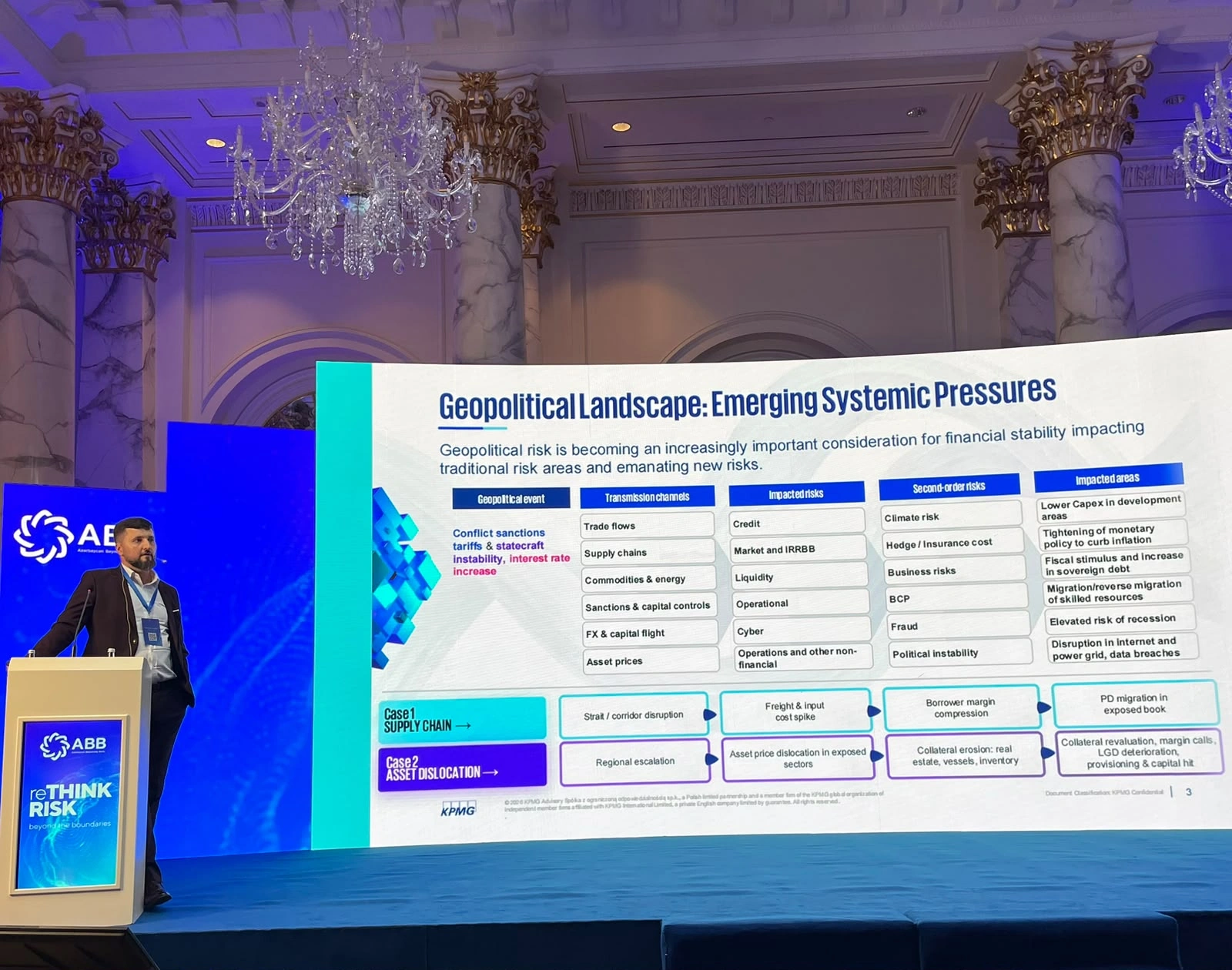
BAKU, Azerbaijan, October 19. Banks need to
move beyond assessing individual risks and analyze how different
threats interact, accumulate, and affect the overall resilience of
financial institutions, KPMG told Trend.
Mateusz Kuzioła, Partner Associate and Head of Banking Sector at
KPMG Poland, made the remarks during the ABB Risk Forum 2026 in
Baku, where he delivered a presentation titled “Emerging Risks:
Risk Management in Times of Turbulence” on the challenges emerging
risks pose to the banking sector.
“In times of turbulence, resilience is not about the ability to
predict the future perfectly, but about withstanding uncertainty
without losing control over what matters most: sound
decision-making, financial and liquidity stability, business
continuity, and customer trust.
“The next shock will be driven by multiple risk categories
rather than a single factor. Uncertainty is not a temporary
disruption but a defining feature of the banking environment.
Resilience is a bank’s strategic capability, not a regulatory
obligation or a cost of doing business,” he said.
According to the company, the presentation emphasized that
effective risk management requires banks to look beyond individual
threats, understand the interconnections between them, assess their
combined impact, and strengthen resilience through scenario
analysis, stress testing, and business continuity planning.
The presentation also examined how technological developments
and external shocks can outpace the evolution of risk management
and control systems, particularly in areas such as artificial
intelligence, cloud services, and critical digital
infrastructure.
KPMG also stressed that effective risk management requires
clearly defined responsibilities, reliable risk data, human
oversight, and continuous monitoring. Coordination among the three
lines of defense, together with cooperation with external
stakeholders, also helps strengthen risk oversight and preparedness
for potential threats.
Although traditional control mechanisms remain essential, they
are not sufficient to address rapidly evolving and interconnected
risks, the company noted.
“Scenario analysis of interconnected threats, liquidity stress
testing, and business continuity exercises help banks assess
potential consequences, prepare for adverse events, and strengthen
their ability to maintain critical services,” the company said.
The ABB Risk Forum 2026 was held under the slogan “reTHINK RISK
beyond the boundaries” and brought together more than 150
representatives of the financial services sector. Participants
discussed emerging risks, geopolitical and macroeconomic trends,
regulatory changes, artificial intelligence, cyber threats, and
operational resilience.
KPMG was also represented at the event by Tomasz Kołodziejczyk,
Partner Associate and Risk & Finance Advisory Leader at KPMG
Poland; Roman Lesnikov, director of financial services at KPMG in
the Caucasus and Central Asia; and Anuar Nurakhmetov, director of
technology consulting at KPMG Azerbaijan.