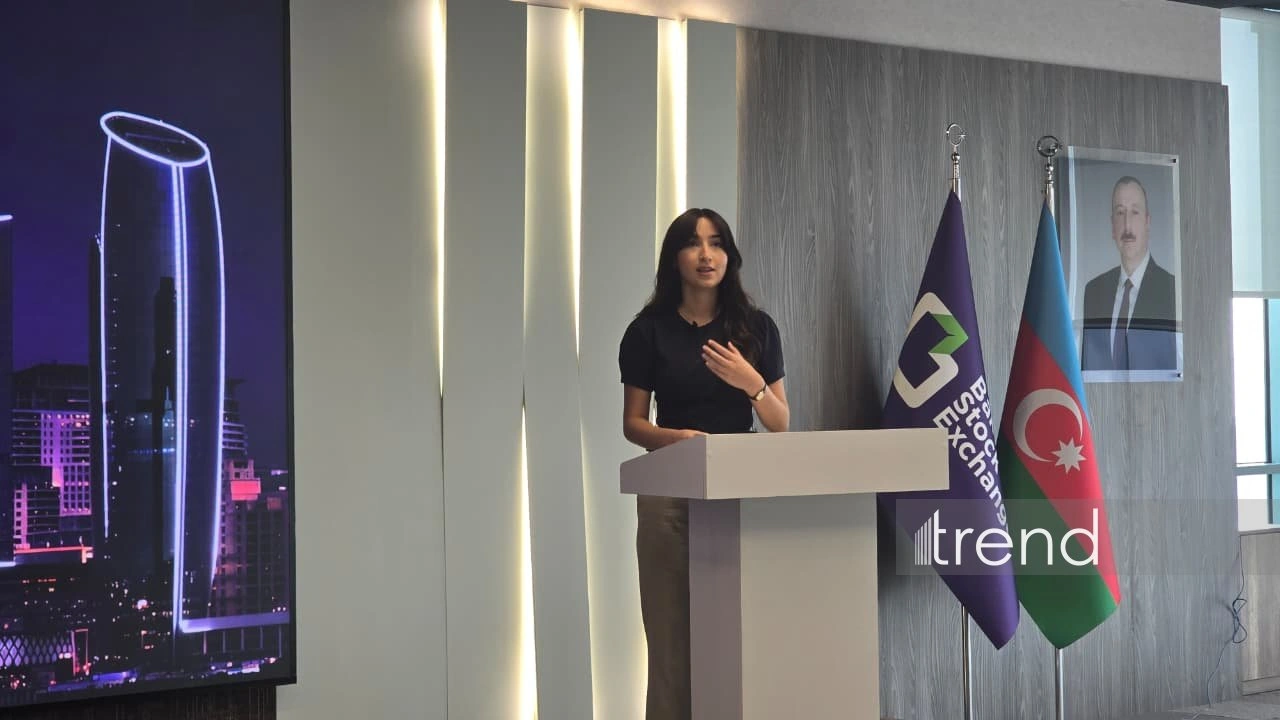
BAKU, Azerbaijan, September
22. The large-scale issuance of SOCAR bonds has
had an impact on the corporate bond market, Financial Analyst at
the Baku Stock Exchange (BSE), Narmin Bayramli, said during the
presentation of the “Q2 2026: Review of the Azerbaijani and Global
Economy and Capital Markets” bulletin prepared by the BSE for the
second quarter of 2026, Trend’s correspondent reports from the event.
She added that the volume of REPO transactions using corporate
securities as collateral amounted to 960 million manat ($564.7
million) in Azerbaijan in the first half of 2026.
According to her, government securities—considered to carry
lower risk—are primarily used in REPO transactions. The previously
high share of corporate securities in REPO transactions was largely
driven by operations involving SOCAR bonds.
Bayramli noted that the withdrawal of that specific issue of
SOCAR bonds from the market, and the subsequent cessation of REPO
transactions involving these securities, led to a significant
decline in the figures for corporate securities.
The BSE official pointed out that high liquidity within the
banking sector also played a role in the decrease in total REPO
turnover. According to her, banks primarily use REPO transactions
to meet short-term liquidity needs; the presence of excess
liquidity in the banking system reduces the demand for this
instrument.
According to the BSE, the volume of REPO transactions using
corporate securities as collateral amounted to 0.96 billion manat
($0.56 billion) in the first half of 2026. In the same period of
2025, this figure stood at 11.85 billion manat ($6.97 billion).
Thus, the volume of REPO transactions involving corporate
securities decreased by around 91.9% year-on-year.
At the same time, the volume of REPO transactions based on
government bonds increased from 19.25 billion manat ($11.32
billion) to 19.97 billion manat ($11.75 billion). As a result,
government bonds accounted for around 93% of total REPO turnover in
the first half of 2026.
Overall, total REPO turnover in Azerbaijan amounted to 21.57
billion manat ($12.69 billion) during the reporting period, down
30.9% compared with the first half of 2025.
Bayramli also noted that increased liquidity in the banking
sector could stimulate future bond issuances.
"We view the banking and securities sectors as complementary
rather than competitive. There may be a decline in the market, but
we don’t interpret this as a weakening of the market itself; it
could stem from various factors, including the choices made by
market participants," she remarked.
The BSE financial analyst also said that numerous factors
influence the capital market, and when assessing the market,
attention is paid not only to fluctuations in turnover but also to
changes in its internal structure.
"We focus primarily on how the market's internal structure is
evolving. We examine factors such as the types of bonds issued, the
terms of issuance, coupon rates, and which coupon rates are most
prevalent," Bayramli emphasized.
According to her, increases or decreases in market indicators
during specific quarters can be attributed to both global and local
macroeconomic conditions.