Inequality between the Global North and Global South continues to grow. Research at the Autonomous University of Barcelona has shown that the income gap between rich and poor countries has widened sharply. What are the reasons behind this trend, and what could it mean for humanity?
Poverty that is falling further behind
Researchers at the Institute of Environmental Science and Technology of the Autonomous University of Barcelona (ICTA-UAB) have challenged the now widespread theory that countries on the global periphery are steadily catching up with the West in terms of living standards. Jason Hickel and Dylan Sullivan were the first to analyse GDP per capita data for the period from 1960 to 2023 across 173 countries, accounting for 99.9% of the world’s population. The data were processed using three methods of currency comparison.
The resulting study, published in New Political Economy, is tellingly titled “The myth of catch-up development: trends in core–periphery inequality from 1960 to 2023.”
The findings completely challenge claims such as those made by Steven Pinker in Enlightenment Now (2018) about “catch-up development”, whereby the neoliberal model supposedly leads to a convergence in incomes between countries.
“In fact, the opposite is occurring,” the researchers from Barcelona argue. “The absolute income gap between the core (‘advanced economies’) and the periphery (‘emerging and developing economies’) has increased since 1960, by 170–270% depending on the currency concept. The core has captured 4–10x more income than the periphery over this period.” The “core” refers to countries that were initially classified as developed according to the IMF list: Western European states, the United States, Canada, Australia, New Zealand and Japan.
There has been no relative convergence either: for most countries in the Global South, the situation has only deteriorated compared with the countries of the “core”. Inequality intensified particularly during the neoliberal era of the 1980s and 1990s. China is the only exception to this pattern.
The incomes of what were until recently referred to as “Third World” countries increased by only a few percentage points at best. But even this figure is driven primarily by China. If China is excluded, the situation of countries in the poorer South has become worse.
It is true that a number of small states, accounting for just 0.5% of the world’s population, have recently moved from the periphery into the “core”. However, the researchers argue that they were deliberately admitted in order to serve the West’s geopolitical interests.
“These countries are not randomly distributed across the globe; they are located almost exclusively in Southern Europe, East Asia and on the eastern border of the EU, forming a cordon sanitaire around the former socialist bloc,” Professor Jason Hickel says.
At the same time, an increasing share of the world’s population is finding itself on the periphery. Since 1960, the proportion of people living outside the affluent “core” has increased from 80% to 86%. Therefore, it would be more appropriate to speak not of “catch-up development”, but of catch-up poverty.
Unequal exchange
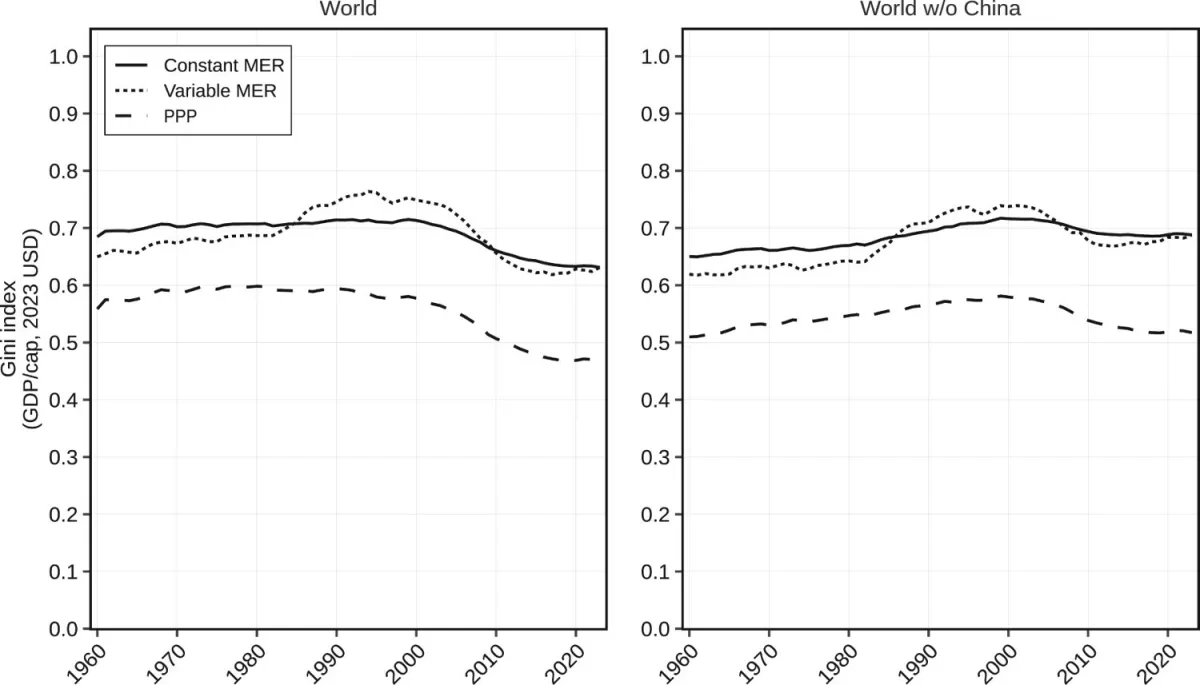
But what about the fact that a number of publications, based on the Gini index, show that inequality is declining, albeit slowly? The reason is that the cross-country Gini coefficient was measured there using purchasing power parity (PPP). The researchers from the Autonomous University of Barcelona also incorporated another indicator into their calculations: the market exchange rate (MER). This substantially changed the picture of how global inequality has evolved.
The decline in real exchange rates in countries of the Global South, as well as currency devaluations, had also not previously been taken into account. However, it is true that after 1960 there were periods when inequality declined to some extent. In the 1970s, this was linked to the fact that the global economic crisis reduced the absolute surplus available for appropriation by elites. But while incomes in the countries of the “golden billion” began to recover and grow in 1982, they continued to decline in the Global South. By 1992, incomes on the periphery had fallen by 54% compared with 1973. Recovery there came only in 2008.
A certain reduction in inequality between 2000 and 2022 was largely due to a sharp rise in commodity prices, which significantly increased incomes in Global South commodity-exporting countries. But over the longer term, the trend towards unequal income growth remained unchanged.
It is also clear from assessing incomes at market exchange rates that incomes in the wealthy “core” have grown roughly nine times faster than those on the periphery since 1960.
“In absolute terms, core–periphery inequalities are more severe now than at any time in history. And this trend of increased absolute inequality holds for all regions of the periphery,” the researchers argue.
“There are only two instances where absolute inequality has declined in recent years – namely, the PPP series for China and Eastern Europe & Central Asia between 2000 and 2023. While this represents a real improvement in the case of China, for the former Eastern Bloc it is little more than a period of recovery from the very low incomes associated with the economic crisis of the 1990s to early 2000s. For both regions, the total income gap in 2023 is several times larger than the 1960 income gap for all regions. However we might assess the core–periphery trends, it makes little sense to describe this as ‘catch-up’ – much less ‘convergence’ – according to any commonsense definitions of these terms.”
Countries of the Global South suffer the most severely during periods of systemic crisis. At the same time, the authors clearly identify the causes behind such glaring inequality. In their view, under neoliberal capitalism, “some 80% of humanity and the large majority of the world’s landmass must always be located in the periphery in order to provide the cheap labour and resources upon which Northern accumulation depends”.
This order did not emerge as a result of the natural workings of the much-vaunted “free market”; rather, it was imposed by force on the Global South by an aggressive North. The stark income divide is driven primarily by the power of the “core” over peripheral countries, against which the West pursues a policy of suppressing wages, facilitating capital accumulation in the metropoles and denying sovereign development.
People in the periphery consume less than they produce. The West and certain other countries simply appropriate the resources, labour and value created in the countries of the Global South through unequal exchange. “The core-periphery divide isn't a development gap—it's a structural feature of the capitalist world economy,” argues Dylan Sullivan.
Economic sovereignty as the basis for overcoming global inequality
China occupies a special place in the analysis of the world system. According to researchers from the Autonomous University of Barcelona and a number of other authors, China played a major role in helping the “core” (the West) overcome the crisis of the 1970s. After the formerly “semi-peripheral” countries of Eastern Europe were transformed into little more than suppliers of energy, raw materials and labour, China became a vast new region with cheap labour, providing a convenient destination for industrial capital. But today, the PRC is challenging the structure of “core–periphery” world trade. And China’s pursuit of sovereign development has already met with an aggressive response from the West.
But it is precisely the PRC that can objectively play a significant role today in overcoming global inequality. And not only through its own example. China’s advanced technologies could enable other countries of the Global South to move away from total dependence on imports from the countries of the northern “core”. Indeed, the modest decline in the Gini index recorded since 1960 is linked not to the convergence or equalisation of the indicators of the “core” and the periphery, but to cooperation between China and countries in Latin America, Eastern Europe and the Middle East, as well as to growing Chinese demand for industrial resources.
The authors of the study also challenge the theory of “catch-up development” with the following argument: economic growth in the wealthy countries of the “core” depends on unequal exchange and the appropriation of resources from the Global South. But countries on the periphery cannot follow the same
The only way to overcome growing global inequality, therefore, is to pursue a
Environmental considerations may provide another argument for abandoning the current unjust “North–South” economic model, as the level of natural-resource consumption imposed by the global centre is driving humanity towards an ecological catastrophe.
“Convergence in the twenty-first century should occur at levels of throughput that are adequate to ensure good lives for all people in all nations, and compatible with ecological objectives,” the scholars from the University of Barcelona conclude.