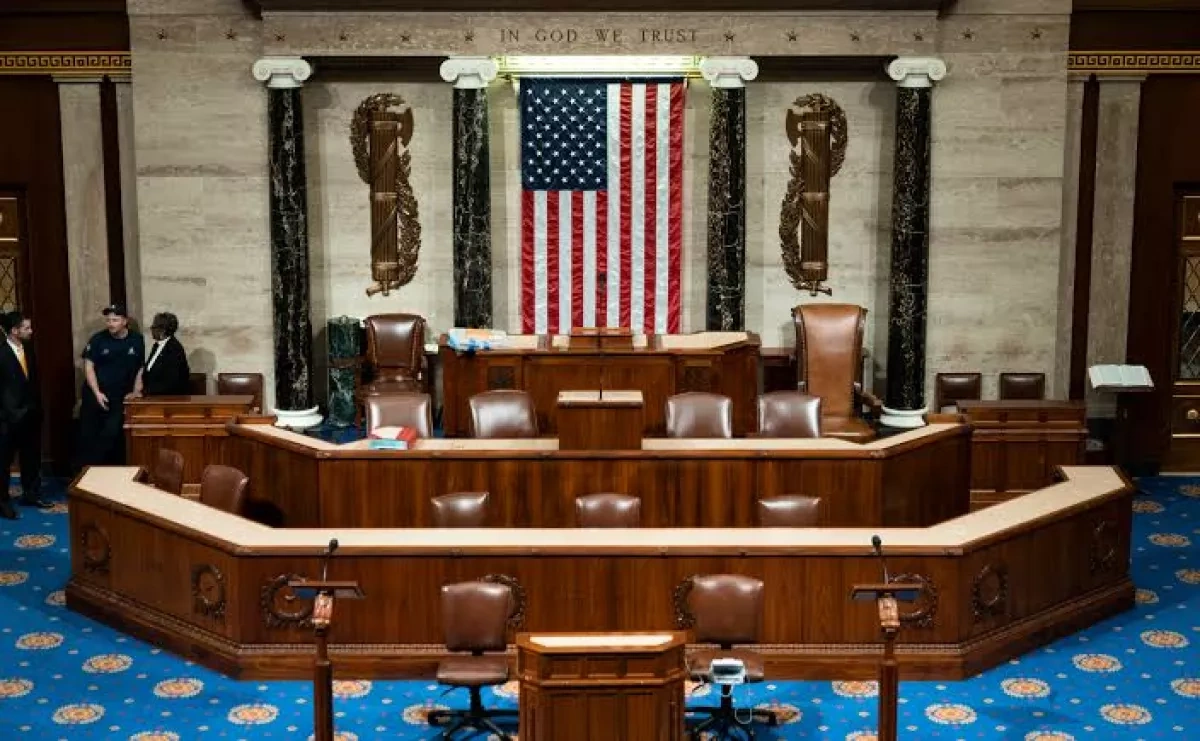
The US House of Representatives voted for a third time on Tuesday, September 15, to direct President Donald Trump to end US military involvement in hostilities with Iran, with seven Republicans joining Democrats in support of the measure.
The resolution passed 220-204, with 213 Democrats and seven Republicans voting in favour. It marked another congressional challenge to the president’s authority over the Iran conflict and attracted more Republican support than the two previous House efforts in June and July.
The seven Republicans who backed the measure included four lawmakers who had supported the previous resolutions — Tom Barrett of Michigan, Brian Fitzpatrick of Pennsylvania, Warren Davidson of Ohio and Thomas Massie of Kentucky — as well as three who voted for the measure for the first time: Nancy Mace of South Carolina, Mariannette Miller-Meeks of Iowa and Zach Nunn of Iowa.
The measure was introduced by Democratic Representative Seth Moulton of Massachusetts. It directs the president, under Section 5(c) of the War Powers Resolution, “to remove United States Armed Forces from hostilities with Iran.”
The House vote came as lawmakers again sought to assert Congress’s role in decisions involving US military action. The June resolution ultimately passed both chambers, with the Senate approving it 50-48.
A separate House war-powers resolution approved in July has not yet been taken up by the Senate. The Senate also rejected attempts in June and July to advance other measures aimed at restricting the president’s authority over military operations involving Iran.
It remains unclear when the Senate will consider the latest House resolution. As of Tuesday, the Senate’s published schedule provided for H. Con. Res. 89 to be discharged from the Foreign Relations Committee and brought to the floor no later than Oct. 2, followed by six hours of debate and a vote.
The House’s latest action therefore does not by itself bring an end to US military operations against Iran. Its significance lies in the repeated effort by lawmakers to invoke the War Powers Resolution and assert congressional authority over the use of US armed forces.
By Tamilla Hasanova