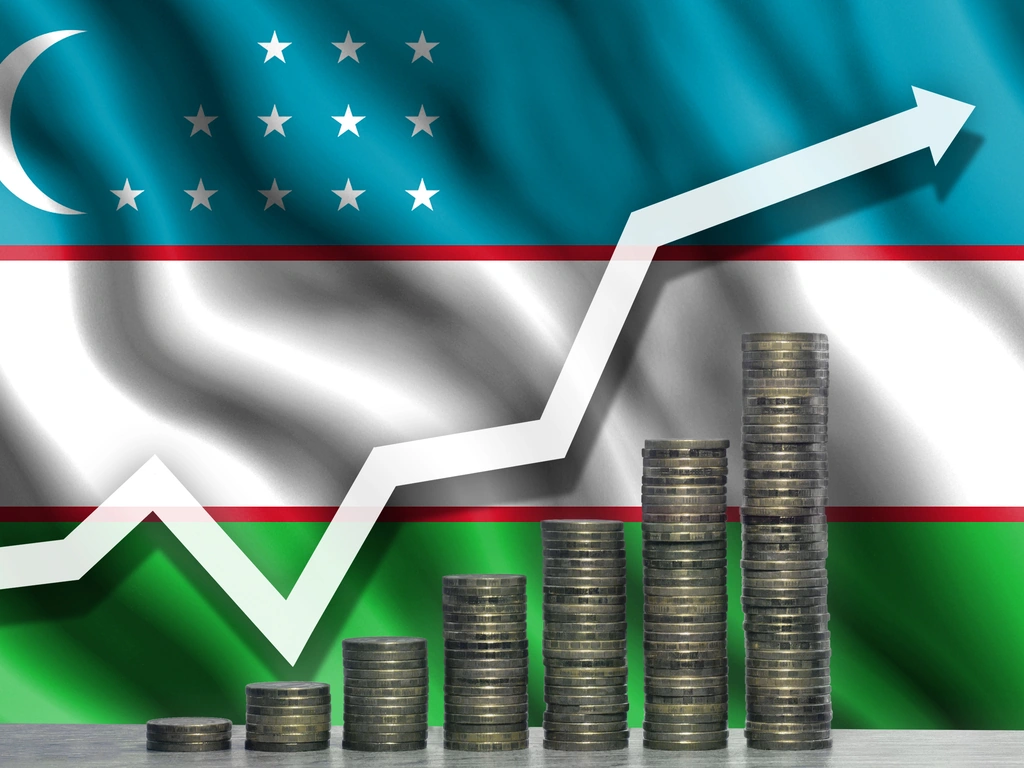
BAKU, Azerbaijan, August 4. Uzbekistan entered
the second half of 2026 with one of the strongest economic
performances in Central Asia, reinforcing its position among the
region's fastest-growing economies. Real gross domestic product
(GDP) expanded by 8.5% year on year during the first six months of
the year, reaching 1.073 quadrillion soums (approximately $89.5
billion). Beyond the headline figure, however, the latest data
point to a broader structural transformation, with growth
increasingly supported by industry, services, construction and
digital sectors rather than a single source of expansion.
This increasingly diversified growth model has helped reduce
dependence on traditional sectors while strengthening the economy's
resilience to external shocks. Nevertheless, persistent
inflationary pressures, geopolitical uncertainty and global market
volatility continue to test policymakers' ability to sustain rapid
growth while preserving macroeconomic stability.
Growth becomes increasingly diversified
The first-half GDP data illustrate that Uzbekistan's economy is
becoming more balanced across sectors. Services remained the
country's largest economic pillar, accounting for 50.8% of GDP,
while industry increased its share to 26.5%. Agriculture, forestry
and fisheries contributed 15%, and construction represented 7.7% of
total output.
More importantly, the fastest-growing sectors were not
traditional industries but modern services and infrastructure.
Transportation, storage, information and communications expanded by
18.6%, while information and communications services alone grew by
23.2%. Construction increased 13.7% and trade, accommodation and
food services expanded 13.5%, both significantly outpacing overall
economic growth.
This pattern indicates that Uzbekistan's expansion is no longer
driven primarily by agriculture or commodity production. Instead,
investment in infrastructure, logistics, digital services and
manufacturing is becoming an increasingly important source of value
creation.
The industrial sector also demonstrated relatively broad-based
growth. Manufacturing increased by 8.8%, electricity, gas and steam
supply expanded by 7.9%, while water supply and waste management
recorded growth of 15.9%. Although mining grew more modestly at
2.1%, overall industrial performance continued to support the
country's broader economic transformation.
Digital economy gains strategic importance
One of the most notable developments is the increasing
contribution of the information and communications technology (ICT)
sector.
Its share of GDP rose to 2.9% during the first half of 2026,
compared with 2.8% a year earlier and 2.4% in 2024. While the
increase may appear gradual, it reflects a consistent shift toward
higher-value economic activities.
Within the ICT sector, computer programming, consulting and
related services accounted for more than half of total value added,
considerably exceeding the contribution of traditional
telecommunications. This suggests that Uzbekistan's digital economy
is evolving beyond communications infrastructure toward software
development, IT services and knowledge-based activities.
The expansion of ICT is particularly significant because digital
industries generally tend to support higher productivity and value
creation, create skilled employment and improve competitiveness
across other sectors of the economy. Continued investment in
digital infrastructure therefore has the potential to amplify
economic growth well beyond the direct contribution of the sector
itself.
Investment, construction and entrepreneurship remain
central
Another defining feature of Uzbekistan's economic performance is
the continued strength of investment-driven growth.
Construction remained among the fastest-growing sectors,
supported by strong expansion across specialized construction
activities, civil engineering and building construction. This
reflects sustained investment in housing, industrial facilities and
infrastructure projects that continue to underpin domestic economic
activity.
At the same time, entrepreneurship continues to play a critical
role. Small businesses generated more than half of the country's
gross value added during the reporting period, accounting for 50.5%
of the total. Their contribution remained particularly dominant in
agriculture and construction, highlighting the importance of
private enterprise for employment creation, regional development
and domestic demand.
The country's investment momentum is supported by several
complementary sources. Government infrastructure spending continues
to underpin construction and industrial development, private
businesses remain central to domestic economic activity, while
banking reforms and privatization are expected to encourage greater
foreign investment and private-sector participation.
The continued expansion of small businesses also suggests that
economic reforms aimed at supporting private-sector activity are
gradually broadening the country's production base beyond large
state-owned enterprises.
Formalization strengthens the economy
The latest GDP data also reveal another important structural
trend that often receives less attention than headline growth
figures.
The share of Uzbekistan's non-observed economy declined from
26.1% during the first half of 2025 to 22.9% in the corresponding
period of 2026. This reduction reflects continued progress in
formalizing economic activity, improving tax compliance and
integrating household production into the official economy.
A shrinking shadow economy has implications that extend beyond
statistical improvements. Greater formalization generally broadens
the tax base, improves the effectiveness of public policy and
increases access to financing for businesses operating within the
legal economy. Over time, these developments can strengthen
productivity and support more sustainable long-term growth.
Fiscal policy supports growth while preserving
stability
Alongside structural changes in the private sector, government
policy continues to play a central role in shaping Uzbekistan's
growth trajectory.
While monetary policy remains restrictive to contain inflation,
fiscal policy continues to support economic activity through
sustained public investment. Together, these policies illustrate
Uzbekistan's effort to balance rapid economic expansion with price
and fiscal stability.
Rapid economic expansion has also been accompanied by a
relatively cautious fiscal strategy. Unlike many emerging economies
that rely on widening budget deficits to stimulate growth,
Uzbekistan aims to expand public investment while maintaining
fiscal discipline.
The government's Fiscal Strategy for 2027–2029 projects
consolidated budget expenditures to increase from 638.4 trillion
soums (about $53.5 billion) in 2026 to 851.7 trillion soums (around
$71.3 billion) by 2029, reflecting continued investment in
infrastructure, public services and development programs. At the
same time, authorities plan to keep the consolidated fiscal deficit
at 3% of GDP throughout the forecast period, in line with the
country's fiscal rule.
The strategy also envisages gradual improvements in public
finances. The primary deficit is expected to narrow from 1.9% of
GDP in 2026 to 1.6% by 2029, while revenues are projected to grow
broadly in line with expenditures, helping maintain the
revenue-to-GDP ratio at around 24%.
Rather than relying on excessive borrowing to sustain growth,
the government appears to be pursuing a model in which expanding
revenues finance higher public investment. This approach supports
infrastructure development, promotes economic diversification, and
helps preserve fiscal sustainability.
Inflation presents the principal macroeconomic
challenge
Despite the strong economic performance, policymakers continue
to face an increasingly delicate balancing act.
The Central Bank of Uzbekistan left its key interest rate
unchanged at 14% in July, arguing that the current monetary stance
remains sufficiently restrictive to guide inflation toward its
medium-term target of 5%.
Annual inflation accelerated to 6.4% in June, driven primarily
by increases in regulated electricity and natural gas tariffs,
together with the liberalization of coal prices. Core inflation
reached 6.9%, indicating that price pressures extend beyond
temporary seasonal factors.
The central bank acknowledged that robust domestic demand, rapid
investment growth and strong consumer spending continue to support
GDP expansion while simultaneously contributing to inflationary
pressures.
Maintaining relatively tight monetary policy therefore reflects
an effort to preserve macroeconomic stability while avoiding
unnecessary pressure on economic growth.
Medium-term outlook
Despite mounting external risks, Uzbekistan's medium-term
outlook remains optimistic. The Ministry of Economy and Finance
expects GDP growth to moderate from 8.1% in 2026 to between 6.9 and
7.4% through 2029, with industry and services continuing to serve
as the main engines of expansion. At the same time, authorities
expect public debt to remain broadly stable at around 31–32% of
GDP, reflecting efforts to balance investment with fiscal
sustainability. The projected moderation in growth should not
necessarily be interpreted as a slowdown in economic performance
but rather as a normalization following several years of
exceptionally rapid expansion.
The government's projections are broadly consistent with
independent forecasts. The Eurasian Development Bank forecasts 7.9%
growth in 2026 and expects Uzbekistan to maintain one of the
fastest growth rates in the region over the following years, citing
strong investment, fiscal support and resilient domestic demand.
The close alignment between official and independent forecasts
suggests growing confidence that Uzbekistan's recent economic
performance is underpinned by structural reforms rather than
temporary cyclical factors.
Continued banking-sector restructuring and the planned
privatization of major state-owned banks are expected to further
strengthen private-sector participation and improve financial
intermediation, supporting the country's longer-term growth
objectives.
The first-half GDP figures indicate that Uzbekistan's economic
transformation is gathering pace. Growth is becoming increasingly
diversified, supported by expanding manufacturing, modern services,
digitalization and sustained investment, while prudent fiscal and
monetary policies aim to preserve macroeconomic stability. Although
inflationary pressures and external uncertainties remain
significant challenges, the broad agreement between government
projections and international forecasts suggests that Uzbekistan is
well positioned to remain one of the fastest-growing economies in
Central Asia. The next phase of growth will be about quality rather
than speed.