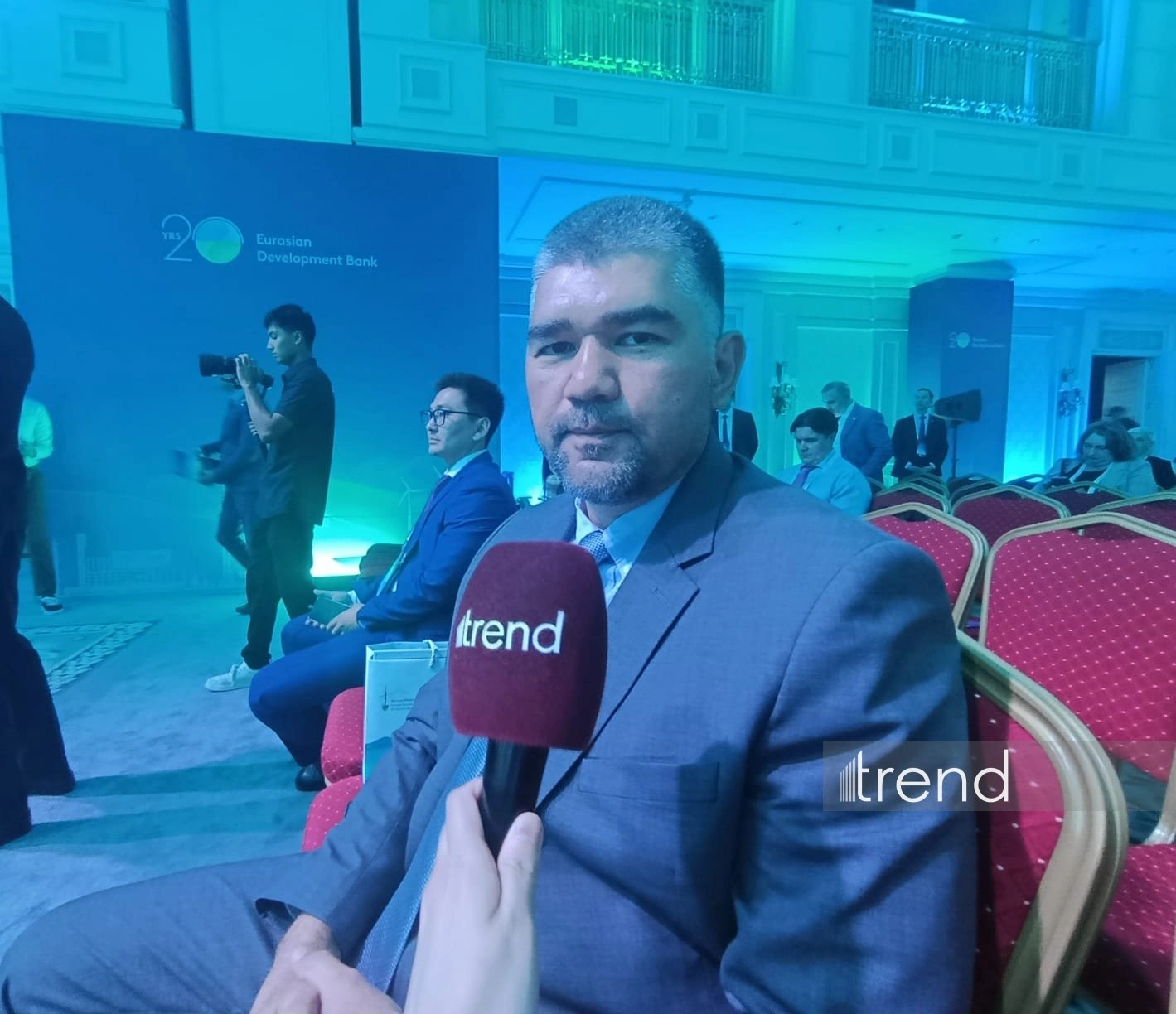
ALMATY, Kazakhstan, June 29. International
development banks are ready to continue investing in the
development of the Middle Corridor, Secretary General of the
Permanent Secretariat of the Intergovernmental Commission TRACECA
Jasurbek Choriev told Trend.
He made the comment on the sidelines of the Annual Meeting and
Business Forum of the Eurasian Development Bank (EDB) in
Almaty.
According to him, the European Union has already allocated $10
billion for the further development of the Middle Corridor’s
infrastructure.
"I recently took part in a major conference in Brussels,
attended by representatives of the European Bank for Reconstruction
and Development, the World Bank and other international financial
institutions. They are all ready to continue investing in improving
the Middle Corridor," Choriev said.
He noted that European partners view the development of the
transport route as an integrated project spanning the Black Sea
region, the Caucasus and Central Asia, with a particular focus on
harmonising transport infrastructure.
According to Choriev, international financial institutions
intend to continue financing projects regardless of whether
alternative routes emerge.
"They understand that if the Middle Corridor is neglected today,
they will still have to return to its development tomorrow in order
to fully utilise its potential. That is why they will continue
investing in it," he said.
Choriev said the Middle Corridor has become one of the key
transport routes between Europe and Asia. Restrictions on the
Northern Corridor, instability along southern routes and the high
cost of shipping around Africa have made the Middle Corridor the
most sought-after alternative.
Speaking about transit digitalisation, Choriev recalled that
Kazakhstan, Kyrgyzstan, Uzbekistan, Azerbaijan and Ukraine became
the first among the 14 TRACECA member countries to sign an
agreement on transitioning from a paper-based permit system to a
unified digital transit system.
The TRACECA Secretary General stressed that this is only the
first stage. Further accession of other member states will depend
on the completion of internal approval procedures in each country.
At the same time, he estimated that by the end of the year, the
number of countries joining the agreement could double.