BAKU, Azerbaijan, June 29. The Eurasian
Development Bank is entering a new phase of expansion that could
reshape how investment flows across Central Asia.
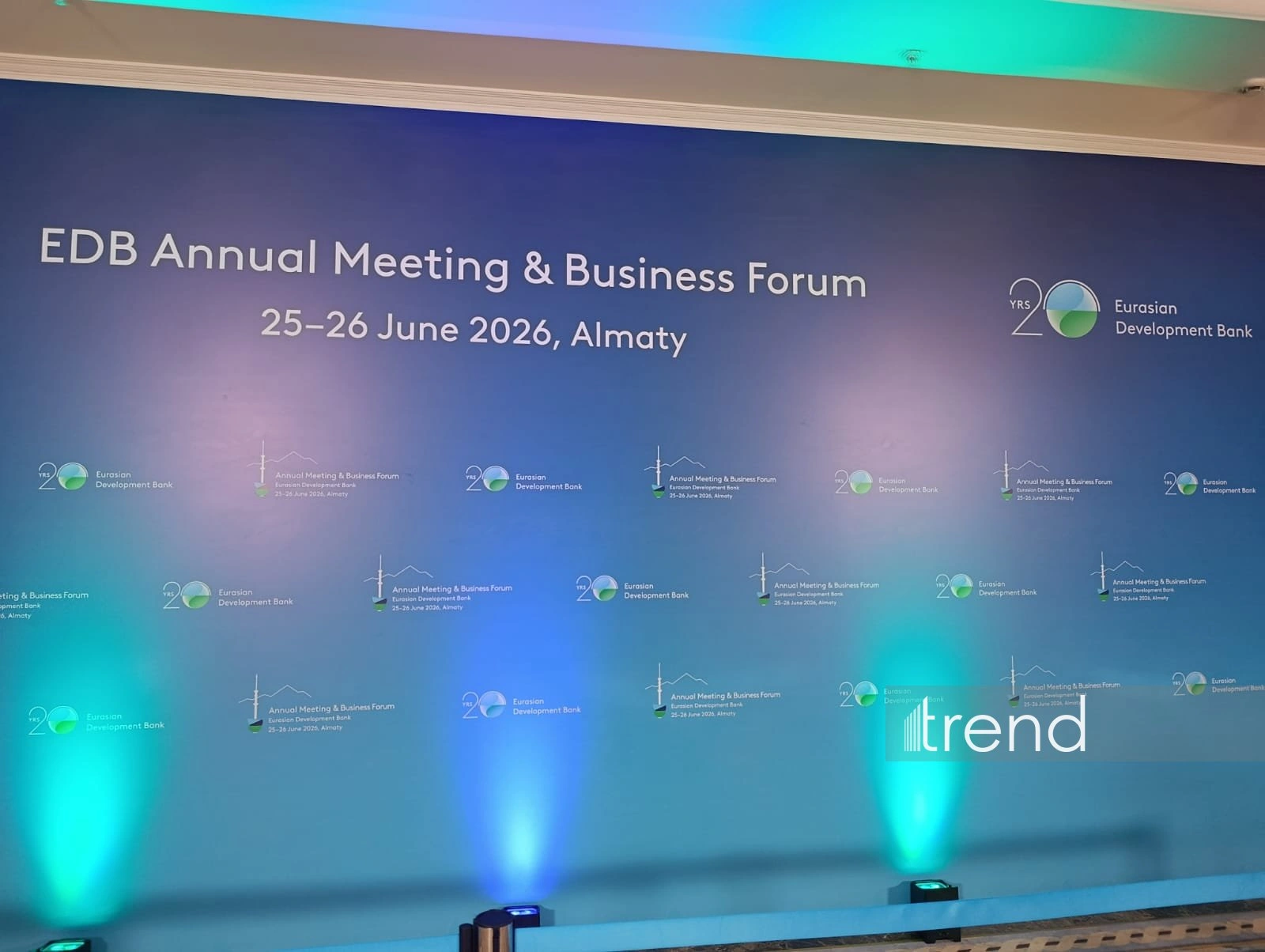
At its Annual Meeting and Business Forum "Eurasia 2030+" in
Almaty, the EDB unveiled its performance record and a new strategy
for 2027-2031 covering a broader geographic footprint, higher
infrastructure financing, and a deeper role in Central Asian
economic integration.
Over two decades, the bank has grown from two offices and five
staff to a $22 billion portfolio spanning 326 projects. Its mandate
now extends well beyond lending into transport, energy, digital
infrastructure, industry, and international capital
mobilization.
The bank's core value to the region lies in building
connectivity - through roads, power grids, supply chains, and new
financial instruments.
Under the 2022–2026 strategy, total investment reached $9.2
billion, with $5.2 billion going to Kazakhstan - roughly matching
what the country received in the previous 15 years combined. Prime
Minister Olzhas Bektenov called the scale of cooperation a
foundation for further foreign investment, pointing to the
country's property rights protections, competitive environment, and
open economy as key draws.
Kazakhstan remains the bank's largest single market. Foreign
direct investment into the country rose 14.4% to $20.5 billion,
while fixed capital investment climbed 13% to a record $43.5
billion.
The next strategic phase envisions expanding EDB operations into
11 new countries, including Georgia, Mongolia, and Gulf states.
Deputy Chairman Madi Takiyev confirmed that Oman is expected to
join this year, with Mongolia in early-stage talks.
"We are expanding our network of overseas offices, which opens
up new opportunities for landmark projects - all of it done in the
shared interests of member states," Takiyev said.
For Central Asia, this translates into potential access to new
capital sources and international partners at a time when the
region faces pressing infrastructure modernization needs,
particularly in energy and transport.
UN ESCAP project officer Sergei Tulinov argued that energy
connectivity requires more than new transmission lines. "What
matters is whether a project actually increases grid capacity,
reduces congestion, eases constraints on renewable energy
connections, and improves system reliability," he said. Central
Asia already has the physical foundations for energy integration,
he noted, but the underlying model was designed for a different
economic era. "Physical connections are no longer enough. You need
modern rules, mechanisms, and institutions to ensure stable and
reliable energy supply."
Kyrgyzstan sees the EDB as a key partner for scaling up its
project pipeline. Economy and Commerce Minister Bakyt Sydykov
reported GDP growth of 12.2% for January–May 2026, driven by
domestic demand, investment, industry, construction, services, and
trade. The country's strategic priorities through 2030 include
reindustrialization, building a regional trade and logistics hub,
unlocking hydropower potential, and developing sustainable tourism.
"The binding constraint today is the ability to turn ideas into
investment-ready projects that meet the standards of international
financial institutions," Sydykov said. "That is where the EDB can
play a distinctive role."
Uzbekistan is similarly looking to multilateral development
banks to accelerate economic cooperation. Deputy Minister of
Investment, Industry and Trade Khurram Teshabaev emphasized that
the greatest impact comes when countries pool resources, markets,
and expertise. "Cross-regional cooperation is what makes it
possible to build shared production and logistics chains," he said,
with transport connectivity, industrial cooperation, green energy,
and the digital economy as the country's stated priorities.
The forum also produced concrete outcomes. The EDB and Griffin
Partners signed a deal to develop the Griffin Logopark Almaty - a
logistics complex valued at approximately $125 million, covering
more than 125,000 square meters and expected to create around 1,000
jobs. Separately, the bank committed $90 million toward
Kazakhstan's first Tier IV data center, to be built with AKASHI
Data Center PLC as part of the country's broader digital
infrastructure for business, government, and international tech
companies. In transport, KazAvtoZhol has signed contracts worth
roughly $3 billion for road reconstruction across Kazakhstan.
Forum participants also flagged structural bottlenecks. Around
35% of experts cited slow customs procedures and insufficient
digitalization as the primary barriers to trade. According to IRU
data, up to half of total transit time is spent at border
crossings.
The EDB's expansion is poised to be one of several factors
supporting Central Asia's economic momentum. The bank already
shapes the region through infrastructure financing, industrial
cooperation support, and international capital attraction. The
2027–2031 strategy extends that reach: more countries will gain
access to its financial resources, technology, and expertise, and
Central Asia will have stronger institutional backing to move from
standalone national projects toward more integrated, cross-border
initiatives.