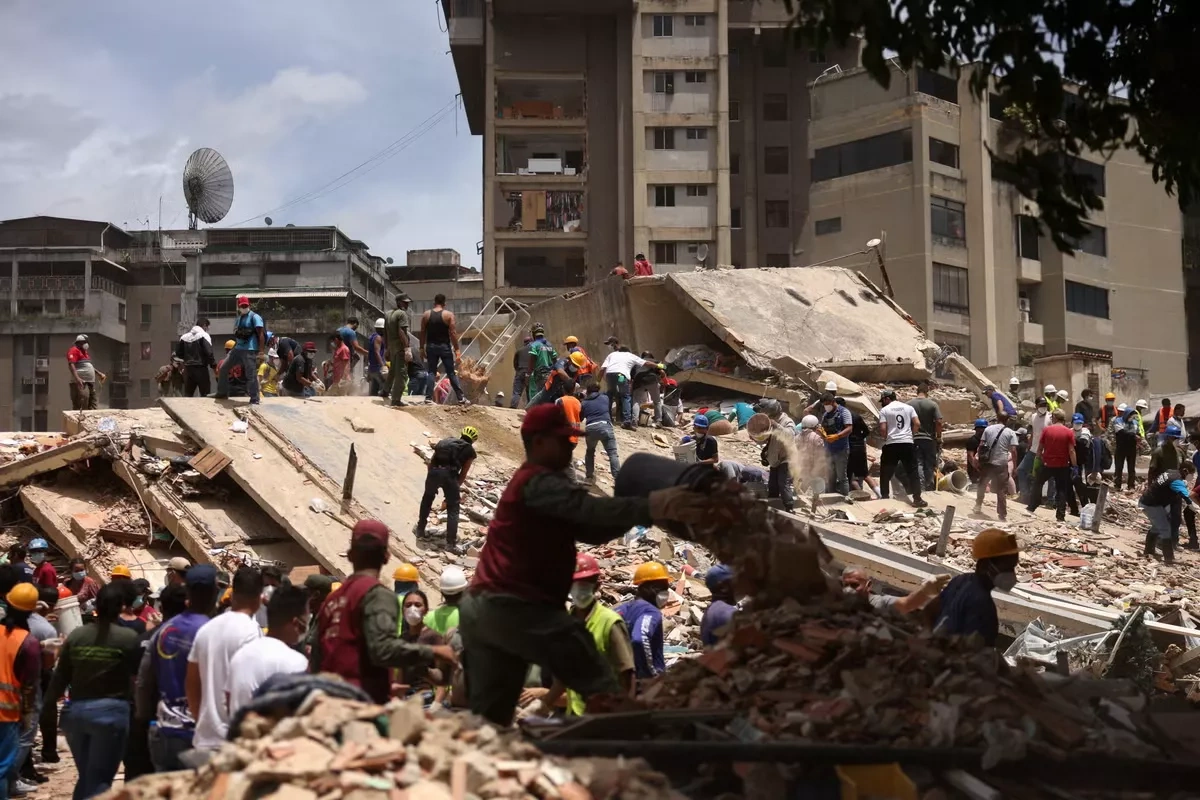
The death toll from twin earthquakes that struck Venezuela this week has risen to 920, as rescue teams continue searching for survivors trapped beneath collapsed buildings across the country.
Authorities said on Friday (June 27) that 172 people remain trapped, while more than 3,300 have been injured, Caliber.Az reports, citing foreign media.
Officials also reported that more than 50,000 people remain unaccounted for following the powerful earthquakes, which struck on Wednesday evening and devastated parts of Caracas and surrounding areas.
A further tremor measuring 4.9 magnitude was felt in the capital Caracas and nearby Maracay on Friday afternoon, adding to fears among residents already coping with widespread destruction.
In some of the worst-affected areas, residents expressed frustration over what they described as a slow and uneven relief effort. In La Guaira state, volunteers and local residents continued searching through rubble with their bare hands as heavy machinery remained scarce.
Jennifer Palacios, whose six-year-old son and five other relatives are believed to be trapped beneath a collapsed housing complex in La Guaira city, said local people had led many of the rescue efforts.
"It's the community that has managed to get people out alive," she said. "We need them to bring cranes to move the slabs. There are still people trapped."
The Hugo Chavez housing complex, an eight-tower residential development, suffered extensive damage during the earthquakes.
The disaster is expected to test the leadership of interim President Delcy Rodriguez, who has promised a major relief operation. The United Nations estimates direct economic damage from the earthquakes at around $6.7 billion.
Reuters journalists travelling through affected areas reported cracked highways, collapsed buildings and extensive infrastructure damage. Volunteers have been transporting food, water and medical supplies from nearby cities, including Caracas and Valencia.
Officials have urged members of the public to stay away from La Guaira city, warning that overcrowded roads are hampering rescue operations. Access restrictions are due to come into force overnight, with only authorised emergency teams permitted to enter.
The slow recovery process has also left grieving families struggling to recover the bodies of loved ones.
"We want them to give us the body ... we can't take it and here it will rot," said Ricardo Trias, whose godson died when a building collapsed in the coastal town of Caraballeda. "No forensic authority has come."
Meanwhile, reports of looting have emerged from several damaged communities. Witnesses said people were seen taking food and household supplies from damaged shops while security forces appeared not to intervene.
Despite the scale of the disaster, Venezuela's oil sector has largely escaped serious damage. Oil Minister Paula Henao said production and fuel distribution remained unaffected.
International assistance has begun arriving from across the region and beyond. Rescue teams from Mexico, El Salvador and several other countries are now operating in affected areas.
The United States has pledged $150 million in emergency aid and announced temporary sanctions relief to support humanitarian efforts. Washington has also dispatched military assets, including ships, helicopters and aircraft to assist rescue operations.
In Los Corales, Salvadoran rescue workers used drones, thermal scanners and search dogs to locate survivors in the ruins of several apartment buildings.
"People have told us they can hear people. They call them on the phone and they answer, and they can hear people screaming and calling," said Roberto Gavidia, who leads El Salvador's rescue mission.
Salvadoran President Nayib Bukele said rescuers had located a 15-year-old girl trapped with her pet on the ninth floor of a damaged building and were working to free her.
The earthquakes have struck a country already weakened by years of economic hardship and political instability.
"My building is uninhabitable and now I have nothing. It's just me and my son, and I have no family in the country," said Suhayl Sarquiz, who lost her job earlier this year.
The U.S. Geological Survey has warned that the final death toll could exceed 10,000, potentially making the disaster one of the deadliest earthquakes in Latin America in more than a century.
The United Nations migration agency estimates that nearly seven million people could be affected, as humanitarian organisations race to provide shelter, food and medical assistance to survivors.
By Aghakazim Guliyev