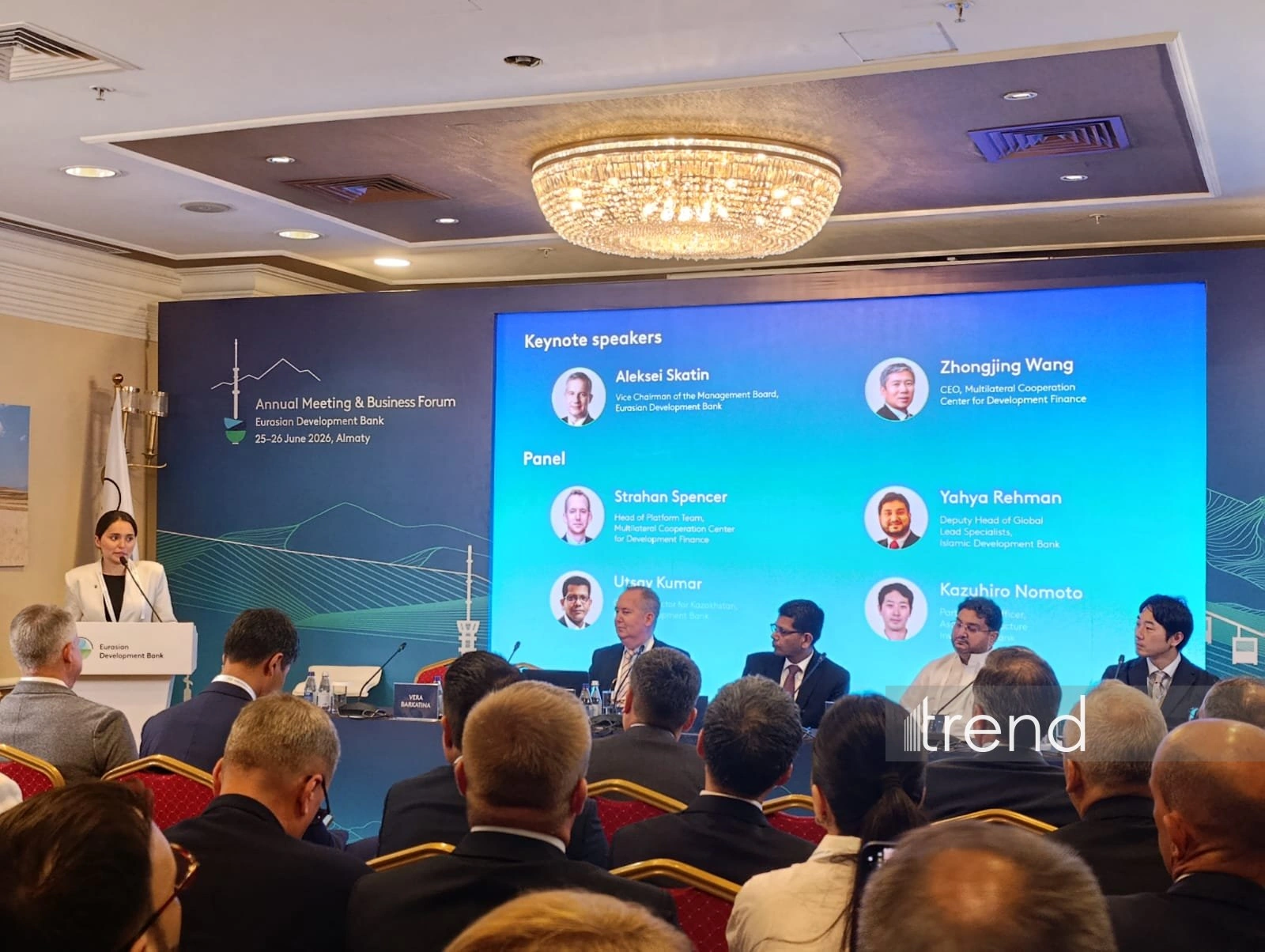
ALMATY, Kazakhstan, June 26. Short-term
technical assistance tools fail to ensure resilient capacity
development, Country Director of the Asian Development Bank (ADB)
office in Kazakhstan, Utsav Kumar, said during a session at the
Eurasian Development Bank (EDB) Annual Meeting and Business Forum
in Almaty, Trend's
correspondent reports from the event.
"As of December 31, 2024, nearly 1,100 technical assistance
projects were active, including 44 regional programs spanning
multiple countries.
We found that many of these focused on similar capacity
development areas but were implemented by different bank units
without coordination," he said.
Kumar noted that an analysis of another 30 knowledge partnership
agreements funded by technical assistance between 2016 and 2024,
involving 25 academic and international organizations, also
revealed duplication of training programs.
"As a result, knowledge gained through one technical assistance
project was rarely used in other programs, and the capacity
developed was virtually never developed in subsequent
initiatives.
The new 2026 policy responds to these challenges by creating a
unified, bank-wide platform for developing knowledge partnerships
that will systematically integrate new ideas, expertise, and
innovations from member countries and partner organizations into
ADB's operations and disseminate them among client countries," said
the ADB representative.
Kumar emphasized that short-term technical assistance
instruments are insufficient to ensure sustainable capacity
development, especially in upper-middle-income countries, which
include Central Asia.
According to him, technical assistance is most effective when
closely linked to investment projects and policy dialogue.
As of 2024, the average duration of technical assistance
programs amounted to 2.8 years.
He noted that Kazakhstan, as an upper-middle-income country,
faces constraints in the allocation of technical assistance
resources, resulting in insufficient funding for capacity
development programs.
"The 2026 policy envisages a unified cost-recovery mechanism for
technical assistance, as well as a system of oversight and
monitoring at the corporate, country, and project levels.
The KEEP knowledge and experience exchange program has been in
place in Kazakhstan since 2013. As part of the program, we have
implemented a 50-50 co-financing mechanism with the Government of
Kazakhstan for knowledge exchange programs, capacity development,
and project preparation.
We expect such mechanisms to be increasingly applied in
upper-middle-income countries.
We continue to discuss opportunities for co-financing such
initiatives with various Kazakh agencies," he said.
Kumar pointed out that this ensures the engagement of both
parties and allows for the use of both ADB's expertise and the
experience accumulated in various member countries.