A sweeping analysis by Politico traces how decades-old U.S. retrenchment doctrine and today’s geopolitical fractures are converging to propel South Korea into the upper ranks of the global arms trade — turning insecurity from Ukraine to NATO into Seoul’s biggest strategic opportunity.
According to a Politico analysis, South Korea’s rapid rise as a global defence exporter is not an accident of the current geopolitical crisis, but the outcome of a historical pattern that began with U.S. strategic withdrawal from frontline commitments.
The story reaches back to the Nixon Doctrine of 1969, when the United States began shifting security responsibilities to regional allies during the Vietnam War era. As Politico notes, that policy forced countries like South Korea to rethink their dependence on Washington. Facing the partial withdrawal of U.S. troops and lingering fears from the Korean War, Seoul embarked on a long-term strategy of military self-reliance — one that would eventually evolve into a globally competitive defence industry.
Fast forward to today, and a similar dynamic is unfolding under Donald Trump’s foreign policy approach, which has questioned NATO commitments and urged allies to shoulder more of their own defence burden. Politico argues that this renewed uncertainty has created fertile ground for South Korea’s defence manufacturers to expand aggressively into Europe and beyond.
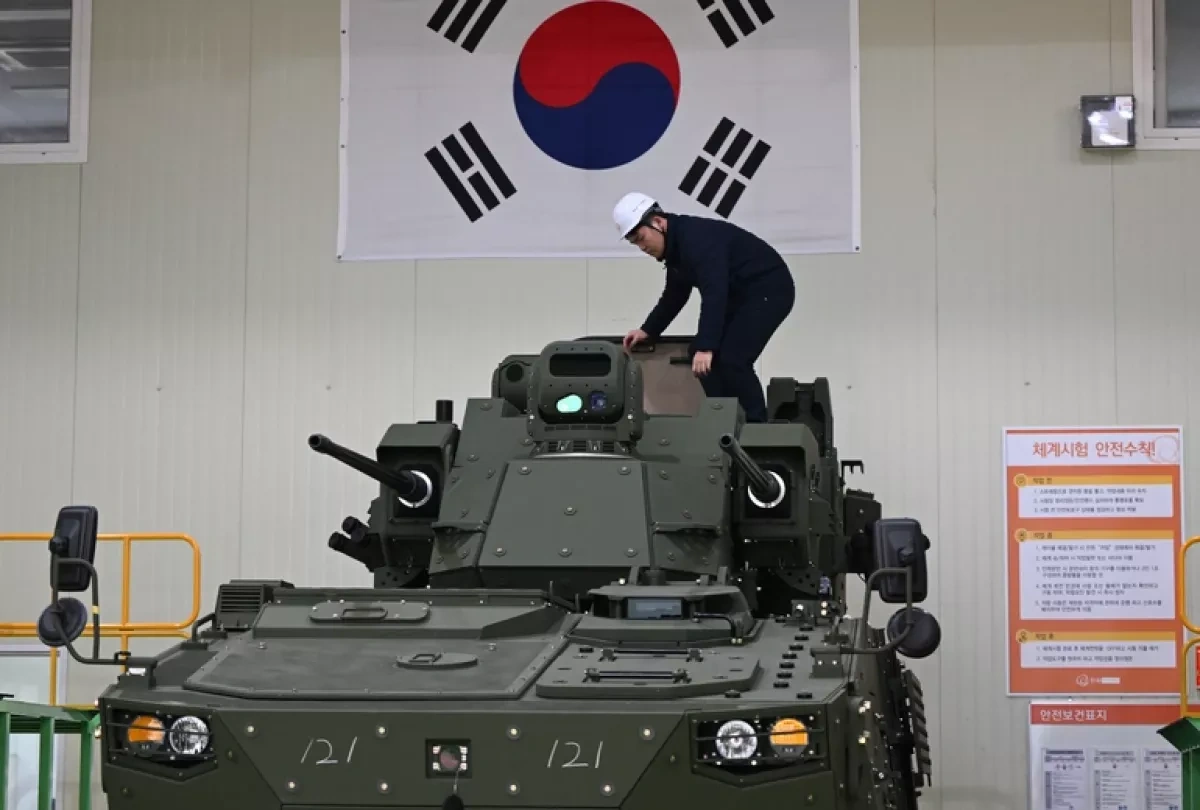
Now the world’s ninth-largest arms exporter and one of the fastest-growing suppliers tracked by the Stockholm International Peace Research Institute, South Korea has turned its industrial base into a strategic asset. Its major defence firms — including Hanwha Group, Hyundai Rotem, LIG Nex1, and Korea Aerospace Industries — are projected to nearly quadruple combined revenues to around $37 billion by 2026, according to figures cited by Politico.
Much of this growth is being driven by Europe. Poland has become the centerpiece of South Korea’s breakthrough, signing a $13.7 billion deal for tanks, rocket launchers, and artillery after Russia’s invasion of Ukraine exposed gaps in NATO’s readiness. Eastern European states, frustrated by slow delivery timelines from traditional Western suppliers, have increasingly turned to Seoul for rapid procurement and deployment.
Speed is one of South Korea’s biggest advantages. As Politico highlights, the country’s defence industry operates at high capacity due to the ongoing military standoff with North Korea, which has kept production lines continuously active. This readiness allows South Korean firms to deliver weapons faster and more cheaply than many Western competitors.
Another key selling point is flexibility. South Korean manufacturers often offer technology transfers and localised production — a rare concession among major arms exporters — allowing client countries to develop their own defence industries in parallel. Egypt, for example, adapted South Korea’s K9 howitser for maritime defence, a customisation that helped secure a $1.7 billion contract in 2022.
Still, the expansion faces constraints. European governments are increasingly promoting “strategic autonomy,” seeking to reduce reliance on external suppliers. At the same time, Japan’s decision to relax its long-standing ban on arms exports introduces a new regional competitor. Even established European firms, particularly in Germany, remain formidable challengers in high-value sectors like submarines.
Despite these obstacles, Politico concludes that South Korea’s ambition is clear: to become the world’s fourth-largest arms exporter by 2030. Whether or not it achieves that goal, its growing presence is already reshaping the global defence market — reflecting a broader shift in which U.S. retrenchment and global instability are redefining who supplies the world’s weapons, and how quickly they arrive.
By Sabina Mammadli