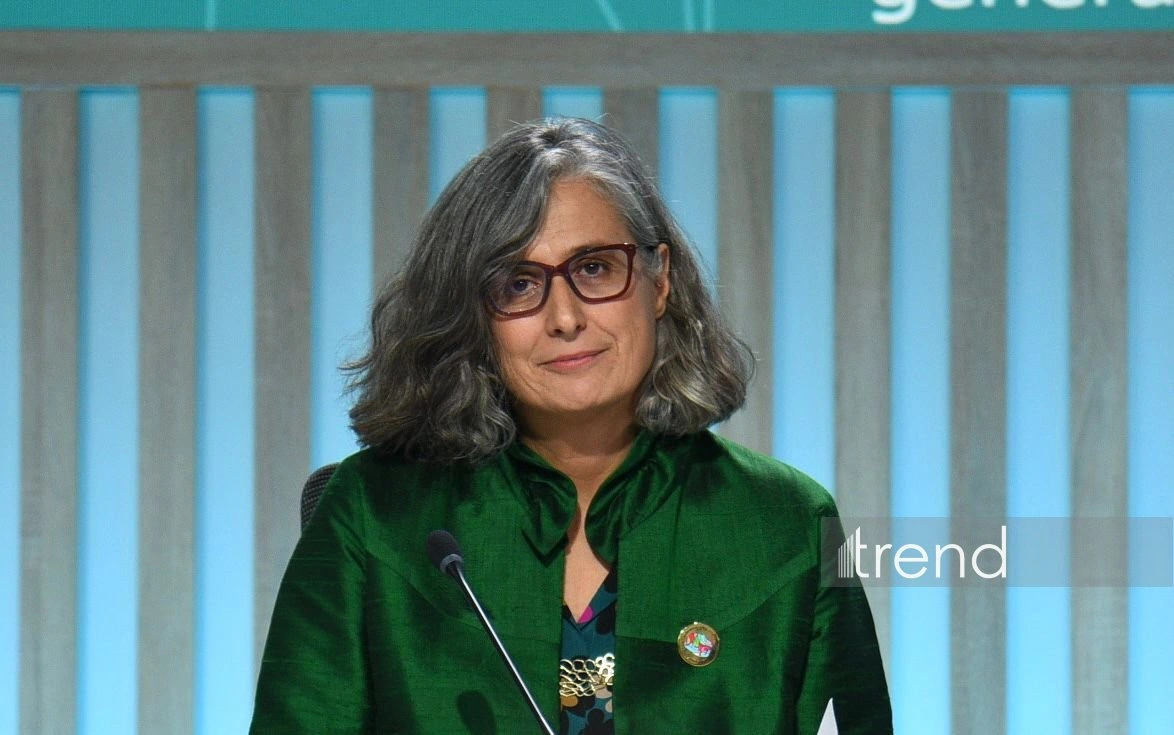
BAKU, Azerbaijan, May 22. The “Baku Call to
Action” document is the highlight of WUF13, Executive Director of
the United Nations Human Settlements Program (Habitat), Anacláudia
Rossbach said, at an official press conference marking the closing
of WUF13 in Baku, Trend reports.
The discussions held in Baku made it clear that housing must be
at the center of comprehensive urban policies related to land,
infrastructure, climate action, financing, and governance.
“The key priorities that came to the fore this week:
- Recognizing the scale of the housing crisis and the fact that
billions of people still lack adequate housing, shifting from
fragmented approaches to broader, systemic solutions;
- Rebalancing housing systems and financing;
- Integrating successful practices, such as the upgrading of
informal settlements, climate-resilient housing, and community-led
approaches, into mainstream policy decisions and investments;
- Strengthening local action and partnerships, and reinforcing the
central role of cities, communities, and local authorities in
scaling up solutions in collaboration with national and
international partners;
- Promoting climate-resilient and inclusive urban transformation,
ensuring that housing systems serve both to mitigate and adapt to
climate change, while protecting the most vulnerable populations
and preventing social exclusion.
The Baku Call to Action will serve as a key guide for advancing
these priorities within global processes and platforms. We will
incorporate the outcomes of this work into UN-Habitat’s
intergovernmental activities, including ongoing discussions on
adequate housing, urban sustainability, and the sustainable
development framework.
These results will also shape our engagement in global processes
related to climate and development and ensure that the role of
housing and cities is upheld in the implementation of the
Sustainable Development Goals, the Paris Agreement, and the New
Urban Agenda,” she said.
Meanwhile, today Baku is hosting the final day of WUF13.
On the first day of the forum, a ministerial meeting on the New
Urban Agenda, a ministerial roundtable, women’s and civil society
assemblies, business sessions, and discussions on urban well-being
took place. The forum also featured a flag-raising ceremony for the
UN and Azerbaijan.
The second day of the forum was marked by the first-ever
Leaders’ Summit. On this day, high-level discussions were held on
the global housing crisis, urbanization policy, and urban
sustainability. Also, as part of WUF13, the Mexico City pavilion
was inaugurated, presented as a key platform for expanding
cooperation with the Latin American region and preparing for
WUF14.
The third day of WUF13 was also marked by an extensive program
of events. Discussions on this day covered topics such as the
global housing crisis, the creation of safe and inclusive cities,
climate resilience, artificial intelligence and urban governance,
“green” urbanization, social equality, and sustainable
transportation.
One of the highlights of the third day was the signing of a
sister-city agreement between the Azerbaijani city of Shusha and
the Turkish city of Trabzon.
The fourth day of WUF13 featured an extensive program of events
dedicated to the themes of urbanization, climate change, inclusive
urban development, housing policy, and sustainable management.
On the fifth day of the forum, discussions continued on the
global housing crisis, the creation of safe and inclusive cities,
climate resilience, the use of artificial intelligence in urban
management, “green” urbanization, and social equality.
One of the key events of the Cities Forum of the United Nations
Special Program for the Economies of Central Asia (SPECA), held on
the fourth day, was the announcement of Almaty’s official accession
to the “Declaration of Intent on the Establishment of the SPECA
Forum on Smart Cities Resilient to Climate Change.”
Also, for the first time in WUF history, the “WUF13 NGO Forum:
Global Partnership and Decision-Making” was held at the initiative
of Azerbaijan.
The WUF13 Forum, dedicated to the theme “"Housing the world:
Safe and resilient cities and communities", brought together
governments, international organizations, experts, and civil
society representatives to strengthen global cooperation in the
field of sustainable urban development. More than 40,000 people
from 182 countries registered to participate in the forum.