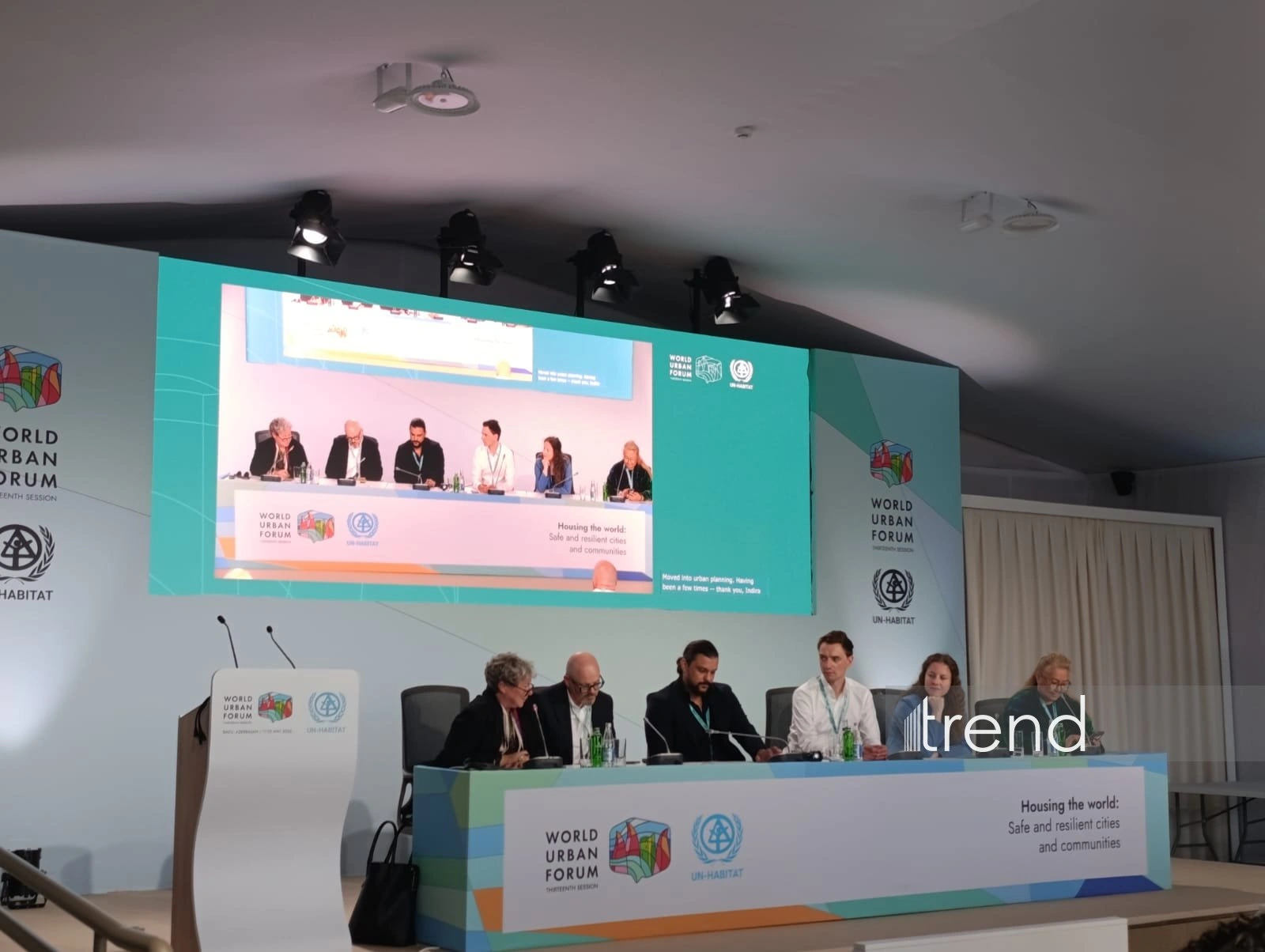
BAKU, Azerbaijan, May 22. UN-Habitat and
Central Asian countries are discussing the Middle Corridor as an
opportunity to attract attention to the region, Katja Schaefer,
Inter-regional Advisor for Eastern Europe and Central Asia at
UN-Habitat, said during a session titled "New Capitals and New
Cities of Central Asia. Water-Sensitive Urban Planning and Housing
for Climate Resilience" within the framework of WUF13, Trend reports.
"We had long discussions in Astana about the formation of the
city and what lessons have been learned over the past 30 years. It
seems to me that these are precisely the questions that inevitably
arise when we see architectural projects, visionary concepts of the
future, and rapidly growing megacities. All of these are challenges
for which humanity has yet to find answers. I also think it is
important to reflect on how a polycentric approach to the
development of cities and settlements can work in countries like
Kazakhstan, with its vast territory and relatively small
population, in contrast to the rapidly growing Uzbekistan. We are
witnessing completely different urbanization scenarios. The
question arises: how can new cities respond to these challenges?"
Schaefer said.
According to her, the Middle Corridor is also being actively
discussed as an opportunity to attract attention to the region,
create new jobs, and attract financial capital.
Meanwhile, today Baku is hosting the final day of WUF13.
On the first day of the forum, a ministerial meeting on the New
Urban Agenda, a ministerial roundtable, women’s and civil society
assemblies, business sessions, and discussions on urban well-being
took place. The forum also featured a flag-raising ceremony for the
UN and Azerbaijan.
The second day of the forum was marked by the first-ever
Leaders’ Summit. On this day, high-level discussions were held on
the global housing crisis, urbanization policy, and urban
sustainability. Also, as part of WUF13, the Mexico City pavilion
was inaugurated, presented as a key platform for expanding
cooperation with the Latin American region and preparing for
WUF14.
The third day of WUF13 was also marked by an extensive program
of events. Discussions on this day covered topics such as the
global housing crisis, the creation of safe and inclusive cities,
climate resilience, artificial intelligence and urban governance,
“green” urbanization, social equality, and sustainable
transportation.
One of the highlights of the third day was the signing of a
sister-city agreement between the Azerbaijani city of Shusha and
the Turkish city of Trabzon.
The fourth day of WUF13 featured an extensive program of events
dedicated to the themes of urbanization, climate change, inclusive
urban development, housing policy, and sustainable management.
On the fifth day of the forum, discussions continued on the
global housing crisis, the creation of safe and inclusive cities,
climate resilience, the use of artificial intelligence in urban
management, “green” urbanization, and social equality.
One of the key events of the Cities Forum of the United Nations
Special Program for the Economies of Central Asia (SPECA), held on
the fourth day, was the announcement of Almaty’s official accession
to the “Declaration of Intent on the Establishment of the SPECA
Forum on Smart Cities Resilient to Climate Change.”
Also, for the first time in WUF history, the “WUF13 NGO Forum:
Global Partnership and Decision-Making” was held at the initiative
of Azerbaijan.
The WUF13 Forum, dedicated to the theme “"Housing the world:
Safe and resilient cities and communities", brought together
governments, international organizations, experts, and civil
society representatives to strengthen global cooperation in the
field of sustainable urban development. More than 40,000 people
from 182 countries registered to participate in the forum.