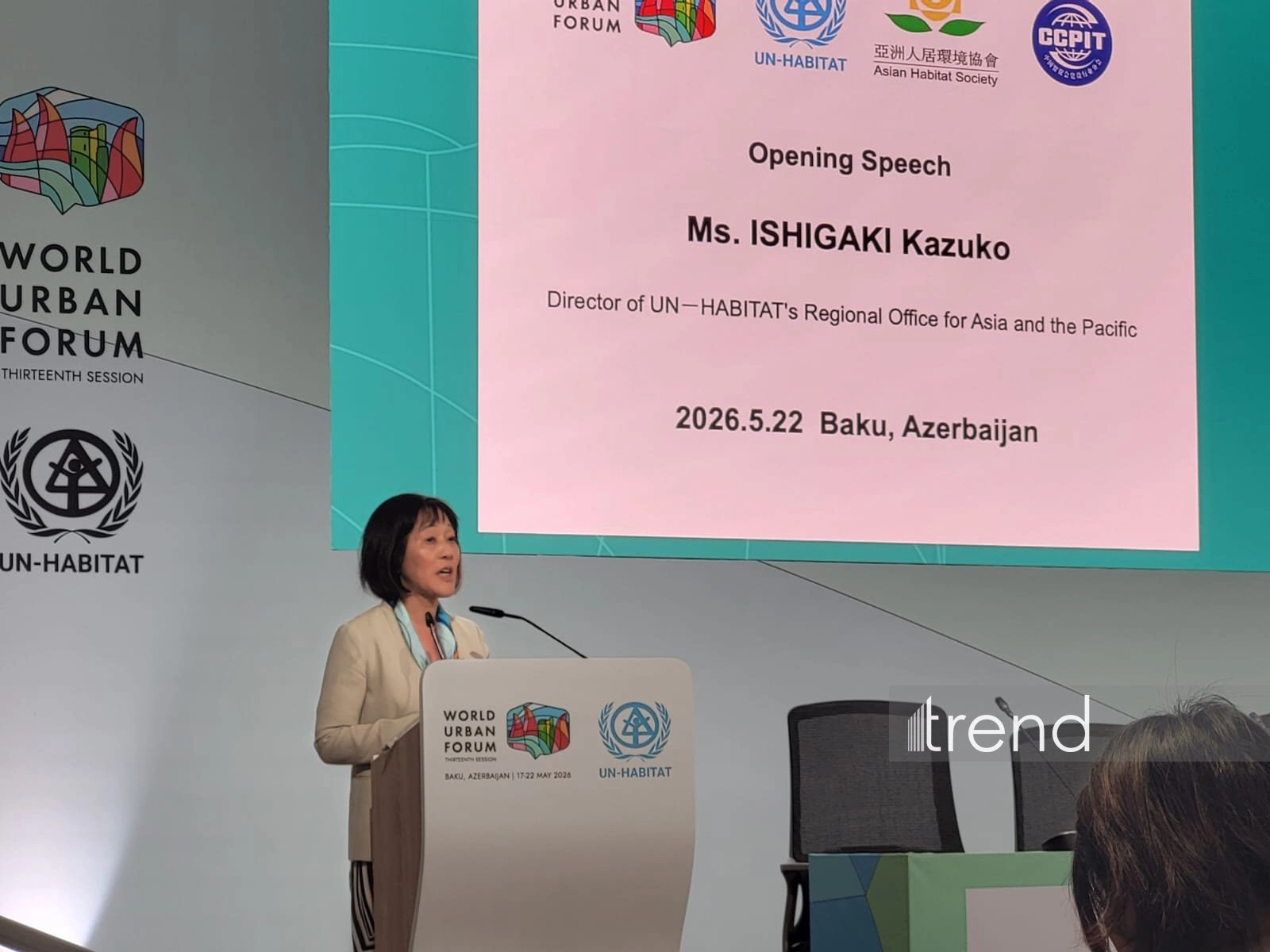
BAKU, Azerbaijan, May 22. Housing policy should
be part of a broader system of urban planning and sustainable
development, Ishigaki Kazuko, Director of the UN-Habitat Regional
Office for Asia and the Pacific, said, Trend reports.
She made the remark during a panel discussion "The Rechargeable
Landscape Powering Sustainable, Resilient Housing with Nature-Based
Systems" held within the framework of the 13th session of the World
Urban Forum (WUF13) in Baku.
According to her, the successful execution of any structural
housing initiative remains completely unfeasible without
systematically reinforcing institutional capacity at the grassroots
level, specifically targeting local self-governance bodies and
community networks.
"Even the most well-designed political and regulatory frameworks
cannot transform into practical, field-level operations without
direct support and deep capacity-building pipelines deployed at the
local municipal layer," Ishigaki pointed out.
The UN-Habitat representative emphasized the critical need for
an integrated, human-centric approach to metropolitan growth. She
noted that long-term housing policies must maintain strict
structural links with urban architectural design, landscape
planning, and the universal delivery of baseline public utilities
and services.
Ishigaki concurrently highlighted the surging demand among
nations across the Asia-Pacific basin for structured, cross-border
knowledge transfers regarding sustainable urbanization models. She
reported that the Asia Townscape Award, founded in 2010, has
evolved into a vital multilateral clearinghouse to showcase
successful field practices and facilitate mutual data sharing among
municipal governments and spatial experts.
According to the regional director, contemporary urban
development projects rolling out across Asia-Pacific showcase
highly innovative methodologies to tackle ecological
sustainability, preserve tangible cultural heritage, and embed
grassroots communities directly into the initial master-planning
and execution workflows.
She stressed that these synchronized localized initiatives are
central to accelerating progress toward United Nations Sustainable
Development Goal 11 (SDG11), which dictates the construction of
inclusive, safe, resilient, and sustainable cities.
Concluding her address, Ishigaki underlined that the World Urban
Forum in Baku delivers an unparalleled platform to advance these
integrated frameworks, effectively bridging the intersections
between housing supply, urban topography, renewable energy grids,
and active civic participation in metropolitan evolution, she
concluded.
Meanwhile, today Baku is hosting the final day of WUF13.
On the first day of the forum, a ministerial meeting on the New
Urban Agenda, a ministerial roundtable, women’s and civil society
assemblies, business sessions, and discussions on urban well-being
took place. The forum also featured a flag-raising ceremony for the
UN and Azerbaijan.
The second day of the forum was marked by the first-ever
Leaders’ Summit. On this day, high-level discussions were held on
the global housing crisis, urbanization policy, and urban
sustainability. Also, as part of WUF13, the Mexico City pavilion
was inaugurated, presented as a key platform for expanding
cooperation with the Latin American region and preparing for
WUF14.
The third day of WUF13 was also marked by an extensive program
of events. Discussions on this day covered topics such as the
global housing crisis, the creation of safe and inclusive cities,
climate resilience, artificial intelligence and urban governance,
“green” urbanization, social equality, and sustainable
transportation.
One of the highlights of the third day was the signing of a
sister-city agreement between the Azerbaijani city of Shusha and
the Turkish city of Trabzon.
The fourth day of WUF13 featured an extensive program of events
dedicated to the themes of urbanization, climate change, inclusive
urban development, housing policy, and sustainable management.
On the fifth day of the forum, discussions continued on the
global housing crisis, the creation of safe and inclusive cities,
climate resilience, the use of artificial intelligence in urban
management, “green” urbanization, and social equality.
One of the key events of the Cities Forum of the United Nations
Special Program for the Economies of Central Asia (SPECA), held on
the fourth day, was the announcement of Almaty’s official accession
to the “Declaration of Intent on the Establishment of the SPECA
Forum on Smart Cities Resilient to Climate Change.”
Also, for the first time in WUF history, the “WUF13 NGO Forum:
Global Partnership and Decision-Making” was held at the initiative
of Azerbaijan.
The WUF13 Forum, dedicated to the theme “Housing the world: Safe
and resilient cities and communities", brought together
governments, international organizations, experts, and civil
society representatives to strengthen global cooperation in the
field of sustainable urban development. More than 40,000 people
from 182 countries registered to participate in the forum.