A group of European lawmakers has criticised the actions of the European Parliament, which they say led to the breakdown of cooperation between the EU assembly and Azerbaijan.
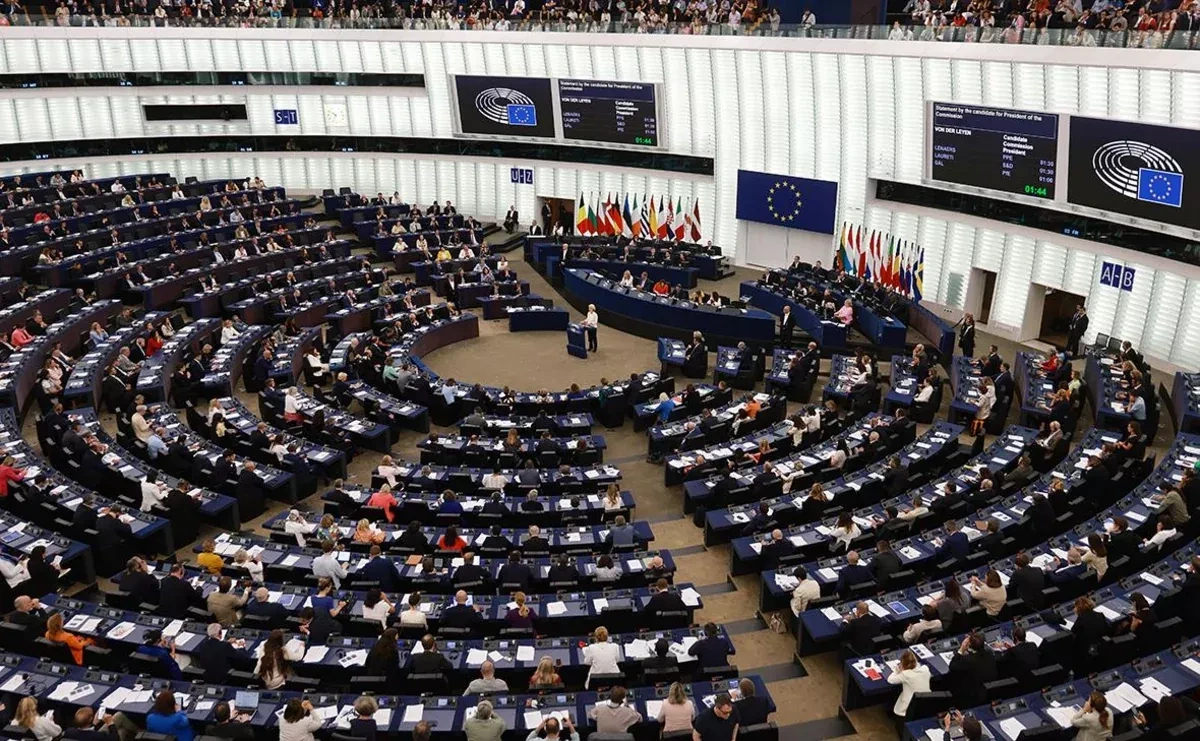
The issue was raised during plenary proceedings in Strasbourg on the evening of May 21, following Azerbaijan’s decision to suspend cooperation with the European Parliament and withdraw from Euronest, Caliber.Az reports per local media.
Head of the European Parliament delegation to Euronest, Sergey Lagodinsky, urged Baku to reconsider its withdrawal. He said the country remains an important part of regional dialogue within the Eastern Partnership, stressing its relevance for discussions on the Black Sea strategy, transport connectivity, energy, digital infrastructure and wider regional cooperation projects.
However, several MEPs argued that the European Union’s own actions contributed to the deterioration in relations with Azerbaijan.
One of the strongest interventions came from Cristian Terheș of the European Conservatives and Reformists Group. He said Azerbaijan’s decision should serve as a warning signal for Brussels, directly accusing the European Parliament of using an April 2026 resolution on Armenia as a tool to pressure Baku.
“This Parliament used the April 2026 resolution on Armenia, which we all supported in terms of Armenia’s democratic development, to attack Azerbaijan, which was completely unnecessary, unwise and counterproductive,” he said.
Terheș noted that Armenia and Azerbaijan are currently working towards a peace agreement after decades of conflict. “After decades of war, they are finally working together and making real efforts towards reconciliation and a peace treaty,” he said, arguing that the European Parliament’s approach was politically short-sighted.
He also criticised broader EU foreign policy, saying: “Constant moralising, an obsession with ideological condemnation — this is not foreign policy. It is political immaturity and geopolitical suicide.”
Terheș warned that such an approach risks alienating partners: “We are seeing the same dynamic in relation to Georgia and other states, which are increasingly distancing themselves from the European Union due to double standards and a patronising approach.”
He added that the EU risks losing influence at a time when the South Caucasus and Central Asia are becoming strategically important.
“Azerbaijan is not just another EU partner. It is of key importance for Europe’s energy security and transport connectivity,” he said, noting that Azerbaijan has helped reduce Europe’s dependence on Russian gas, supplies energy resources and provides humanitarian assistance to Ukraine.
“Alienating countries such as Azerbaijan is not just irresponsible, it is geopolitically self-destructive,” he added, calling for realism, strategic thinking and partnership based on mutual respect rather than lectures and superiority.
Angéline Furet of the Patriots for Europe group described the crisis in relations with Baku as a failure of the EU’s regional strategy. “Azerbaijan’s decision to leave Euronest cannot be seen as a mere procedural step. It is a strategic punishment for Europe,” she said.
She directly linked the crisis to EU policies: “We are paying for your interference and for our approach to Armenia.”
Furet said Europe had attempted to maintain energy cooperation with Baku while simultaneously increasing political pressure. “You thought you would secure gas supplies while at the same time adopting all these resolutions,” she said, adding that Europe had failed to achieve humanitarian objectives while worsening ties with Azerbaijan.
She also accused EU institutions of overstepping their role: “You have taken on the role of states in order to lecture.”
Turning to geopolitics, she said that while the EU focused on declarations, the region was reorganising itself without Europe. She referred to what she described as a new transit corridor agreement facilitated by the United States, involving Azerbaijan and Armenia.
She highlighted the economic dimension of the so-called “Trump Route” (TRIPP), describing it as “a new strategic road — peaceful and effectively under American capital influence”.
Furet argued that Europe is being left behind as Central Asia’s geopolitical and economic architecture evolves without the EU, urging European institutions to adapt rather than observe global shifts passively. “Stop lecturing the world and move towards mature realpolitik,” she said.
Thierry Mariani of the same political grouping said the South Caucasus is at a historic moment, with Azerbaijan and Armenia moving closer to peace after decades of conflict. He noted that such an outcome was previously considered impossible: “Today we are seeing what many thought impossible — a process of reconciliation is beginning.”
However, he argued that the European Parliament is moving in the opposite direction by adopting resolutions that worsen tensions. He said Azerbaijan had wanted constructive relations with the European Parliament but had “closed the door due to legitimate concerns”.
“Peace in the Caucasus will not be achieved through European Parliament intervention, but through negotiations in the region,” he concluded.
MEP Tomasz Froelich linked the crisis with Azerbaijan to broader weaknesses in EU foreign policy: “Bad relations with the United States. Bad relations with China. No relations with Russia.”
He said the EU appears increasingly sidelined in global politics. According to him, Azerbaijan has grown tired of what he described as the European Parliament’s moral judgements, a sentiment he said he shares.
Froelich warned that further conflict with Baku could harm Europe’s energy security: “If we continue to speak to Azerbaijan in this way, it could be the final blow to Europe’s energy security.”
The debate ultimately raised the question of whether EU policy — combining resolutions, pressure, public criticism and value-based rhetoric — has contributed to a loss of influence in a strategically important region at the very moment the South Caucasus is entering a phase of potential peace settlement.
By Aghakazim Guliyev