BAKU, Azerbaijan, May 21. The government of
Azerbaijan’s extensive strategic experience in executing
post-conflict recovery and infrastructure rehabilitation across the
Karabakh region can serve as a vital operational blueprint for
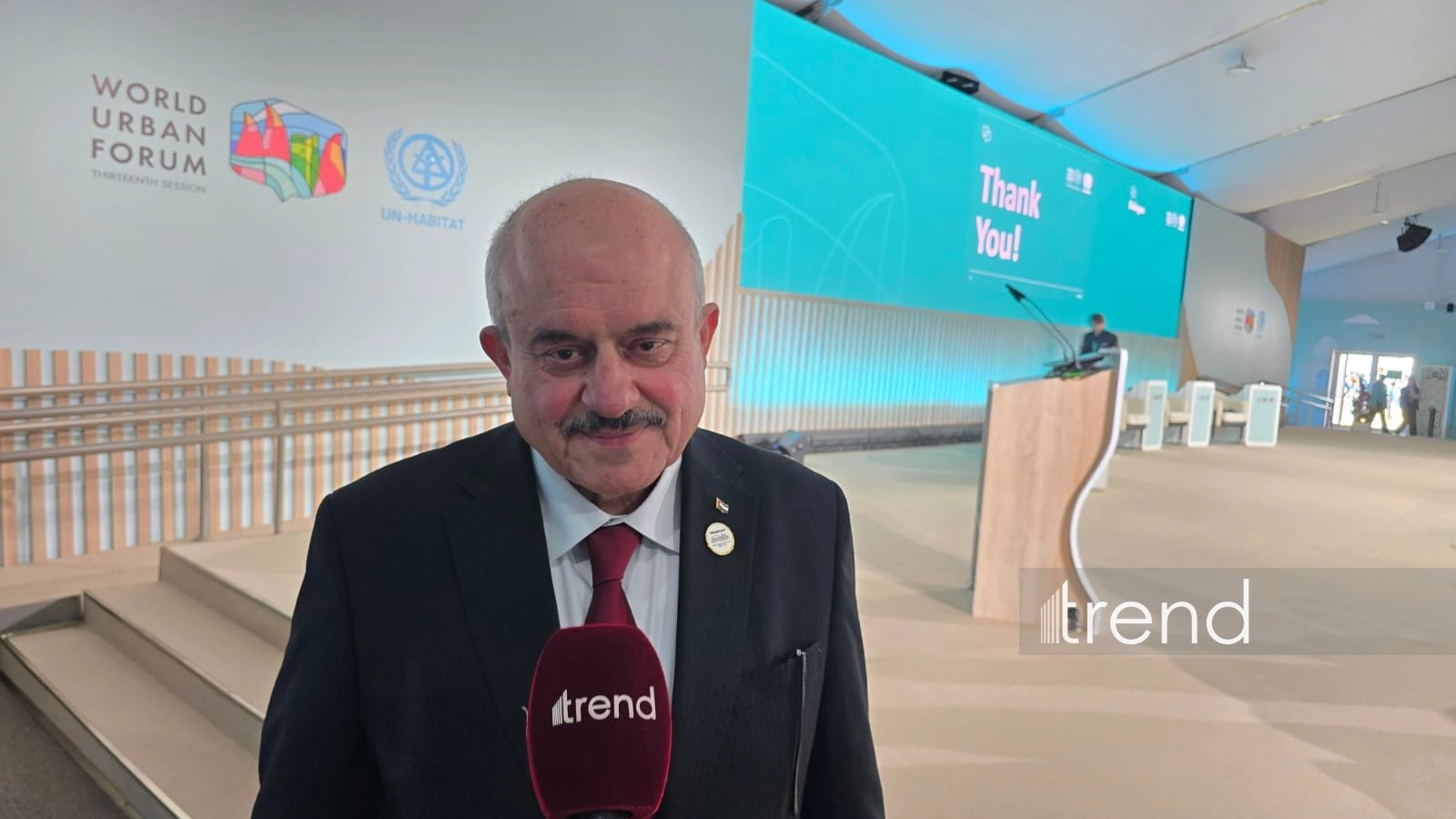
Palestine, Sami Hijjawi, Minister of Local Government of the
Palestinian Authority, told Trend on the sidelines of WUF13 in Baku.
According to him, Palestine currently confronts severe, systemic
structural destruction across both the Gaza Strip and the West
Bank—a highly volatile situation that mirrors the complex
infrastructural and humanitarian challenges previously managed by
Azerbaijan in its post-conflict zones.
"We fundamentally intend to leverage our excellent bilateral
relations with Azerbaijan to directly benefit from its specialized
institutional expertise in large-scale reconstruction. Azerbaijan
consistently stands out as a reliable partner delivering critical
humanitarian aid to the Palestinian people, a baseline support
package that our leadership holds in exceptionally high regard,"
the minister noted.
Hijjawi pointed out that initiating a comprehensive recovery
trajectory within Palestine remains structurally impossible without
mobilizing synchronized international backing, adding that such
multilateral efforts achieve maximum efficiency when driven by
close partner nations.
The government official emphasized that the primary operational
bottleneck at the current stage remains the ongoing military
operations, which completely block the launch of any large-scale
physical rebuilding phase.
"As long as active military operations persist across Gaza and
the West Bank, deploying long-term reconstruction workflows remains
a deep logistical challenge," he stressed.
Hijjawi concurrently highlighted the pressing strategic
necessity of expanding inter-agency cooperation with Azerbaijan
specifically within the domain of municipal governance and local
self-administration. He reported that Palestine possesses 136
functioning municipal councils, and drawing upon Azerbaijan's
institutional modernization and public administration models could
significantly accelerate domestic municipal reforms.
To anchor these collaborative targets, the minister announced
that delegation-level meetings have already taken place with
Azerbaijani government officials to map out concrete frameworks for
cross-border knowledge transfers.
Concluding his remarks, Hijjawi reiterated that the Palestinian
Authority remains deeply committed to cementing closer
institutional bonds with Baku, emphasizing that this technical
partnership will play a central role in framing Palestine’s
long-term master-planning and spatial reconstruction roadmaps.
Today marks the fifth day of WUF13 in Baku.
The first day included a ministerial meeting dedicated to the
New Urban Agenda, a ministerial roundtable, assemblies for women
and civil society, business sessions, and discussions on urban
prosperity. An official ceremony marking the raising of the UN and
Azerbaijani flags also took place.
The second day stood out for the inaugural Leaders' Summit,
featuring high-level discussions on the global housing crisis,
urbanization policy, and urban resilience. Concurrently, the
opening of the Mexico City pavilion took place, serving as a
significant platform for expanding cooperation with the Latin
American region and preparing for WUF14.
The third day of WUF13 featured a comprehensive program of
events covering the global housing crisis, the formation of safe
and inclusive cities, climate resilience, artificial intelligence
and urban governance, green urbanization, social equity, and
sustainable transport.
One of the highlights of the third day was the signing of a
sister-city memorandum between the Azerbaijani city of Shusha and
the Turkish city of Trabzon.
The fourth day of WUF13 featured a broad program of events
dedicated to urbanization, climate change, inclusive urban
development, housing policy, and sustainable governance.
One of the important events of the UN Special Programme for the
Economies of Central Asia (SPECA) Cities Forum, held on the fourth
day, was the announcement of Almaty’s official accession to the
“Declaration of Intent on the Establishment of the SPECA Smart
Climate-Resilient Cities Forum.”
Also, for the first time in WUF history and at Azerbaijan’s
initiative, the “WUF13 NGO Forum: Global Partnership and
Decision-Making” was held.
WUF13, which has attracted more than 40,000 registered
participants from 182 countries, will continue until May 22. Held
under the theme “Housing the world: Safe and resilient cities and
communities,” the forum brings together governments, international
organizations, experts, and representatives of civil society to
strengthen global cooperation in the field of sustainable urban
development.