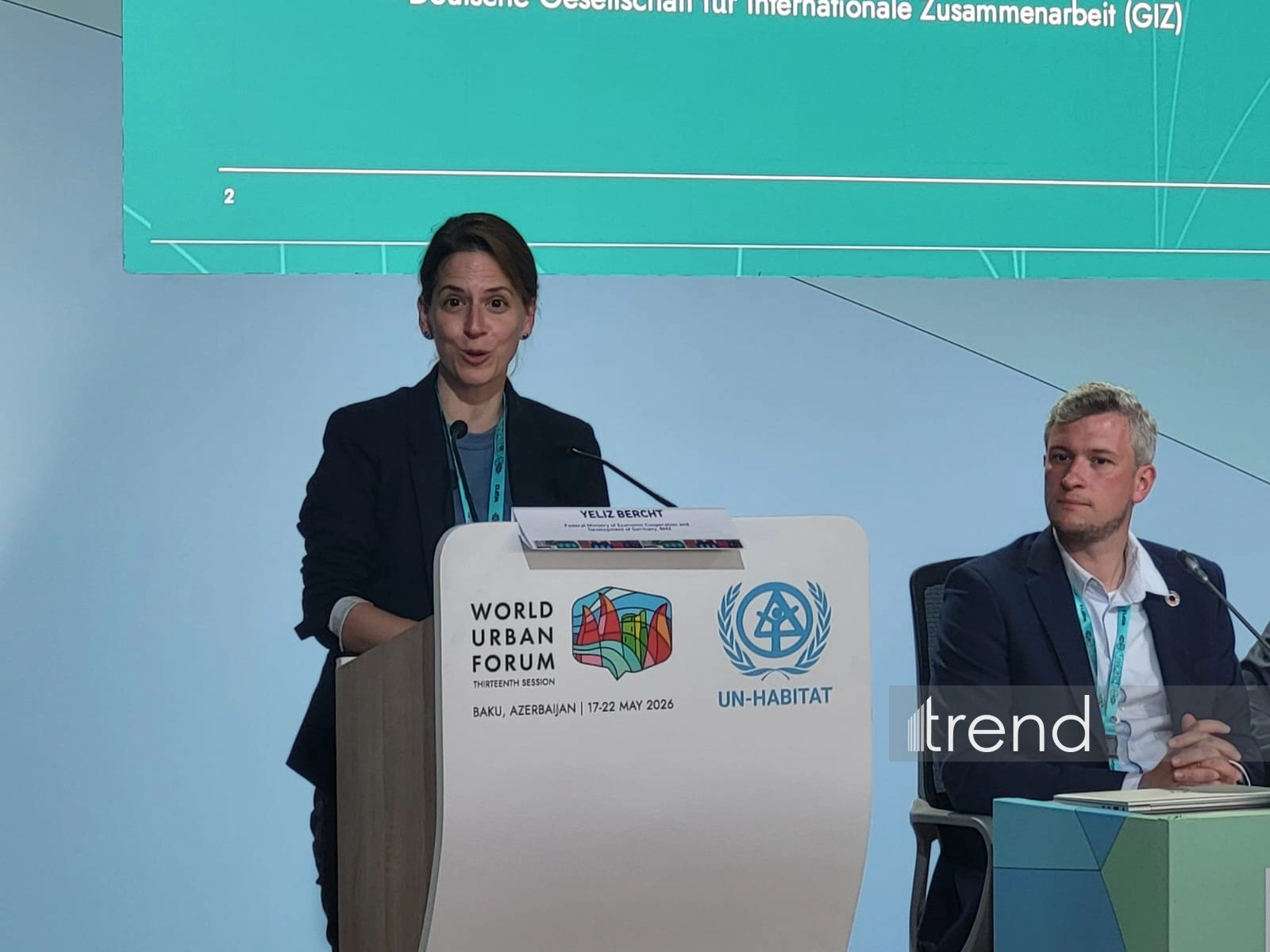
BAKU, Azerbaijan, May 21. Housing policy can be
a powerful tool for sustainable development, Yeliz Bercht, head of
department at Germany’s Federal Ministry for Economic Cooperation
and Development said, Trend reports.
She made the remark made during an event on “Is the housing of
tomorrow in line with the SDGs of today - How localization
strategies help to bring us back on track” as part of WUF13.
"The question for today’s session is both simple and complex:
Does the housing of tomorrow align with today’s Sustainable
Development Goals? This is not merely a technical question. It is
not just about indicators, reporting systems, or planning tools—no
matter how important they may be. Above all, it is a profoundly
human question. Housing determines whether people can live in
safety, whether families can build a secure future, whether
children have a stable environment in which to live, and whether
people have access to jobs, education, healthcare, and public
transportation. “In this way, housing creates opportunities,
strengthens social cohesion, and influences citizens’ trust in
their cities and public institutions,” she said.
Bercht noted that the housing issue remains one of the most
pressing social challenges of our time.
"And, as we all know, this challenge is relevant to every region
and continent. Rapid urbanization, rising construction costs, land
scarcity, population displacement, migration, climate risks, and
the need for recovery are placing significant pressure on housing
systems around the world. Today, the question is no longer just
about how to build more housing. The main question is how to build
and provide housing that is affordable, decent, sustainable,
resilient, and socially inclusive. This is precisely where the UN
2030 Agenda takes on practical significance. Sustainable
Development Goal 11, particularly Target 11.1, which calls for
access to adequate, safe, and affordable housing and basic
services, is not an isolated challenge. It is closely linked to
many other SDGs—poverty reduction, health, gender equality, the
climate agenda, and the reduction of inequality. “If housing policy
proves ineffective, achieving many other development goals becomes
significantly more difficult. But if housing policy is
comprehensive, inclusive, and based on local needs, it can become a
powerful tool for sustainable development,” she said.
Today marks the fifth day of WUF13 in Baku.
The first day included a ministerial meeting dedicated to the
New Urban Agenda, a ministerial roundtable, assemblies for women
and civil society, business sessions, and discussions on urban
prosperity. An official ceremony marking the raising of the UN and
Azerbaijani flags also took place.
The second day stood out for the inaugural Leaders' Summit,
featuring high-level discussions on the global housing crisis,
urbanization policy, and urban resilience. Concurrently, the
opening of the Mexico City pavilion took place, serving as a
significant platform for expanding cooperation with the Latin
American region and preparing for WUF14.
The third day of WUF13 featured a comprehensive program of
events covering the global housing crisis, the formation of safe
and inclusive cities, climate resilience, artificial intelligence
and urban governance, green urbanization, social equity, and
sustainable transport.
One of the highlights of the third day was the signing of a
sister-city memorandum between the Azerbaijani city of Shusha and
the Turkish city of Trabzon.
The fourth day of WUF13 featured a broad program of events
dedicated to urbanization, climate change, inclusive urban
development, housing policy, and sustainable governance.
One of the important events of the UN Special Program for the
Economies of Central Asia (SPECA) Cities Forum, held on the fourth
day, was the announcement of Almaty’s official accession to the
“Declaration of Intent on the Establishment of the SPECA Smart
Climate-Resilient Cities Forum.”
Also, for the first time in WUF history and at Azerbaijan’s
initiative, the “WUF13 NGO Forum: Global Partnership and
Decision-Making” was held.
WUF13, which has attracted more than 40,000 registered
participants from 182 countries, will continue until May 22. Held
under the theme “Housing the world: Safe and resilient cities and
communities,” the forum brings together governments, international
organizations, experts, and representatives of civil society to
strengthen global cooperation in the field of sustainable urban
development.