BAKU, Azerbaijan, May 21. Ecological
sustainability, climate resilience, and efficient transit networks
operate as foundational pillars within the regulatory framework of
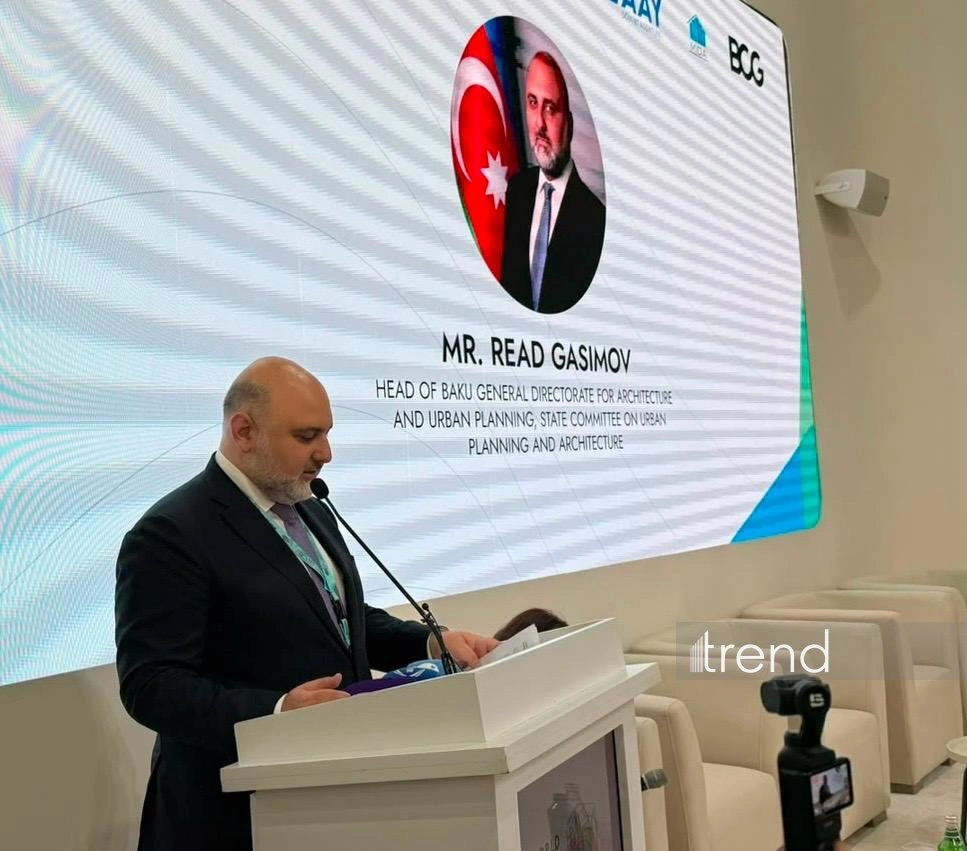
the Baku City Master Plan 2040, Riad Gasimov, Head of the Baku Main
Department for Architecture and Urban Planning, said, Trend reports.
He made the remark during a specialized session dedicated to the
capital’s developmental blueprint, held within the framework of the
13th session of the World Urban Forum (WUF13) in Baku.
According to him, Baku, in alignment with other major coastal
cities globally, confronts acute environmental and climate-induced
challenges.
"Consequently, the Master Plan undergoes engineering based
strictly upon the principles of green urbanism, high-tier energy
efficiency, ecological restoration, and sustainable mobility. The
document outlines a comprehensive pipeline of targeted measures
geared toward scaling municipal green spaces, lowering aggregate
environmental impacts, promoting distributed renewable energy
solutions, and systematically optimizing air quality metrics
alongside the broader urban ecosystem," Gasimov explained.
The department head reported that Azerbaijan, in close
collaboration with international partners, actively drives the
enforcement of standardized green building codes and
resource-utilization efficiency parameters across new
developments.
Gasimov concurrently pointed out that another critical focus of
the Master Plan lies in the creation of a fully integrated
multi-modal transportation matrix.
"Securing the sustainable development of the capital remains
fundamentally dependent upon reinforcing public mass transit
networks, optimizing seamless connectivity lines across diverse
transportation modes, and mitigating traffic congestion
bottlenecks. Our ultimate target remains the engineering of a
highly balanced urban environment where citizens spend
significantly less time in transit, experiencing maximum comfort.
The Baku Master Plan 2040 stands as a strategic constitution
designed to anchor the city’s future expansion firmly upon
sustainability, continuous technological innovation, and
human-centric design," the planning chief concluded.
Today marks the fifth day of WUF13 in Baku.
The first day included a ministerial meeting dedicated to the
New Urban Agenda, a ministerial roundtable, assemblies for women
and civil society, business sessions, and discussions on urban
prosperity. An official ceremony marking the raising of the UN and
Azerbaijani flags also took place.
The second day stood out for the inaugural Leaders' Summit,
featuring high-level discussions on the global housing crisis,
urbanization policy, and urban resilience. Concurrently, the
opening of the Mexico City pavilion took place, serving as a
significant platform for expanding cooperation with the Latin
American region and preparing for WUF14.
The third day of WUF13 featured a comprehensive program of
events covering the global housing crisis, the formation of safe
and inclusive cities, climate resilience, artificial intelligence
and urban governance, green urbanization, social equity, and
sustainable transport.
One of the highlights of the third day was the signing of a
sister-city memorandum between the Azerbaijani city of Shusha and
the Turkish city of Trabzon.
The fourth day of WUF13 featured a broad program of events
dedicated to urbanization, climate change, inclusive urban
development, housing policy, and sustainable governance.
One of the important events of the UN Special Program for the
Economies of Central Asia (SPECA) Cities Forum, held on the fourth
day, was the announcement of Almaty’s official accession to the
“Declaration of Intent on the Establishment of the SPECA Smart
Climate-Resilient Cities Forum.”
Also, for the first time in WUF history and at Azerbaijan’s
initiative, the “WUF13 NGO Forum: Global Partnership and
Decision-Making” was held.
WUF13, which has attracted more than 40,000 registered
participants from 182 countries, will continue until May 22. Held
under the theme “Housing the world: Safe and resilient cities and
communities,” the forum brings together governments, international
organizations, experts, and representatives of civil society to
strengthen global cooperation in the field of sustainable urban
development.