BAKU, Azerbaijan, May 21. Urban form
constitutes much more than a simple allocation of physical space;
it operates fundamentally as a metric of systemic performance,
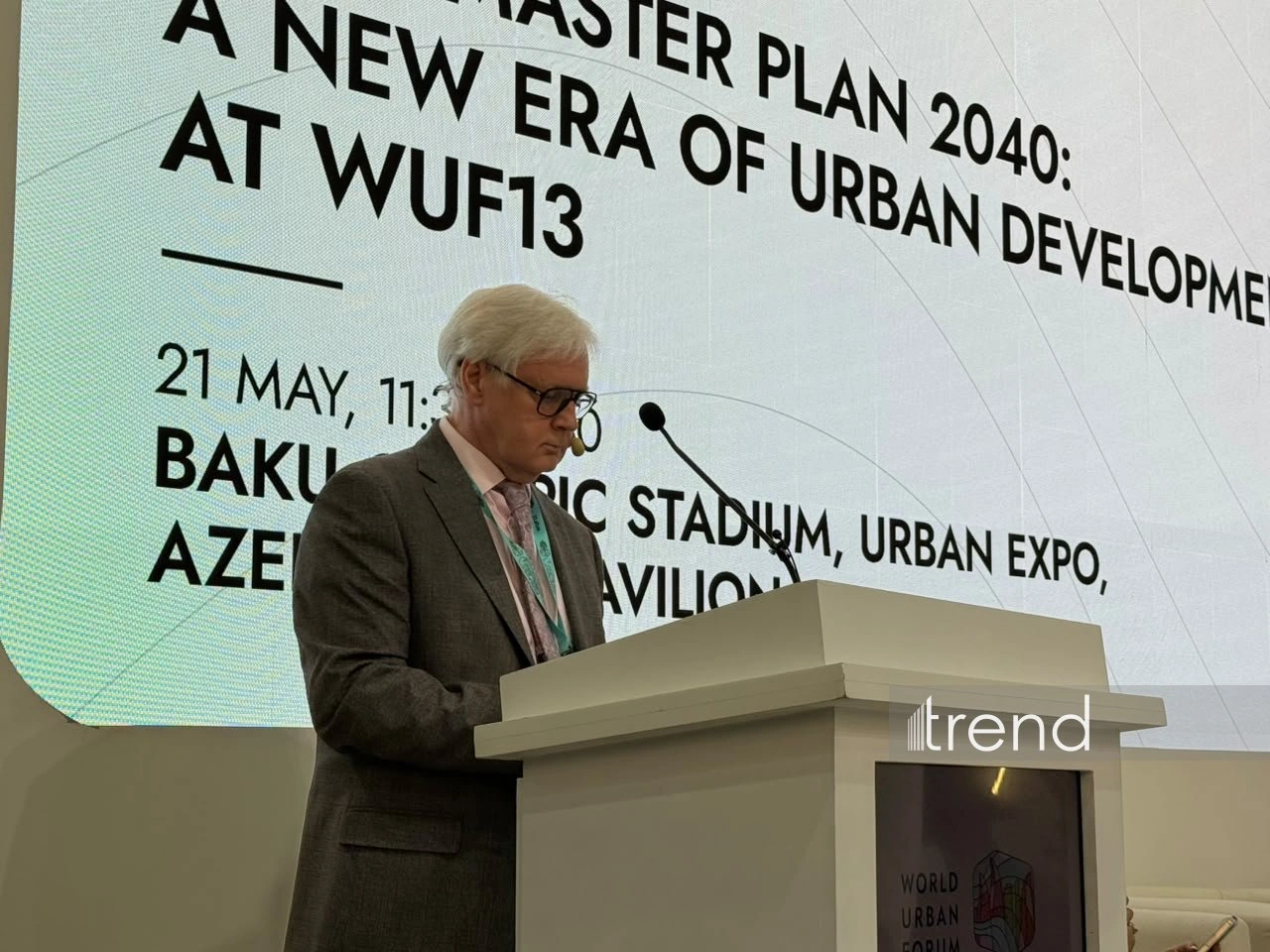
Chris Trott, Head of Sustainability Policy and Research at Foster +
Partners (United Kingdom), said, Trend reports.
He made the remark during a specialized event dedicated to the
Baku City Master Plan, held within the framework of the 13th
session of the World Urban Forum (WUF13) in Baku.
According to him, the precise spatial layout of a city exerts a
direct, unyielding impact on local mobility, baseline
accessibility, and daily civic life.
"This lived experience ultimately dictates whether an urban
transformation remains socially and politically viable over
extended horizons. Engineering increasingly resilient, low-carbon
municipalities depends on far more than just deploying cutting-edge
technology or securing heavy capital investments. The core
challenge requires that as a city expands, its citizens must
continuously experience tangible, qualitative improvements in their
daily lives. We recently completed exhaustive empirical research on
London, utilizing it as an active baseline to evaluate diverse
spatial expansion pathways within the 'London 2050' planning
framework," Trott pointed out.
Furthermore, he noted that his research team systematically
cross-analyzed four distinct urban growth strategies, ranging from
hyper-dense, high-rise clusters to widely decentralized horizontal
development models.
"A critical takeaway here is that merely introducing a
polycentric (multi-centric) development model remains completely
insufficient. A network of multiple urban hubs only achieves
operational success when these centers undergo genuine physical
integration through Transit-Oriented Development (TOD), mixed-use
zoning, pedestrian-accessible links, and comfortable, vibrant
public spaces where people actively choose to spend time," the UK
expert explained.
Trott concurrently emphasized that more compact, interconnected
urban forms naturally stimulate pedestrian foot traffic, bicycle
micro-mobility, and public mass transit utilization, effectively
driving down average daily trip distances while generating a
significantly healthier urban environment.
"Conversely, fragmented, sprawled, and poorly coordinated
metropolitan configurations inevitably accelerate private
automobile dependency and necessitate much longer commuting
distances. In reality, the built environment of a city actively
engineers human behavior. A successful sustainable transition
depends on far more than isolated architectural design, civil
engineering, technology, or capital injection," he stated.
Concluding his address, Trott underlined that
pedestrian-friendly access corridors, baseline accessibility, green
infrastructure networks, active public life, and the preservation
of local community identity must never be treated as secondary
aesthetic components.
"These elements constitute a core part of the primary
infrastructure required to cultivate highly resilient, adaptive,
and low-carbon urban ecosystems. In essence, cities shape
behavioral patterns, and those behavioral patterns ultimately
dictate the trajectory of the global urban transition," he
concluded.
Today marks the fifth day of WUF13 in Baku.
The first day included a ministerial meeting dedicated to the
New Urban Agenda, a ministerial roundtable, assemblies for women
and civil society, business sessions, and discussions on urban
prosperity. An official ceremony marking the raising of the UN and
Azerbaijani flags also took place.
The second day stood out for the inaugural Leaders' Summit,
featuring high-level discussions on the global housing crisis,
urbanization policy, and urban resilience. Concurrently, the
opening of the Mexico City pavilion took place, serving as a
significant platform for expanding cooperation with the Latin
American region and preparing for WUF14.
The third day of WUF13 featured a comprehensive program of
events covering the global housing crisis, the formation of safe
and inclusive cities, climate resilience, artificial intelligence
and urban governance, green urbanization, social equity, and
sustainable transport.
One of the highlights of the third day was the signing of a
sister-city memorandum between the Azerbaijani city of Shusha and
the Turkish city of Trabzon.
The fourth day of WUF13 featured a broad program of events
dedicated to urbanization, climate change, inclusive urban
development, housing policy, and sustainable governance.
One of the important events of the UN Special Program for the
Economies of Central Asia (SPECA) Cities Forum, held on the fourth
day, was the announcement of Almaty’s official accession to the
“Declaration of Intent on the Establishment of the SPECA Smart
Climate-Resilient Cities Forum.”
Also, for the first time in WUF history and at Azerbaijan’s
initiative, the “WUF13 NGO Forum: Global Partnership and
Decision-Making” was held.
WUF13, which has attracted more than 40,000 registered
participants from 182 countries, will continue until May 22. Held
under the theme “Housing the world: Safe and resilient cities and
communities,” the forum brings together governments, international
organizations, experts, and representatives of civil society to
strengthen global cooperation in the field of sustainable urban
development.