BAKU, Azerbaijan, May 21. Driven by conflict,
violence, and systematic persecution, approximately 117 million
individuals have undergone forced displacement worldwide, a
vulnerability further compounded by escalating climate change
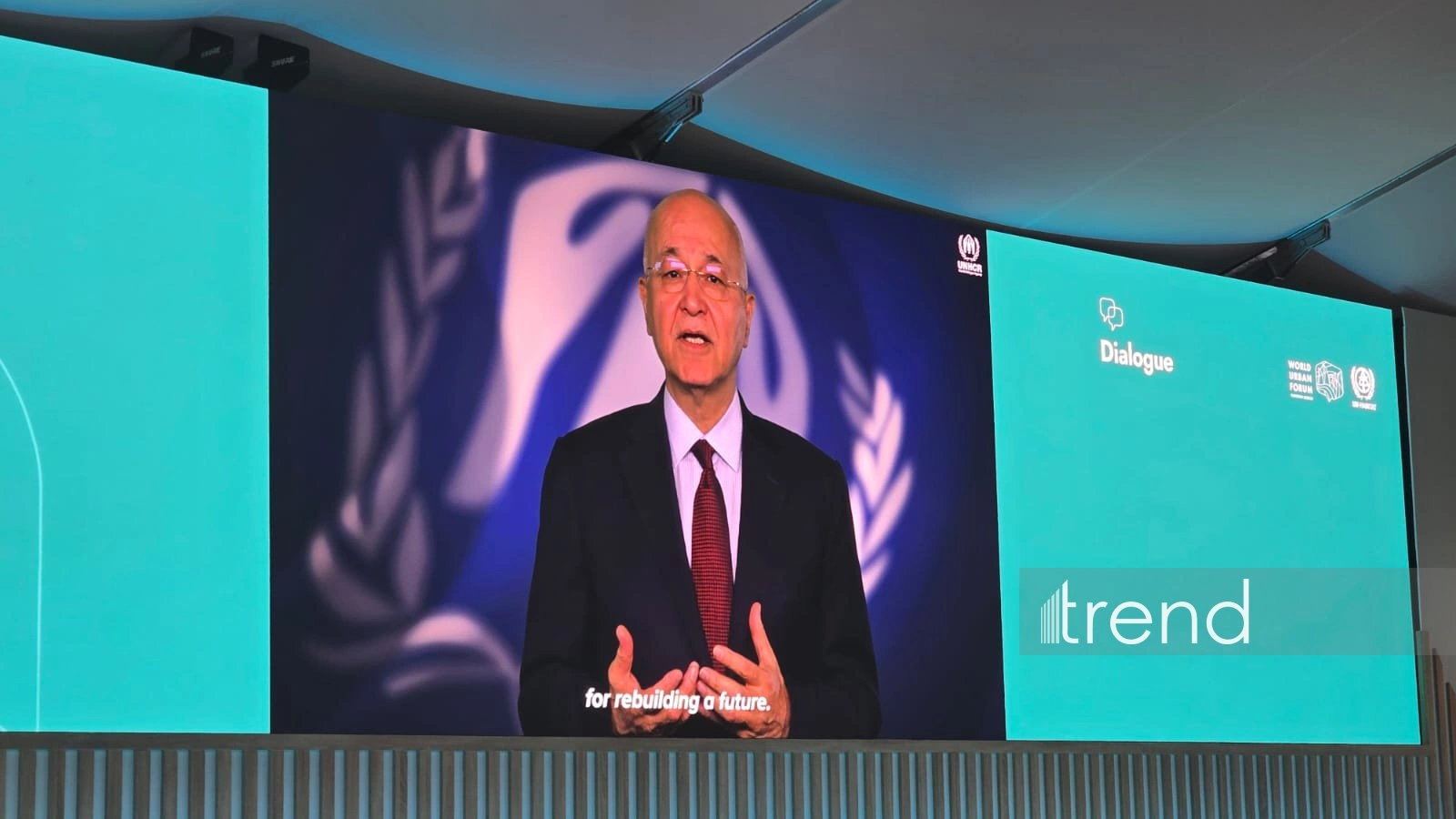
disasters, Barham Salih, former President of the Republic of Iraq,
said, Trend
reports.
He made the remarks during a session titled "Housing at the
Centre of Crisis Recovery and Reconstruction" held within the
framework of the 13th session of the World Urban Forum (WUF13) in
Baku.
Salih pointed out that empirical evidence gathered across
diverse global geographies—including Chad, Brazil, Jordan,
Colombia, Türkiye, and Syria—confirms a fundamental truth: the
broader recovery cycle must begin with establishing a safe and
livable physical space for affected populations.
"Concurrently, host communities continue to exhibit profound
solidarity. Even when navigating extremely constrained domestic
resources, they consistently share their homes, land assets, and
essential municipal services with internally displaced persons
(IDPs) and refugees," he emphasized.
According to Salih, the rapid escalation in global displacement
figures demands entirely new operational methodologies. As rapidly
expanding cities and townships absorb higher influxes of displaced
persons, the compounding structural pressure on existing housing
stock, public infrastructure utilities, and local social cohesion
intensifies significantly.
"Absent adequate housing provision, the entire post-crisis
rehabilitation trajectory stalls. The livelihoods of affected
individuals remain highly volatile, access to foundational
educational and healthcare networks suffers deep disruptions, and
the path toward economic self-reliance becomes increasingly
fraught," he noted.
The former president underscored that the primary turning point
in engineering resilient recovery and reconstruction policies lies
in placing the right to adequate housing at the absolute center of
strategic planning frameworks.
"The conceptual blueprint of a home does not merely begin with
erecting physical walls," Salih stated. "This process initiates
with securing legal access to land plots, guaranteeing property
tenure and spatial rights, and establishing robust documentation
frameworks that collectively empower individuals to live with
dignity, enter localized job markets, and rebuild their lives from
scratch."
Salih emphasized that institutional shifts along this path have
already begun emerging on the global stage. He highlighted that the
"Human Settlements Commitment" spearheaded within the framework of
the Global Refugee Forum actively promotes a progressive
paradigm—treating forced displacement not as an insurmountable
crisis, but as a structural window for inclusive spatial planning,
localized development, and shared economic prosperity.
"Factual data demonstrates that when refugees secure direct
access to stable housing frameworks and unhindered freedom of
movement, they contribute substantially to the macroeconomic and
social fabric of their host communities. Displaced populations
should never undergo evaluation as a fiscal burden; they represent
a core component of the structural solution," he added.
He cited several successful institutional precedents taking
shape across diverse developing regions. Notable examples include
the systematic transformation of humanitarian refugee camps into
integrated urban centers across Kenya and Ethiopia, the deployment
of inclusive governance models in Chad and Mauritania, and the
execution of robust municipal management strategies across various
European metropolitan zones.
"Cities must look beyond serving as mere passive management hubs
handling migration inflows. They function as the primary incubators
where legal protection, socioeconomic inclusion, and durable
infrastructure solutions materialize," he noted.
However, Salih cautioned that local municipal authorities cannot
bear this fiscal and operational weight in isolation. To succeed,
local governments require clearly defined legislative mandates,
sustainable long-term financing mechanisms, and deeply integrated
collaborative partnerships connecting sovereign state organs,
international development actors, the private sector, and local
civil society groups.
Concluding his address, the former president called upon the
international community to rapidly pivot away from obsolete
temporary emergency shelter models, moving instead toward
permanent, institutionalized housing solutions.
"We must systematically transition from short-term reactive
measures to long-term structural strategies, and shift away from
fragmented parallel tracking systems toward inclusive national
policy frameworks. The window for execution is now. Our ultimate
objective must extend beyond merely reconstructing what was lost,
targeting instead the cultivation of stronger, more inclusive, and
highly resilient communities for all," Salih concluded.
Today marks the fifth day of WUF13 in Baku.
The first day included a ministerial meeting dedicated to the
New Urban Agenda, a ministerial roundtable, assemblies for women
and civil society, business sessions, and discussions on urban
prosperity. An official ceremony marking the raising of the UN and
Azerbaijani flags also took place.
The second day stood out for the inaugural Leaders' Summit,
featuring high-level discussions on the global housing crisis,
urbanization policy, and urban resilience. Concurrently, the
opening of the Mexico City pavilion took place, serving as a
significant platform for expanding cooperation with the Latin
American region and preparing for WUF14.
The third day of WUF13 featured a comprehensive program of
events covering the global housing crisis, the formation of safe
and inclusive cities, climate resilience, artificial intelligence
and urban governance, green urbanization, social equity, and
sustainable transport.
One of the highlights of the third day was the signing of a
sister-city memorandum between the Azerbaijani city of Shusha and
the Turkish city of Trabzon.
The fourth day of WUF13 featured a broad program of events
dedicated to urbanization, climate change, inclusive urban
development, housing policy, and sustainable governance.
One of the important events of the UN Special Program for the
Economies of Central Asia (SPECA) Cities Forum, held on the fourth
day, was the announcement of Almaty’s official accession to the
“Declaration of Intent on the Establishment of the SPECA Smart
Climate-Resilient Cities Forum.”
Also, for the first time in WUF history and at Azerbaijan’s
initiative, the “WUF13 NGO Forum: Global Partnership and
Decision-Making” was held.
WUF13, which has attracted more than 40,000 registered
participants from 182 countries, will continue until May 22. Held
under the theme “Housing the world: Safe and resilient cities and
communities,” the forum brings together governments, international
organizations, experts, and representatives of civil society to
strengthen global cooperation in the field of sustainable urban
development.