BAKU, Azerbaijan, May 21. Investments in
housing construction generate a multiplier effect on the economy,
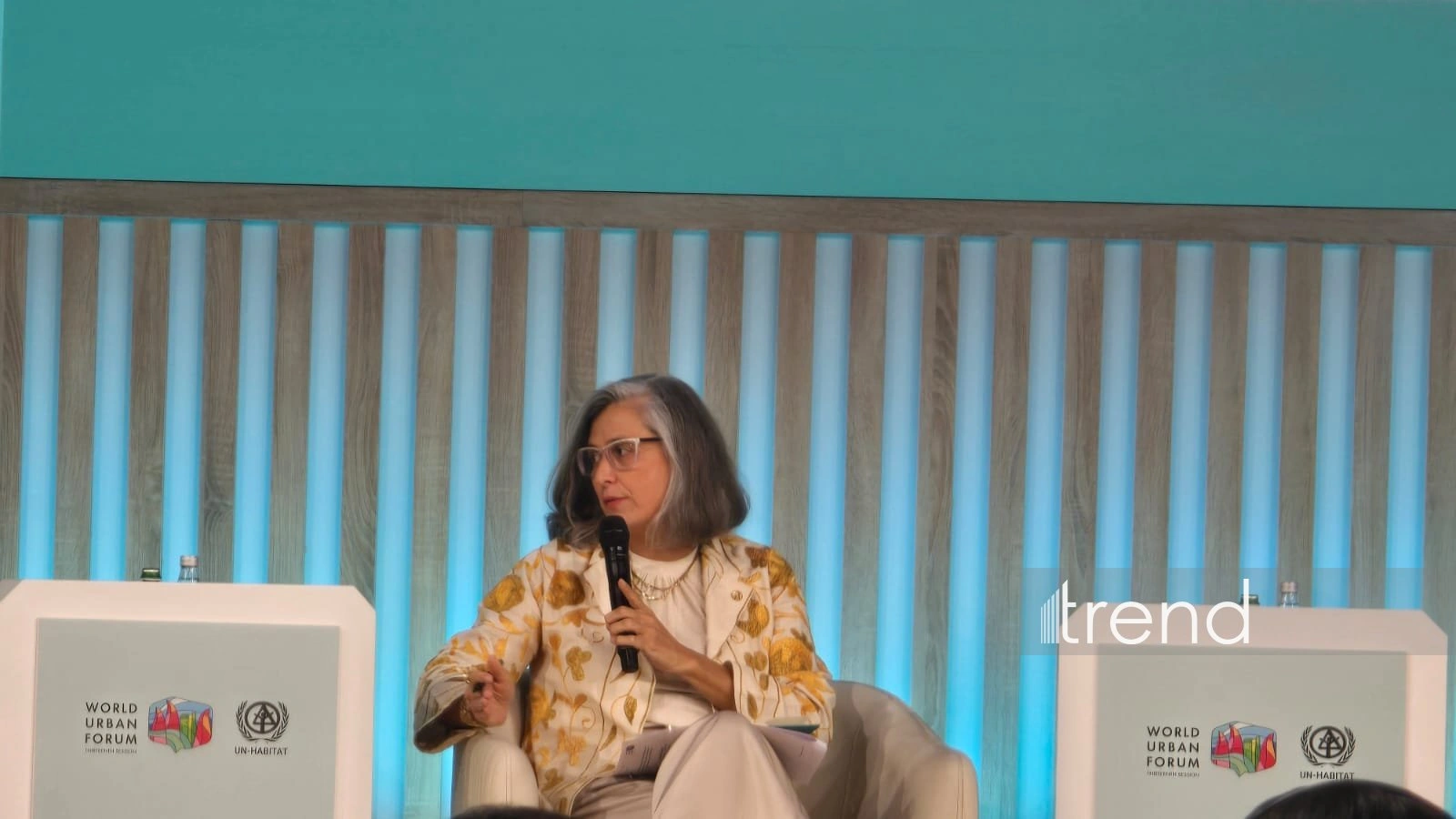
Anacláudia Rossbach, Executive Director of the United Nations Human
Settlements Program (UN-Habitat), said, Trend reports.
She made the remarks during a session titled "Housing at the
Centre of Crisis Recovery and Reconstruction" held within the
framework of the 13th session of the World Urban Forum (WUF13) in
Baku.
According to her, the residential housing sector remains
insufficiently prioritized even within broader development finance
architectures, holding an exceedingly small share across the
aggregate portfolios of international development banks.
The Executive Director noted that across most global
geographies, resolving the housing deficit anchors itself strictly
to the mobilization of domestic financial resources.
''Humanitarian funding secured by United Nations agencies and
non-governmental organizations targets life-saving operations and
emergency relief as a primary objective, meaning these streams
rarely undergo direct allocation toward long-term housing
provisions,'' she added.
"In nations unable to build resilient domestic financial
frameworks, the housing deficit deepens severely. Consequently,
populations undergo forced displacement across wider peripheral
areas, aggravating uncontrolled urban sprawl," Rossbach
explained.
This structural breakdown operates as a systemic flaw on a
global scale, she noted, emphasizing that the international
community must collectively engineer comprehensive mechanisms to
address it.
Rossbach underscored that even when emergency humanitarian
planning operates under hyper-constrained fiscal baselines, housing
provision must be classified as a core priority from the initial
conceptualization and master-planning phases.
"We must systematically fortify local social capital and
community-based capacities. When backed by targeted institutional
support, community-led resources can successfully scale into a
phased, highly sustainable post-crisis recovery trajectory," she
pointed out.
According to her, this localized methodology can undergo partial
execution immediately, even prior to achieving sweeping structural
transformations across existing global financial systems.
The Executive Director highlighted that local municipal
authorities fulfill a uniquely critical role within this matrix.
"This stems from the reality that local government bodies operate
as the primary anchors ensuring continuous utility service delivery
and long-term operational sustainability throughout the
reconstruction cycle," she emphasized.
Rossbach concluded that housing should transcend its standard
evaluation as a mere social welfare issue, demanding recognition
instead as a high-value macroeconomic sector.
"The residential housing sector commands a massive vertical
value chain, generating extensive downstream commercial channels
for both multinational corporations and small-to-medium
enterprises. Direct capital injection into housing stimulates
localized economic development, drives employment loops, and
triggers substantial income expansion," she stated.
"This comprehensive operational approach exerts a powerful
positive influence on a nation's Gross Domestic Product (GDP),
allowing initial infrastructure investments to deliver robust
multiplier economic effects throughout the broader financial
circulation loop," the UN-Habitat chief concluded.
Today marks the fifth day of WUF13 in Baku.
The first day included a ministerial meeting dedicated to the
New Urban Agenda, a ministerial roundtable, assemblies for women
and civil society, business sessions, and discussions on urban
prosperity. An official ceremony marking the raising of the UN and
Azerbaijani flags also took place.
The second day stood out for the inaugural Leaders' Summit,
featuring high-level discussions on the global housing crisis,
urbanization policy, and urban resilience. Concurrently, the
opening of the Mexico City pavilion took place, serving as a
significant platform for expanding cooperation with the Latin
American region and preparing for WUF14.
The third day of WUF13 featured a comprehensive program of
events covering the global housing crisis, the formation of safe
and inclusive cities, climate resilience, artificial intelligence
and urban governance, green urbanization, social equity, and
sustainable transport.
One of the highlights of the third day was the signing of a
sister-city memorandum between the Azerbaijani city of Shusha and
the Turkish city of Trabzon.
The fourth day of WUF13 featured a broad program of events
dedicated to urbanization, climate change, inclusive urban
development, housing policy, and sustainable governance.
One of the important events of the UN Special Program for the
Economies of Central Asia (SPECA) Cities Forum, held on the fourth
day, was the announcement of Almaty’s official accession to the
“Declaration of Intent on the Establishment of the SPECA Smart
Climate-Resilient Cities Forum.”
Also, for the first time in WUF history and at Azerbaijan’s
initiative, the “WUF13 NGO Forum: Global Partnership and
Decision-Making” was held.
WUF13, which has attracted more than 40,000 registered
participants from 182 countries, will continue until May 22. Held
under the theme “Housing the world: Safe and resilient cities and
communities,” the forum brings together governments, international
organizations, experts, and representatives of civil society to
strengthen global cooperation in the field of sustainable urban
development.