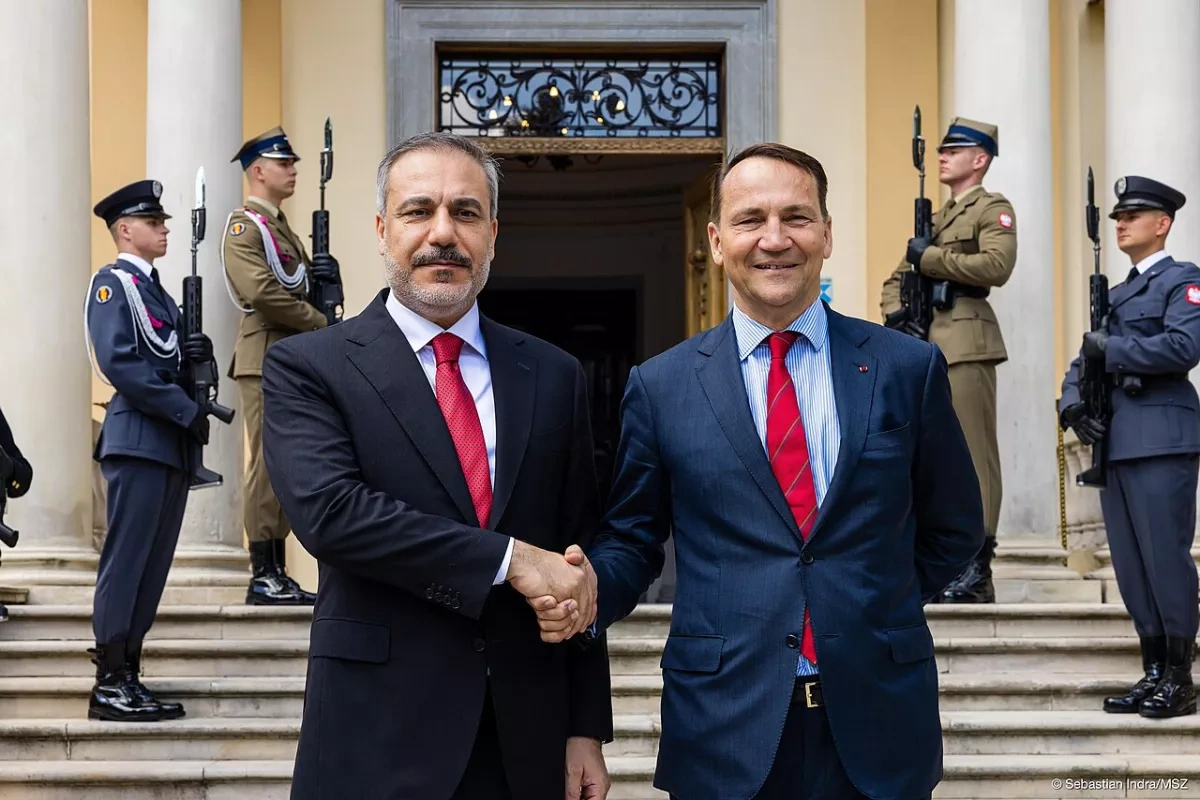
An emerging but underdeveloped Türkiye–Poland defence relationship could become a significant building block in Europe’s evolving security architecture.
While recent EU initiatives such as the Security Action for Europe (SAFE) programme signal renewed momentum in European defence integration, an opinion piece by Eastern New Europe suggests that bilateral cooperation outside Brussels may ultimately prove more decisive in shaping military capability on the continent.
The piece highlights a memorandum of understanding on defence signed last year between Türkiye and Poland, describing it as currently limited in scope but strategically important. Although the arrangement reflects existing NATO cooperation and prior procurement ties — including Poland’s purchase of Turkish Bayraktar drones — it remains largely transactional in nature, according to the analysis.
However, Eastern New Europe argues that the partnership has the potential to evolve into a more structured defence axis, one that could complement and potentially influence broader European defence planning.
Strategic complementarity between Ankara, Warsaw
The opinion piece frames Poland’s security posture as heavily shaped by its deterrence strategy against Russia. While the likelihood of full-scale invasion is considered relatively low, the article emphasises that hybrid threats — including drone incursions, sabotage incidents, and airspace violations — are increasingly central to Warsaw’s defence planning.
Citing Polish Foreign Minister Radosław Sikorski, the piece notes warnings against strategic inertia, including his statement: “We cannot afford paralysis. Passivity or relying on others is an invitation to escalation.”
Within this context, Poland is portrayed as prioritising layered deterrence through systems such as Patriot and Narew air defence platforms, while still facing vulnerabilities in drone warfare and electromagnetic disruption.
Türkiye’s defence industry
On the other side, the article outlines Türkiye’s dual interest in European defence cooperation: strengthening national capabilities and expanding access to European defence markets.
EU defence spending has risen sharply in recent years, with programmes such as the European Defence Fund and related initiatives channeling billions of euros into joint procurement and innovation. Against this backdrop, Türkiye’s defence sector — estimated at around €14–15 billion annually — is significantly smaller than Europe’s but highly competitive in drone and mid-range systems.
The analysis suggests that Turkish firms could benefit substantially from deeper integration into European procurement frameworks, while European states could in turn access cost-effective drone and electronic warfare capabilities.
Technological synergies
A central argument advanced by Eastern New Europe is that Türkiye and Poland possess complementary defence capabilities.
Poland’s military modernisation focuses on heavy armour, artillery systems, and Western aircraft such as F-35s and F-16s, alongside missile defence platforms. Türkiye, by contrast, is described as specialising in drones (including the ANKA and Bayraktar TB2) and electronic warfare systems such as KORAL and IHTAR.
The article argues that these systems directly address gaps in Polish and broader NATO defence doctrine, particularly in the electromagnetic domain and in countering low-cost aerial threats.
In the land domain, Poland’s investments in platforms such as HIMARS, K9 Thunder, and K2 Black Panther tanks are highlighted as strong conventional capabilities. However, the opinion piece argues that modern battlefield realities — particularly lessons from Ukraine — demonstrate the growing importance of counter-drone systems and electronic warfare integration.
The European Defence Fund and Permanent Structured Cooperation (PESCO) are project-based, fragmented, and dependent on consensus among member states, the article notes. This structure limits long-term strategic integration and complicates participation by non-EU partners such as Türkiye.
By contrast, a Poland–Türkiye partnership is presented as more flexible, operationally focused, and capable of rapid capability integration — particularly in areas such as drone warfare, electronic warfare, and air defence interoperability.
Rather than waiting for full consensus within EU structures, bilateral initiatives such as this may act as catalysts for wider defence integration.
By Sabina Mammadli