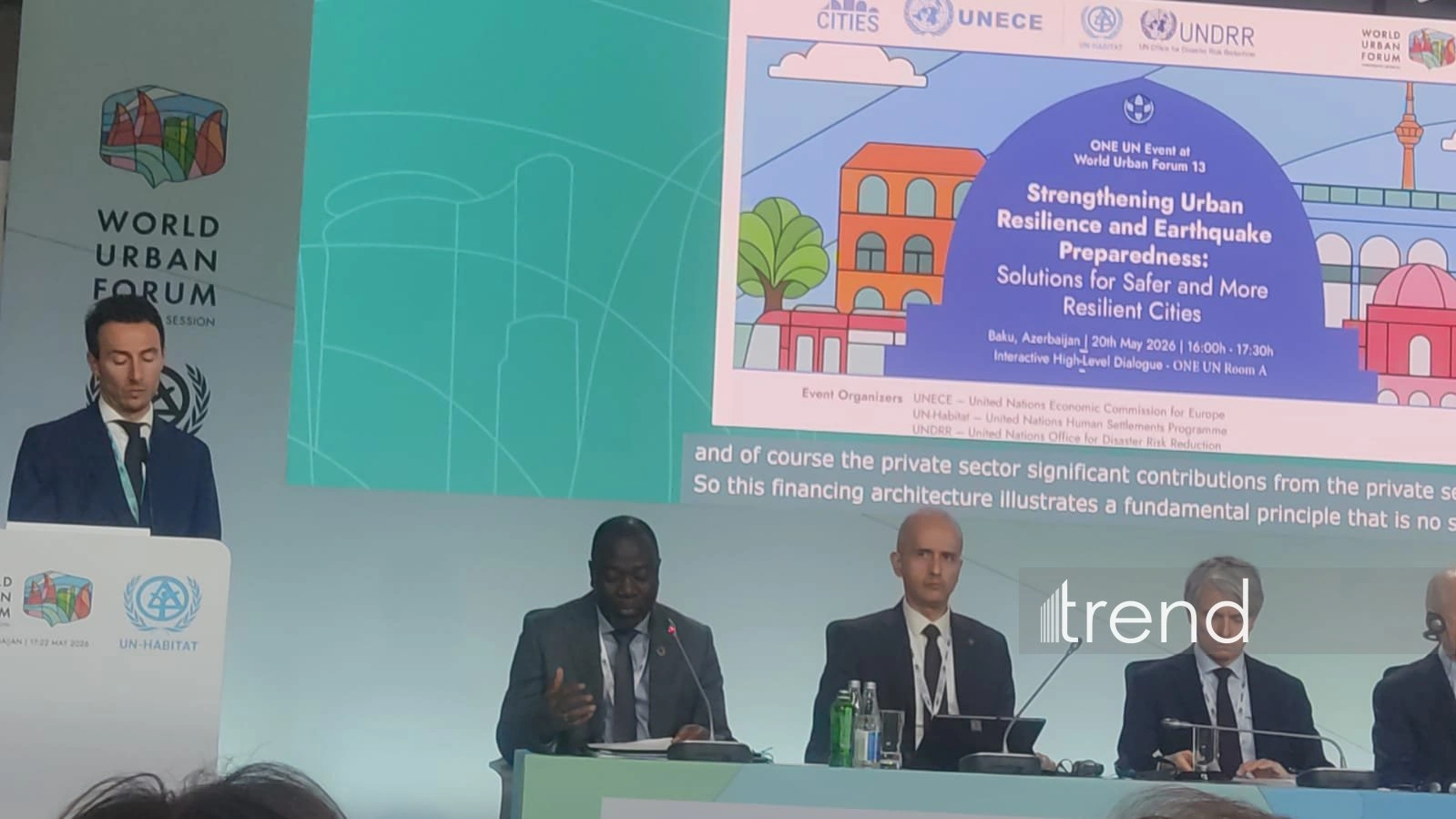
BAKU, Azerbaijan, May 20. A conference titled
"Strengthening Urban Earthquake Preparedness ONE UN Solutions for
Safer and More Resilient Cities" has taken place within the
framework of the 13th session of the World Urban Forum (WUF13) in
Baku, Trend
reports.
Speaking at the event, Dmitry Mariyasin, Deputy Executive
Secretary of the United Nations Economic Commission for Europe
(UNECE), highlighted the profound potential risks that earthquakes
pose to municipal environments.
According to him, earthquakes instantly expose the deep
structural vulnerabilities of cities. "Investments in resilience
require allocation long before a crisis begins. Once a crisis
occurs, it is already too late. The devastating earthquake that
struck Türkiye a few years ago provided us with highly critical and
urgent lessons," Mariyasin pointed out.
Babatunde Ahonsi, UN Resident Coordinator in Türkiye, emphasized
that urban resilience should never undergo evaluation as a standard
expense. Instead, he noted, it represents one of the most strategic
and cost-effective investments possible for sustainable
development. Civil society, academia, the private sector, and
specifically the affected communities themselves must actively
engage as co-creators of the recovery process.
Hasan Suver, Deputy Minister of Environment, Urbanization, and
Climate Change of Türkiye, detailed the extensive rehabilitation
and structural engineering initiatives executed in Türkiye
following the disaster. He stated that within this framework, a
comprehensive social housing initiative, targeting the construction
of 500,000 social housing units across 81 provinces and an
additional 100,000 units in Istanbul, directly supports equitable
access to safe and affordable housing.
Talantbek Imanakun Uulu, Deputy Minister of Construction,
Architecture, and Housing and Communal Services of the Kyrgyz
Republic, noted that a robust building code framework integrates
construction rules, guidelines, and technical standards to ensure a
standardized engineering approach nationwide. According to him, one
of the primary outcomes of modernizing their regulatory base
involves the mandatory implementation of advanced peak ground
acceleration (PGA) mapping tools.
Today marks the fourth day of WUF13 in Baku.
The first day included a ministerial meeting dedicated to the
New Urban Agenda, a ministerial roundtable, assemblies for women
and civil society, business sessions, and discussions on urban
prosperity. An official ceremony marking the raising of the UN and
Azerbaijani flags also took place.
The second day stood out for the inaugural Leaders' Summit,
featuring high-level discussions on the global housing crisis,
urbanization policy, and urban resilience. Concurrently, the
opening of the Mexico City pavilion took place, serving as a
significant platform for expanding cooperation with the Latin
American region and preparing for WUF14.
The third day of WUF13 featured a comprehensive program of
events covering the global housing crisis, the formation of safe
and inclusive cities, climate resilience, artificial intelligence
and urban governance, green urbanization, social equity, and
sustainable transport.
WUF13, which has attracted more than 40,000 registered
participants from 182 countries, will continue until May 22. Held
under the theme “Housing the world: Safe and resilient cities and
communities,” the forum brings together governments, international
organizations, experts, and representatives of civil society to
strengthen global cooperation in the field of sustainable urban
development.