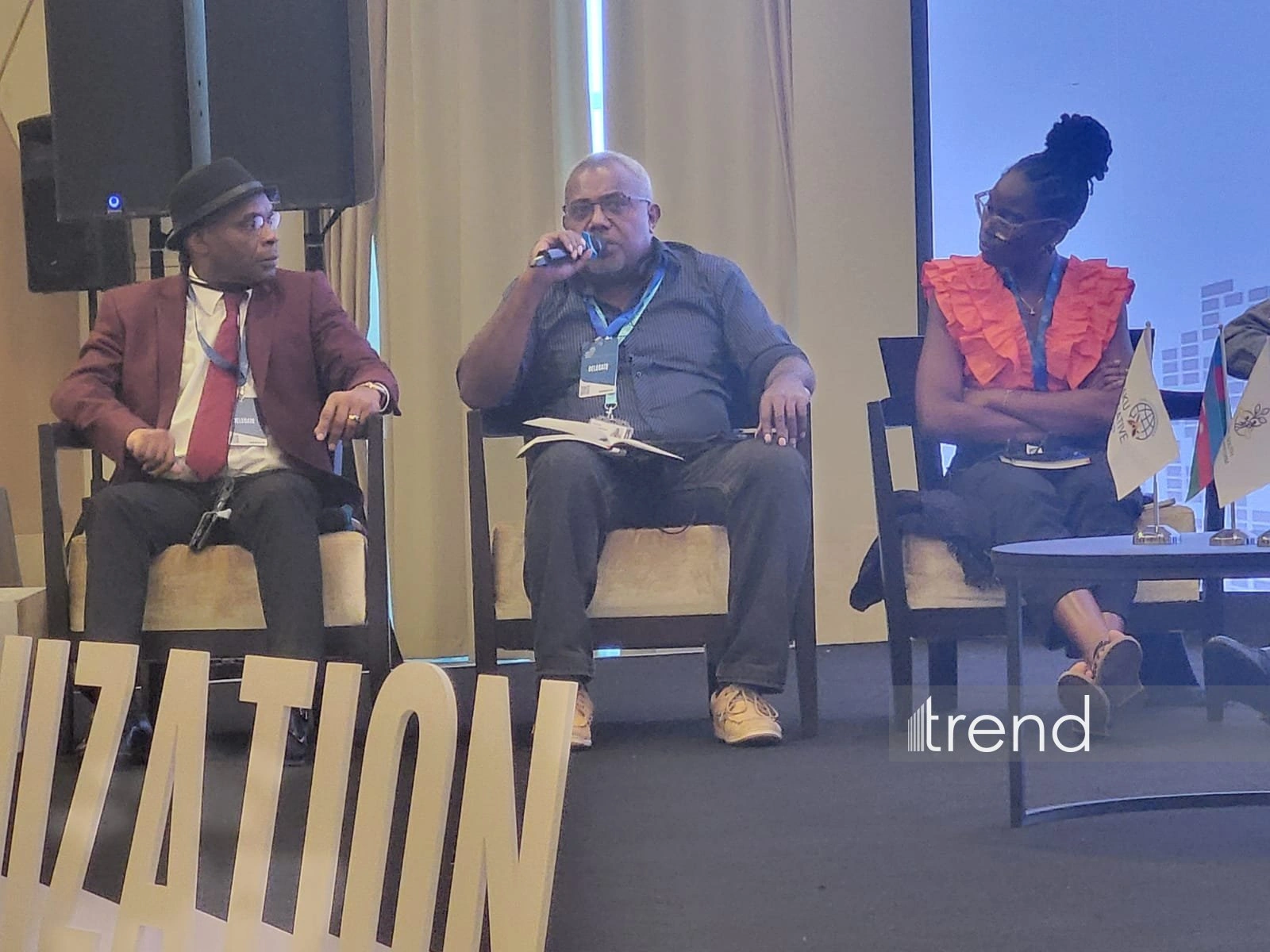
BAKU, Azerbaijan, May 20. The youth of Kanak
played a key role in the 2024 protests against France’s policies in
New Caledonia and continue to be a central force in the struggle
for the territory’s future, Rock Haocas, vice president of the
Union of Kanak Workers and Employers (USTKE), said, Trend reports.
Speaking at the international conference 'The Role of Youth in
Urban Planning in the Decolonization Process,' held as part of the
13th World Urban Forum (WUF13), Haocas emphasized that, in
territories still under colonial domination, urban development
continues to reflect externally imposed models, rather than locally
driven frameworks
“We, the countries still under colonial rule, do not ask
ourselves this question. It is the colonizer who continues to
impose its model on us,” he said.
Furthermore, Rock Haocas noted that for the Kanak people, the
primary task is the “decolonization of consciousness” and the
building of an independent state.
He recalled the events of May 2024 in New Caledonia, when youth
protests erupted following France’s attempts to change the
territory’s electoral system.
“Thanks to the mobilization of the country’s youth, especially
Kanak youth, who were not necessarily politicized but were directly
facing problems with education, housing, and employment, people
rose on May 13, 2024,” he stated.
According to him, the protests were spontaneous and arose in
response to the French government’s actions regarding the
territory’s future.
“If we don’t engage with young people, it is not the future that
is at risk, but ourselves,” he emphasized.
The USTKE vice president also noted the importance of combining
global reflection with local action.
“Reflection may be global, but action always remains local,” he
said.
Haocas added that Kanak youth face not only the consequences of
the colonial legacy but also internal social stratification between
young people living in cities and those who maintain ties to
traditional communities and culture.
He also emphasized the importance of international solidarity
and regional cooperation, particularly with Vanuatu, which has a
similar historical experience.
“It is necessary to build networks of solidarity and exchange
experiences with neighboring countries that face similar challenges
regarding youth and urbanization,” he noted.
Haocas Rock separately addressed the issue of language and
terminology.
“Colonization also occurs through words. Perhaps it is time to
reconsider certain terms and use words that reflect our own
realities,” he said.
Today, the fourth day of the WUF13 conference is taking place in
Baku.
The first day included a ministerial meeting dedicated to the
New Urban Agenda, a ministerial roundtable, assemblies for women
and civil society, business sessions, and discussions on urban
prosperity. An official ceremony marking the raising of the UN and
Azerbaijani flags also took place.
The second day stood out for the inaugural Leaders' Summit,
featuring high-level discussions on the global housing crisis,
urbanization policy, and urban resilience. Concurrently, the
opening of the Mexico City pavilion took place, serving as a
significant platform for expanding cooperation with the Latin
American region and preparing for WUF14.
The third day of WUF13 featured a comprehensive program of
events covering the global housing crisis, the formation of safe
and inclusive cities, climate resilience, artificial intelligence
and urban governance, green urbanization, social equity, and
sustainable transport.
WUF13, which has attracted more than 40,000 registered
participants from 182 countries, will continue until May 22. Held
under the theme “Housing the world: Safe and resilient cities and
communities,” the forum brings together governments, international
organizations, experts, and representatives of civil society to
strengthen global cooperation in the field of sustainable urban
development.