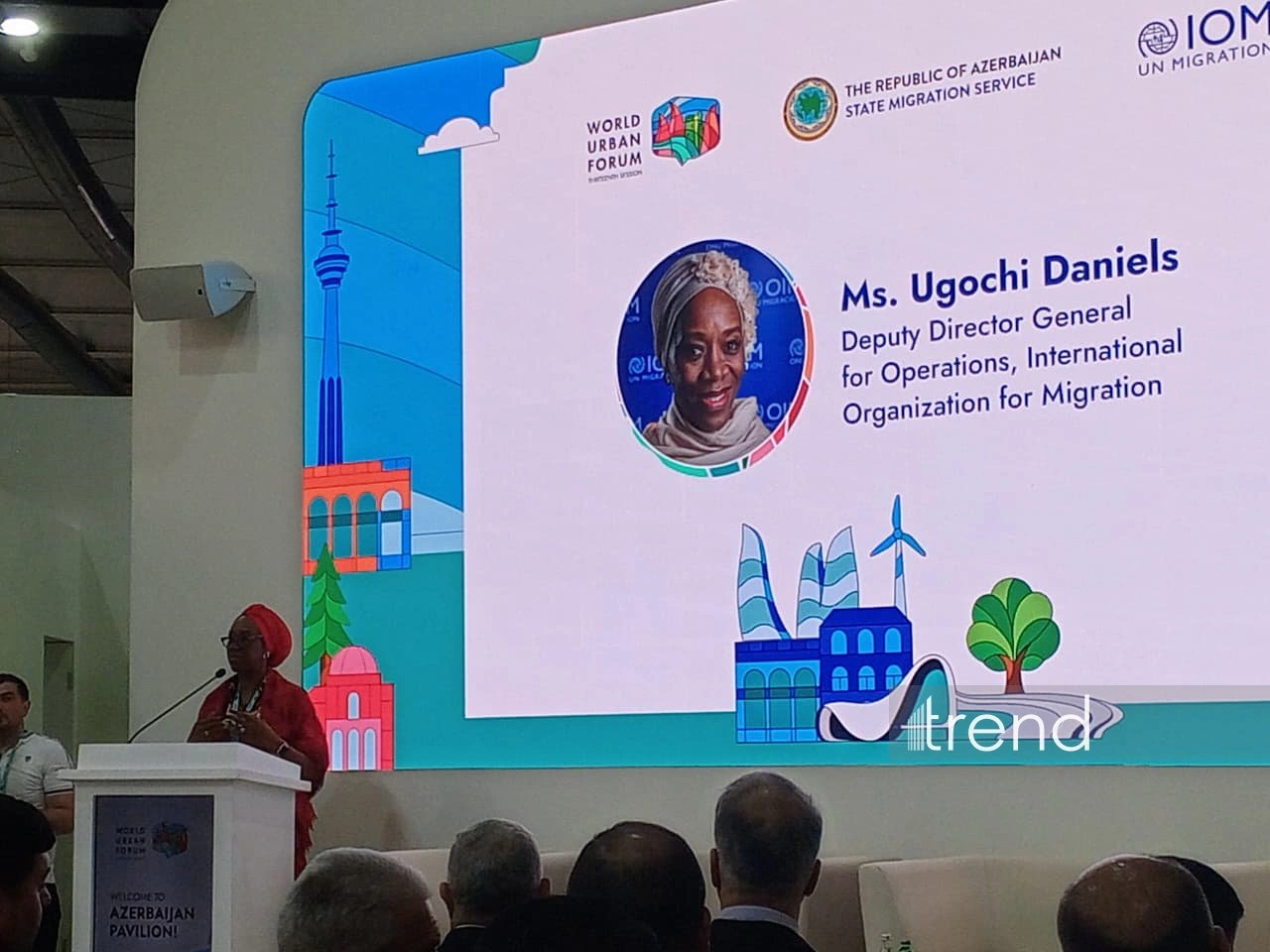
BAKU, Azerbaijan, May 20. Safe and decent
housing is one of the key prerequisites for building inclusive and
sustainable cities, the Deputy Director General of the
International Organization for Migration (IOM) for Operations,
Ugochi Daniels, said, Trend reports.
Addressing the panel discussion “Migration and Cities: A
Framework for Safe, Innovative and Sustainable Governance,” held as
part of the 13th World Urban Forum (WUF13), Ugochi Daniels noted
that today, one of the most serious problems facing cities is the
housing issue.
“Currently, more than 1.1 billion people worldwide live in
substandard housing conditions. About 3 billion people face housing
security issues in various forms,” she emphasized.
Daniels noted that the theme of WUF13, “Housing the world: Safe
and resilient cities and communities,” is highly relevant in this
context.
“Housing is not just shelter. It is the foundation of
inclusivity, sustainability, and a dignified life,” she
emphasized.
The Deputy Director-General added that without safe and adequate
housing, people’s access to services, employment opportunities, and
participation in social life is significantly limited.
“Today, cities are grappling with various challenges, such as
forced migration, climate change, and rapid urbanization. This
calls for a crisis-sensitive approach to urban governance,” she
noted.
Furthermore, Daniels added that local authorities play a key
role in this process, and that cities with strong multilateral
partnerships are better able to manage migration more effectively
and humanely.
“The New Urban Agenda and the Global Compact for Safe, Orderly,
and Regular Migration are key international framework agreements in
this area. Inclusive urban planning and equal access to adequate
housing and services are not options, but necessities,” she
added.
Today, the fourth day of the WUF13 conference is taking place in
Baku.
The first day included a ministerial meeting dedicated to the
New Urban Agenda, a ministerial roundtable, assemblies for women
and civil society, business sessions, and discussions on urban
prosperity. An official ceremony marking the raising of the UN and
Azerbaijani flags also took place.
The second day stood out for the inaugural Leaders' Summit,
featuring high-level discussions on the global housing crisis,
urbanization policy, and urban resilience. Concurrently, the
opening of the Mexico City pavilion took place, serving as a
significant platform for expanding cooperation with the Latin
American region and preparing for WUF14.
The third day of WUF13 featured a comprehensive program of
events covering the global housing crisis, the formation of safe
and inclusive cities, climate resilience, artificial intelligence
and urban governance, green urbanization, social equity, and
sustainable transport.
WUF13, which has attracted more than 40,000 registered
participants from 182 countries, will continue until May 22. Held
under the theme “Housing the world: Safe and resilient cities and
communities,” the forum brings together governments, international
organizations, experts, and representatives of civil society to
strengthen global cooperation in the field of sustainable urban
development.