BAKU, Azerbaijan, May 20. Adapting physical
structures to climate change and bolstering the resilience of urban
environments stands as a central challenge facing the global
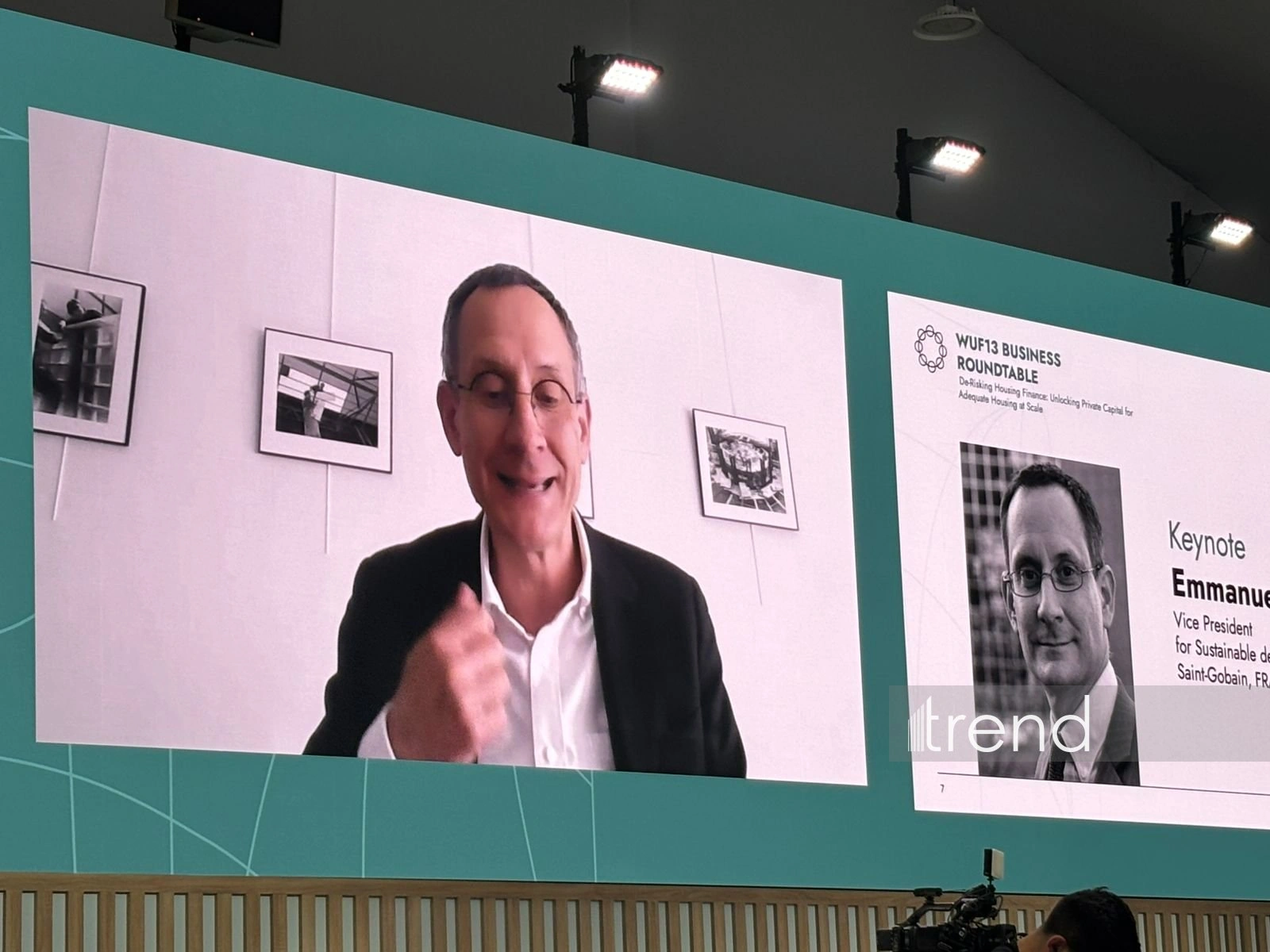
construction industry, Emmanuel Normant, Vice President for
Sustainable Development at the French company Saint-Gobain, said,
Trend reports.
The executive made the remarks during a business roundtable on
affordable housing finance held within the framework of the World
Urban Forum (WUF13) in Baku.
In his address, Normant referenced the results of an annual
global survey conducted by Bouygues dedicated to sustainable
construction trends. According to the poll, which surveyed 4,800
construction industry professionals and 30,000 citizens across 30
countries, public awareness of sustainable building concepts
remains high, with 94% of participants having heard of the concept
and 67% expressing a clear understanding of the topic.
"However, the research captures a substantial gap between
theoretical awareness and practical implementation," Normant
pointed out. "Only 30% of industry professionals actively execute
sustainable building projects, while 55% plan to deploy them. Among
municipal authorities, 86% view sustainability as a critical public
procurement benchmark, yet a mere 20% have previously rejected
project proposals for failing to meet these criteria," he said.
He noted that in regions highly exposed to climate risks,
resilience increasingly shapes the local definition of sustainable
building. For instance, 42% of respondents in Africa and 41% in the
Middle East directly link sustainable construction to the capacity
of physical assets to withstand environmental and climatic
threats.
Normant emphasized that climate adaptation translates into a
current operational necessity rather than a distant future
scenario.
"Concurrently, the financial sector grapples with an inherent
asymmetry: adaptation outlays incur immediately, whereas the
economic yield materializes down the road through mitigated losses
and extended asset longevity," he stressed.
He also drew attention to a shifting sentiment within the
industry, noting that for the first time in the survey's history,
fewer than half of the respondents (47%) perceive sustainable
construction as yielding greater overall value - in terms of
economic, social, and environmental efficiency - when compared to
traditional building practices.
To bridge this gap between strategic ambition and daily
practice, Arup, in coordination with Saint-Gobain, compiled a
specialized report focusing on structural climate adaptation. The
document underscores that by the year 2050, roughly 80% of Europe's
building stock will consist of structures that already stand today,
identifying the retrofitting and modernizing of existing real
estate portfolios as a critical priority track.
Today marks the fourth day of WUF13 in Baku.
The first day included a ministerial meeting dedicated to the
New Urban Agenda, a ministerial roundtable, assemblies for women
and civil society, business sessions, and discussions on urban
prosperity. An official ceremony marking the raising of the UN and
Azerbaijani flags also took place.
The second day stood out for the inaugural Leaders' Summit,
featuring high-level discussions on the global housing crisis,
urbanization policy, and urban resilience. Concurrently, the
opening of the Mexico City pavilion took place, serving as a
significant platform for expanding cooperation with the Latin
American region and preparing for WUF14.
The third day of WUF13 featured a comprehensive program of
events covering the global housing crisis, the formation of safe
and inclusive cities, climate resilience, artificial intelligence
and urban governance, green urbanization, social equity, and
sustainable transport.
WUF13, which has attracted more than 40,000 registered
participants from 182 countries, will continue until May 22. Held
under the theme “Housing the world: Safe and resilient cities and
communities,” the forum brings together governments, international
organizations, experts, and representatives of civil society to
strengthen global cooperation in the field of sustainable urban
development.