BAKU, Azerbaijan, May 20. A "5P model" concept
that expands classical public-private partnerships by incorporating
two additional components - people and policy - aims to reshape
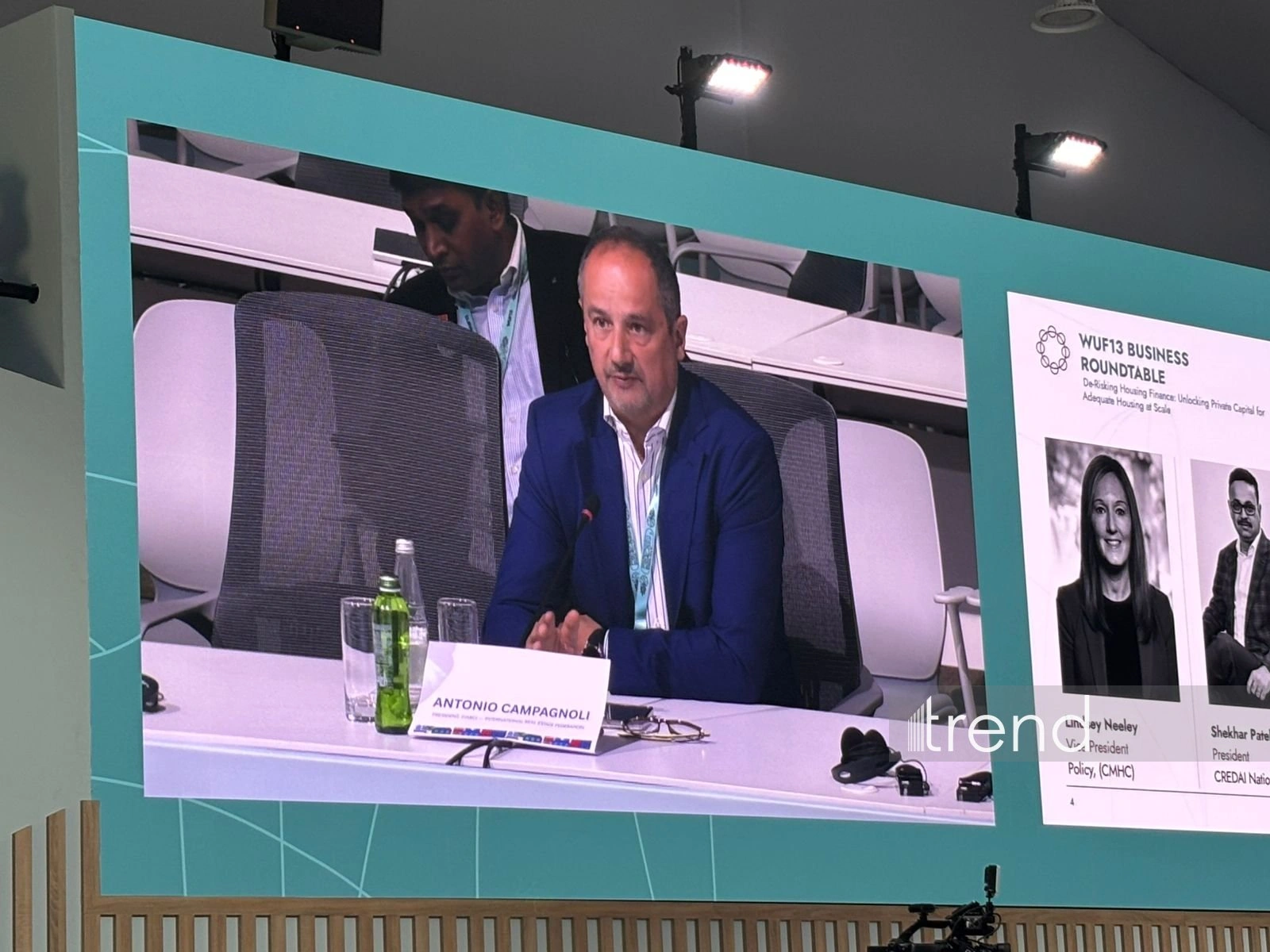
urban governance, said Antonio Campagnoli, President of the
International Real Estate Federation (FIABCI), Trend reports.
The official made the remarks during a business roundtable on
affordable housing finance held within the framework of the World
Urban Forum (WUF13) in Baku.
According to him, sustainable city development and the
attraction of long-term capital into the housing sector require a
novel approach to risk mitigation, alongside a more comprehensive
interaction model between the state, business, and society.
Campagnoli stated that the traditional framework of public-private
partnerships no longer suffices to address modern urbanization and
housing construction challenges.
He noted that alongside financial and investment risks,
non-financial factors - such as a lack of trust, fragmented
management, institutional instability, and weak coordination among
urban development stakeholders - increasingly carry substantial
weight. Campagnoli emphasized that the newly proposed model
encompasses government, business, citizens, and a stable
political-institutional foundation.
He stressed that engaging local communities bolsters the
legitimacy of infrastructure projects and minimizes local
conflicts, while stable and predictable policy remains critical for
attracting institutional investors, including pension and
international funds.
"The future of urban development will be determined not just by
technology and financing, but by the quality of interaction between
institutions, the market, and society. The '5P' model represents
not only an economic system but a governance and trust-building
framework aimed at reducing investment, social, and political
risks," Campagnoli concluded.
Today marks the fourth day of WUF13 in Baku.
The first day included a ministerial meeting dedicated to the
New Urban Agenda, a ministerial roundtable, assemblies for women
and civil society, business sessions, and discussions on urban
prosperity. An official ceremony marking the raising of the UN and
Azerbaijani flags also took place.
The second day stood out for the inaugural Leaders' Summit,
featuring high-level discussions on the global housing crisis,
urbanization policy, and urban resilience. Concurrently, the
opening of the Mexico City pavilion took place, serving as a
significant platform for expanding cooperation with the Latin
American region and preparing for WUF14.
The third day of WUF13 featured a comprehensive program of
events covering the global housing crisis, the formation of safe
and inclusive cities, climate resilience, artificial intelligence
and urban governance, green urbanization, social equity, and
sustainable transport.
WUF13, which has attracted more than 40,000 registered
participants from 182 countries, will continue until May 22. Held
under the theme “Housing the world: Safe and resilient cities and
communities,” the forum brings together governments, international
organizations, experts, and representatives of civil society to
strengthen global cooperation in the field of sustainable urban
development.