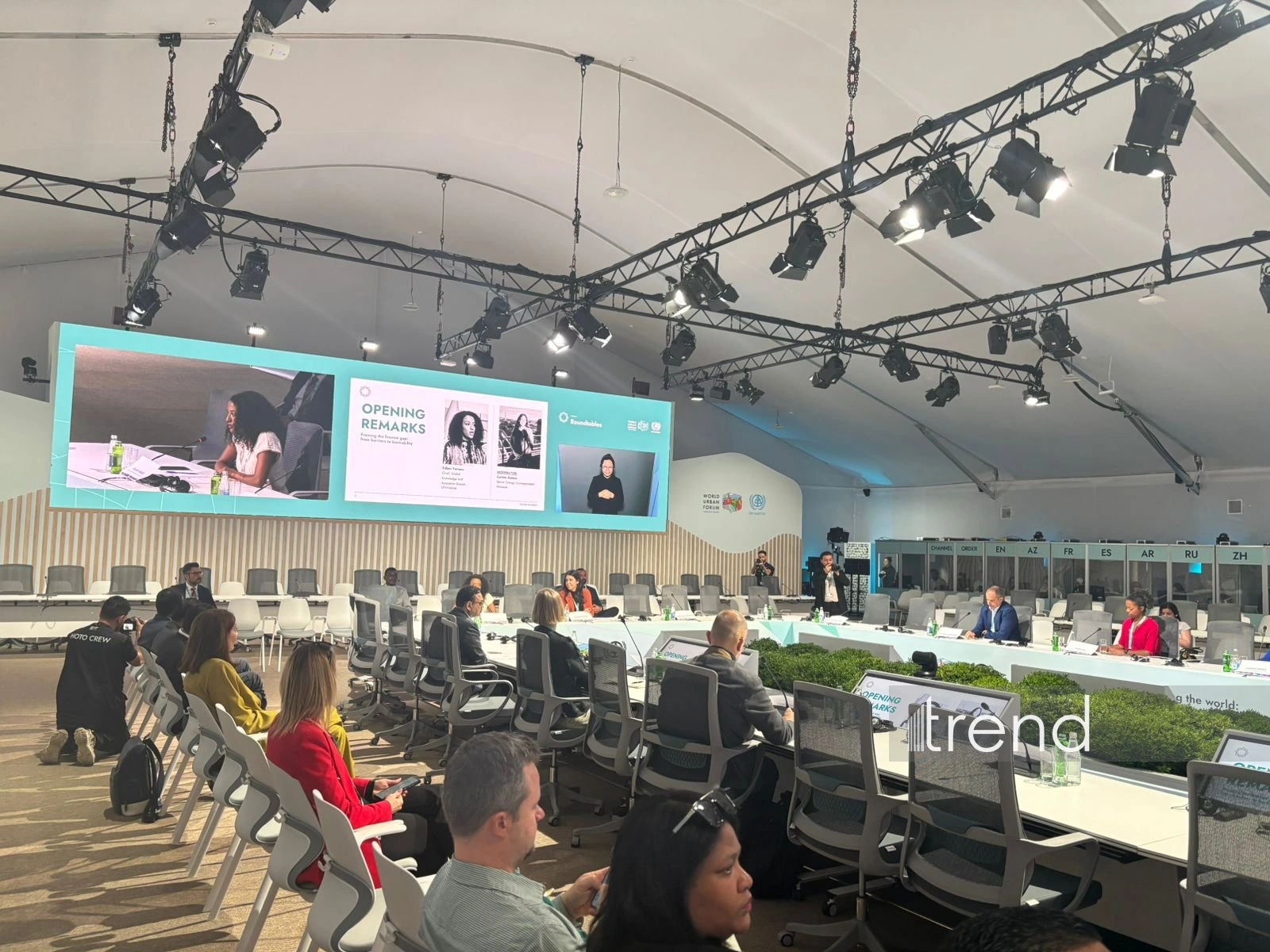
BAKU, Azerbaijan, May 20. A business roundtable
is being held during the World Urban Forum (WUF13) to discuss
ensuring affordable housing for all through the lens of long-term
investment, asset sustainability, and the management of
construction and investment risks, Trend reports.
The session brings together investors, developers, financial
institutions, public sector representatives, international
financial organizations, and experts in urban development.
Participants are discussing how housing finance can simultaneously
provide stable returns for investors and sustainable, high-quality
housing solutions for the population.
Particular attention is paid to creating favorable conditions
for investment and the interplay of key factors - risk level,
expected returns, the regulatory environment, and sustainability
requirements - at all stages of the housing construction cycle.
The impact of climate risks on underwriting processes, insurance
availability, operating costs, and asset valuation is examined
separately.
The discussion also focuses on the question of when investments
in sustainability increase the long-term returns of projects
without reducing their economic attractiveness, while maintaining
housing affordability, especially in well-located urban areas.
The session draws on the experience of leading international
housing finance platforms and examines three key areas that shape
investment decisions: the predictability of the investment
environment, the development of public-private partnerships, and
the scaling up of financial models that combine affordability,
sustainability, and commercial viability.
Innovative financial instruments are discussed separately,
including blended finance mechanisms, guarantees, social bonds, and
public-private partnership models capable of supporting the
implementation of sustainable housing in both the formal and
informal sectors.
The discussion also examines private investors’ expectations of
government agencies—specifically regarding the predictability of
urban planning, infrastructure provision, and risk allocation.
The goal of the roundtable is to identify where private capital
is already flowing into the housing sector, which factors remain
key barriers for investors, and what changes in policy, financial
instruments, and partnership models could unlock the potential for
large-scale private investment in affordable and sustainable
housing.
Today, the fourth day of the WUF13 conference is taking place in
Baku.
The first day included a ministerial meeting dedicated to the
New Urban Agenda, a ministerial roundtable, assemblies for women
and civil society, business sessions, and discussions on urban
prosperity. An official ceremony marking the raising of the UN and
Azerbaijani flags also took place.
The second day stood out for the inaugural Leaders' Summit,
featuring high-level discussions on the global housing crisis,
urbanization policy, and urban resilience. Concurrently, the
opening of the Mexico City pavilion took place, serving as a
significant platform for expanding cooperation with the Latin
American region and preparing for WUF14.
The third day of WUF13 featured a comprehensive program of
events covering the global housing crisis, the formation of safe
and inclusive cities, climate resilience, artificial intelligence
and urban governance, green urbanization, social equity, and
sustainable transport.
WUF13, which has attracted more than 40,000 registered
participants from 182 countries, will continue until May 22. Held
under the theme “Housing the world: Safe and resilient cities and
communities,” the forum brings together governments, international
organizations, experts, and representatives of civil society to
strengthen global cooperation in the field of sustainable urban
development.
Will be updated