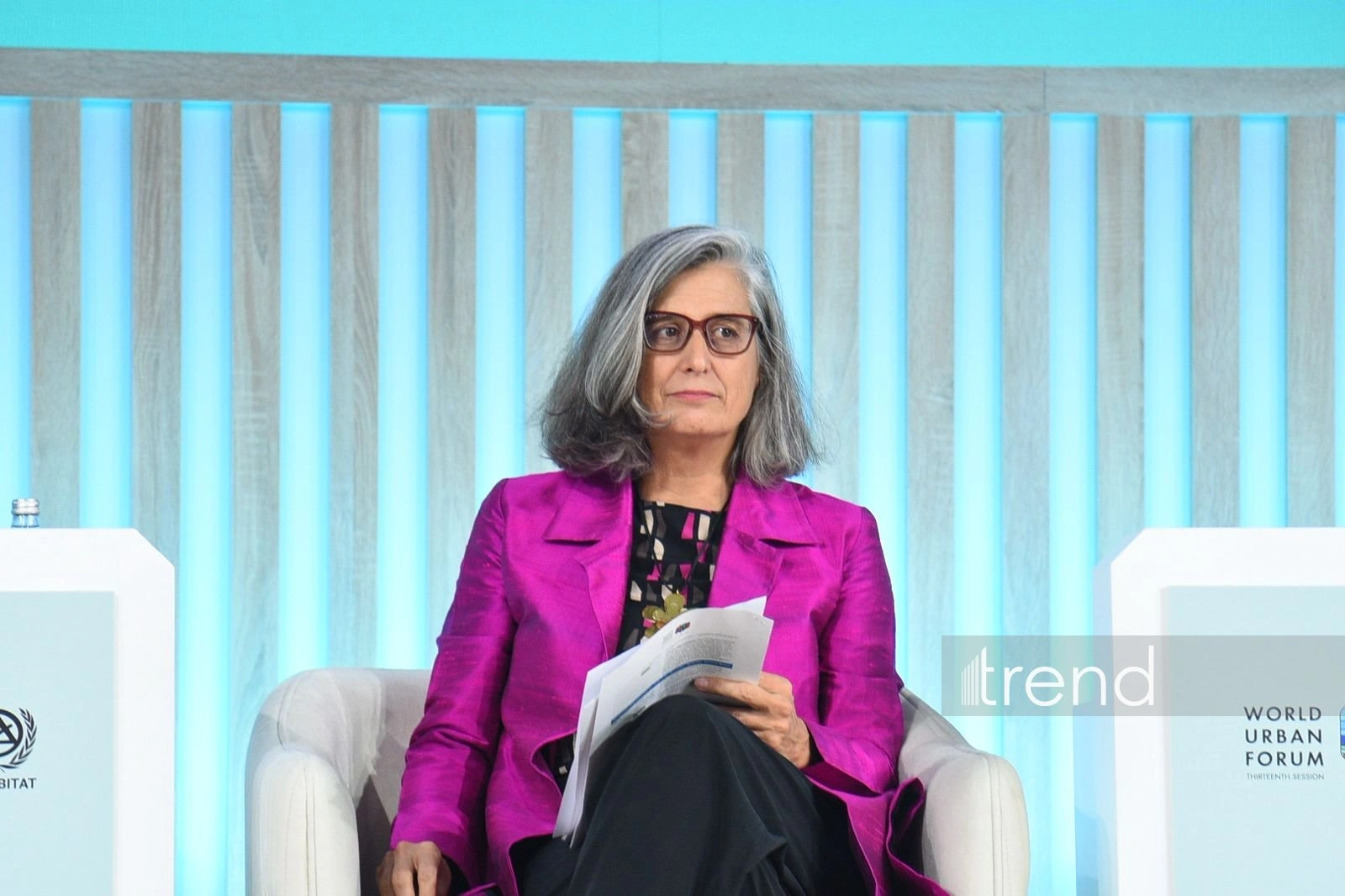
BAKU, Azerbaijan, May 20. Over four million
people worldwide live in slums, Executive Director of the United
Nations Human Settlements Program (UN-Habitat) Anacláudia Rossbach
said at the event "Transforming Informal Settlements and Slums for
Housing the World" within the framework of the 13th session of the
World Forum of Cities (WUF13) in Baku, Trend reports.
"I lived in a slum in Brazil. I dedicated a period of my life to
solving problems in this direction," she recalled.
According to her, millions of people in Africa and South Asia
are facing this problem.
"Currently, a large number of people in the world suffer from
the problem of slums. They do not have the most basic services such
as toilets, electricity, and gas. People have difficulty finding
clothes and jobs. All this creates serious social problems.
Health problems are directly related to informal settlements.
Climate change and slums are closely related issues. More than four
million people around the world live in slums. The current
situation is critical. Therefore, we must work to reduce the number
of slums. State policy alone is not enough. An integrated, complex
framework must be formed for this. Azerbaijan is already supporting
Somalia in this direction. It's working to transform the slums in
Somali into living quarters," she noted.
Today marks the fourth day of WUF13 in Baku.
The first day included a ministerial meeting dedicated to the
New Urban Agenda, a ministerial roundtable, assemblies for women
and civil society, business sessions, and discussions on urban
prosperity. An official ceremony marking the raising of the UN and
Azerbaijani flags also took place.
The second day stood out for the inaugural Leaders' Summit,
featuring high-level discussions on the global housing crisis,
urbanization policy, and urban resilience. Concurrently, the
opening of the Mexico City pavilion took place, serving as a
significant platform for expanding cooperation with the Latin
American region and preparing for WUF14.
The third day of WUF13 featured a comprehensive program of
events covering the global housing crisis, the formation of safe
and inclusive cities, climate resilience, artificial intelligence
and urban governance, green urbanization, social equity, and
sustainable transport.
WUF13, which has attracted more than 40,000 registered
participants from 182 countries, will continue until May 22. Held
under the theme “Housing the world: Safe and resilient cities and
communities,” the forum brings together governments, international
organizations, experts, and representatives of civil society to
strengthen global cooperation in the field of sustainable urban
development.