BAKU, Azerbaijan, May 20. The gradual return of
the population to the liberated territories of Azerbaijan has a
significant impact on reducing the burden on housing provision in
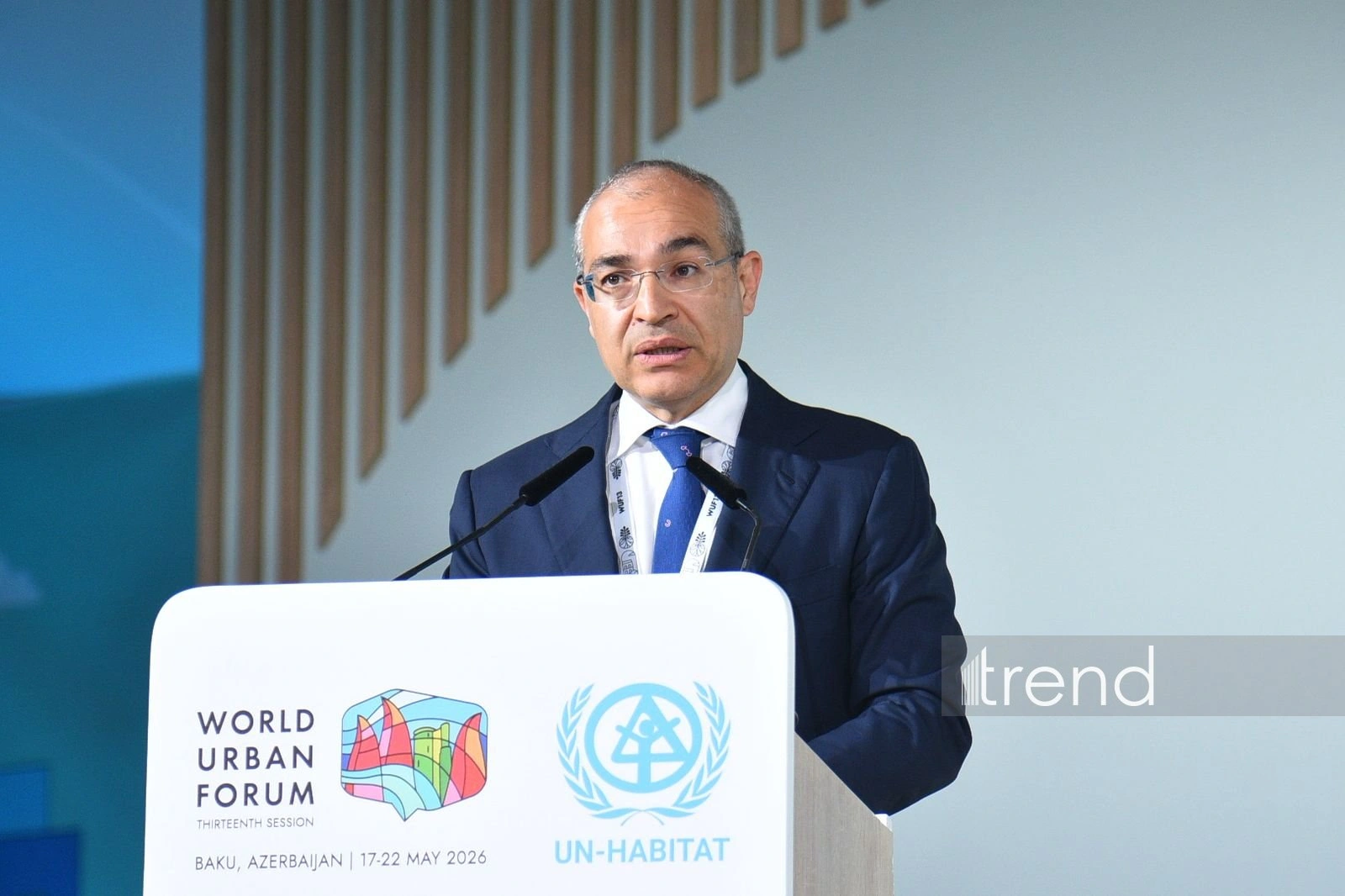
the country, the Minister of Economy Mikayil Jabbarov said at the
event "Transforming Informal Settlements and Slums for Housingthe
World" within the framework of the 13th session of the World Forum
of Cities (WUF13) in Baku, Trend reports.
According to him, in recent years, the procedures for accepting
multi-apartment residential buildings into operation have been
further simplified, and amnesty mechanisms have been introduced for
some informal structures that comply with the basic requirements of
urban planning norms.
"Although the legalization of illegal structures supports the
elimination of certain social problems, this process may create new
challenges in the long term. In this regard, a balanced and
cautious approach to the issue of legalization is of particular
importance because although granting a broad amnesty to
unauthorized structures serves to solve short-term social needs, it
may stimulate an increase in illegal construction in the future. As
a result, risks such as weakening control over land use and
increasing pressure on agricultural lands, forest areas, water
resources, and strategic infrastructure zones may arise," he
explained.
The minister noted that during the Soviet period, informal
settlements (slums) existed to some extent, but were not recognized
by the state.
According to him, this process was accompanied by the occupation
of Azerbaijani territories, the constant growth in the number of
refugees, the situation of the Azerbaijani ethnic community who
lived in Armenia, as well as the problem of internally displaced
persons from the occupied territories of Azerbaijan. Despite the
demographic boom, the population increased from 7 million to 10
million in the following years. One in every 8 people in Azerbaijan
was a refugee or internally displaced person. The country was
facing serious socio-economic difficulties, and until the end of
the 1990s, solving these problems was one of the main
priorities.
Since 2003, the country's economy has undergone a process of
stabilization. Tent camps have already been abolished, and at the
same time, attention has also begun to be paid to the issue of
classic informal settlements.
"The processes that took place over the next decade led to
social migration. In particular, economic difficulties accelerated
this process. The period from 2003 through 2020 was the next stage
of development. Since 2020, the Great Return process has begun.
Large-scale construction and restoration work is being carried out
in the liberated territories.
What conclusions have we drawn? We believe that the problem
needs to be properly recognized. In addition to understanding the
problem, ways to solve it must also be identified. Complex
solutions should be put forward here in political, social, and
economic aspects. The main will and goal of the state are aimed at
solving these problems," he added.
Today marks the fourth day of WUF13 in Baku.
The first day included a ministerial meeting dedicated to the
New Urban Agenda, a ministerial roundtable, assemblies for women
and civil society, business sessions, and discussions on urban
prosperity. An official ceremony marking the raising of the UN and
Azerbaijani flags also took place.
The second day stood out for the inaugural Leaders' Summit,
featuring high-level discussions on the global housing crisis,
urbanization policy, and urban resilience. Concurrently, the
opening of the Mexico City pavilion took place, serving as a
significant platform for expanding cooperation with the Latin
American region and preparing for WUF14.
The third day of WUF13 featured a comprehensive program of
events covering the global housing crisis, the formation of safe
and inclusive cities, climate resilience, artificial intelligence
and urban governance, green urbanization, social equity, and
sustainable transport.
WUF13, which has attracted more than 40,000 registered
participants from 182 countries, will continue until May 22. Held
under the theme “Housing the world: Safe and resilient cities and
communities,” the forum brings together governments, international
organizations, experts, and representatives of civil society to
strengthen global cooperation in the field of sustainable urban
development.