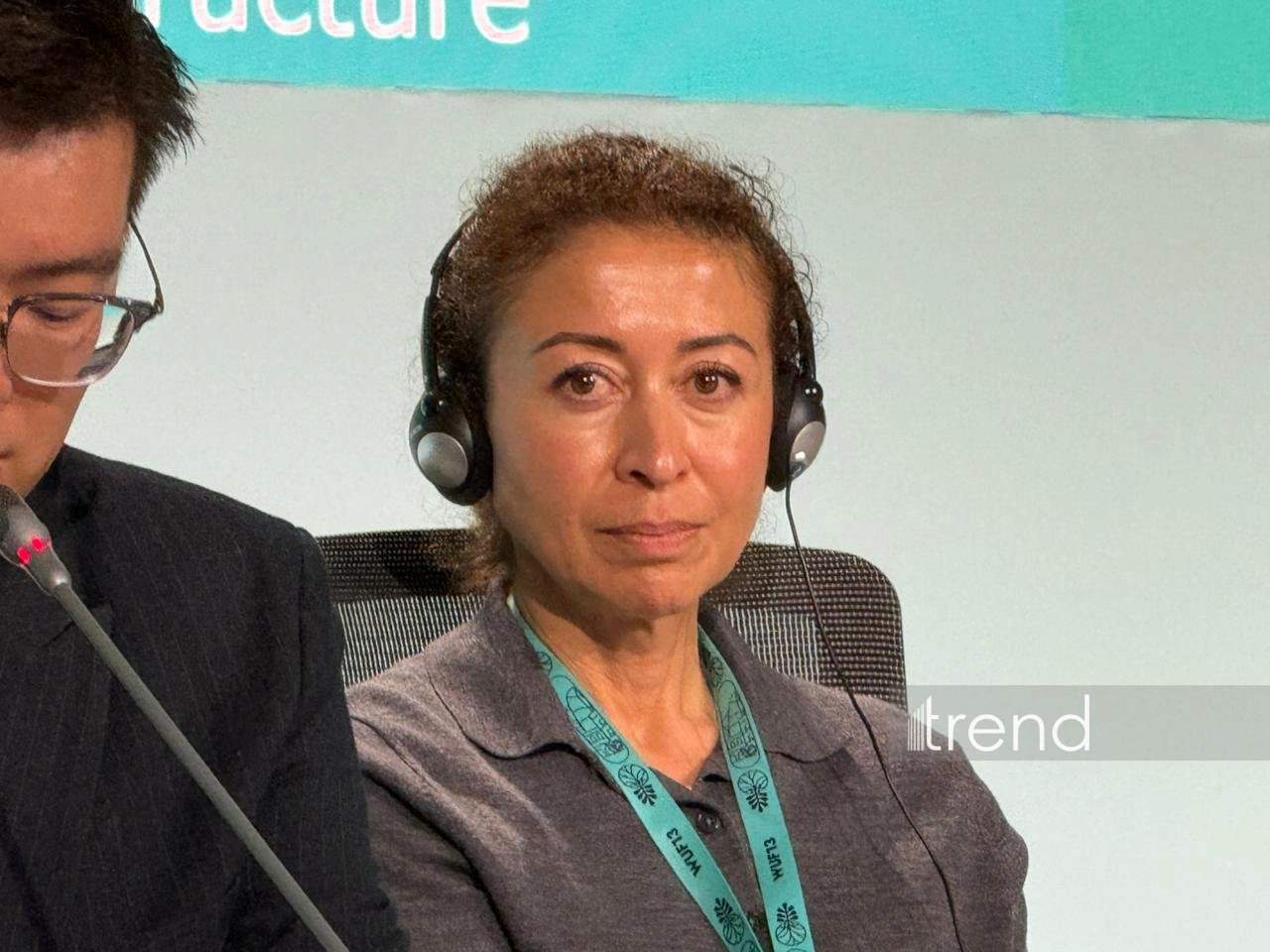
BAKU, Azerbaijan, May 17. There is still
substantial growth potential in terms of direct investments by
German companies into Azerbaijan, and a certain level of interest
already exists among foreign investors looking at infrastructure
and construction projects, Nargiz Uiek, Executive Director of the
German-Azerbaijani Chamber of Commerce (AHK Azerbaijan), said
during the Business Assembly session titled "Private Sector
Leadership Across the Housing Value Chain: Delivering Results
Against the Odds," held within the framework of WUF13 in Baku,
Trend reports.
She stated that compliance requirements and risk-sharing issues
faced by foreign companies in their home countries also remain
significant factors.
"I see serious opportunities for investment in Azerbaijan. This
view was further strengthened particularly after my recent trip to
the Karabakh region. We are witnessing massive state-led
restoration and reconstruction work being carried out in Karabakh.
Currently, about 30 percent of the territories have been cleared of
landmines, and urbanization is being implemented precisely in these
areas. The notable point here is that this model works if the
planning is conducted in the form of 'smart villages' or urban
development from scratch. In other words, the system operates
effectively when there is strong interest from the state,
utilities, investors, and developers," Uiek said.
She added that the real challenge arises in upgrading existing
infrastructure, namely within decarbonization processes.
"In terms of technology, investors show great interest in
renewable energy solutions, battery storage systems, and
decentralized energy models as a whole. The problem is no longer
whether the technology exists—it does. The main question is: how
are these technologies integrated into the overall project system?
It is not about bringing in isolated solutions, but rather
incorporating them into a unified project planning framework," the
executive director explained.
She emphasized that the industrial potential of cities is also a
crucial factor.
"Critical criteria for investors include whether a city
possesses industrial infrastructure and whether it is feasible to
establish decarbonized industrial zones. Alongside this, digital
infrastructure and the interconnectedness of urban services
represent key directions. Overall, several critical factors exist
for investors. First and foremost are bankable projects—meaning
that the return on investment, profitability, and risk profile must
be clear. Risk-sharing carries particular importance. A
public-private partnership (PPP) model is needed for urban
development. Another vital issue is the speed of permitting
processes—how quickly the approvals required to start a project can
be obtained. Finally, regional connectivity comes to the forefront.
The visibility of projects and the ability to source resources like
energy within or outside the region must be more flexible. For this
reason, regional cooperation is highly significant in the Caucasus
and Central Asia region," Uiek concluded.