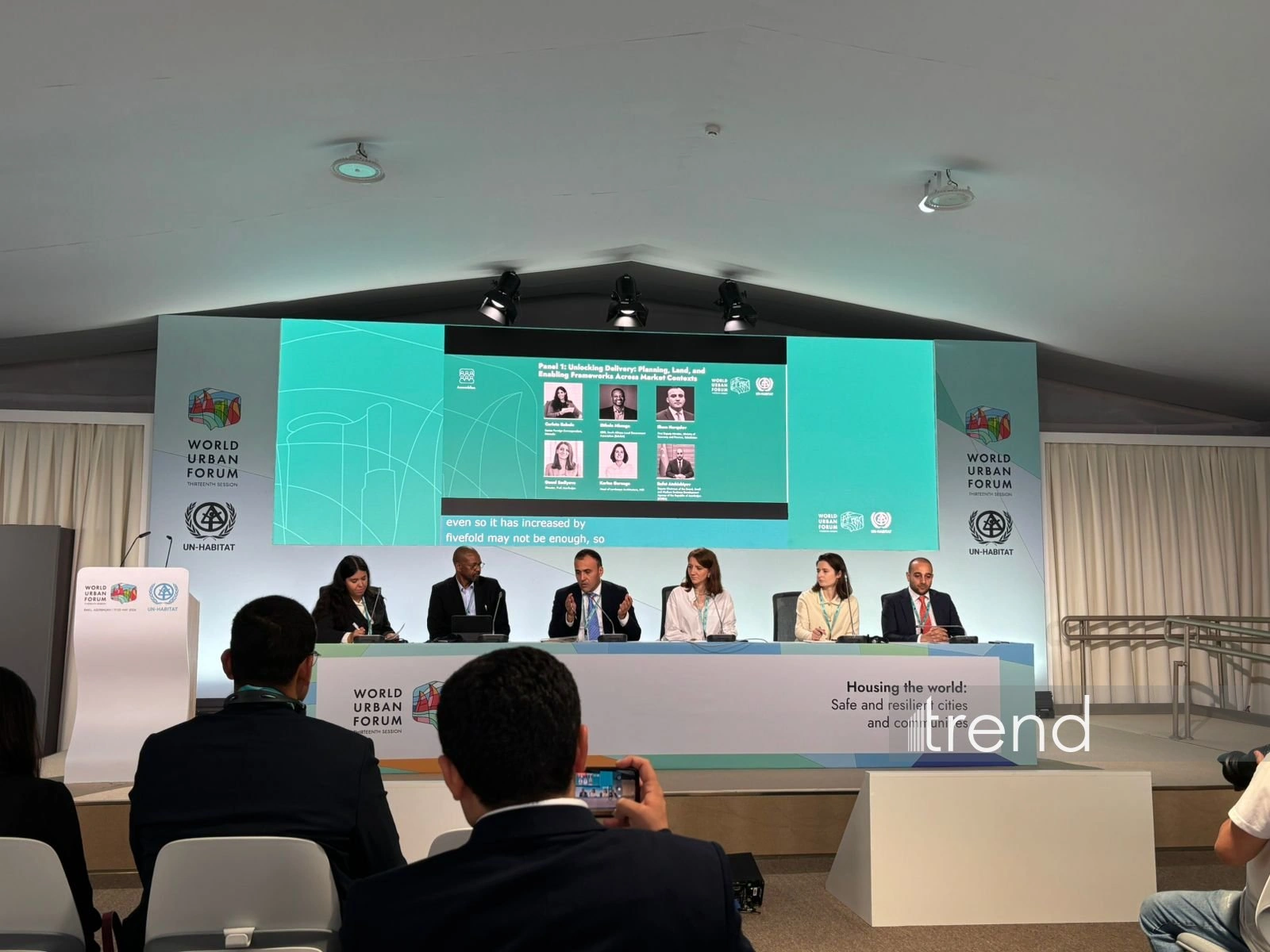
BAKU, Azerbaijan, May 17. Uzbekistan has
significantly accelerated its housing construction volumes in
recent years while fundamentally restructuring its mortgage market
to expand public access to affordable housing and build a resilient
financial ecosystem, Ilkhom Norkulov, First Deputy Minister of
Economy and Finance of the Republic of Uzbekistan, said, Trend reports.
He made the remark during a Business Assembly session dedicated
to Public-Private Partnerships (PPP) held within the framework of
the 13th session of the World Urban Forum (WUF13) in Baku.
According to the deputy minister, following systemic structural
reforms launched in 2017, annual residential construction outputs
in Uzbekistan skyrocketed more than fivefold—surging from an
average of 15,000–20,000 apartments per year to over 100,000
apartments last year. For the current year, the government projects
the construction of more than 140,000 housing units.
However, Norkulov noted that despite this aggressive expansion,
construction paces are still working to catch up with rapid
demographic growth. With approximately 1 million births annually
and around 270,000 new families forming each year, the country
faces a sustained, long-term demand for residential real
estate.
The deputy minister emphasized that engineering an efficient,
sustainable mortgage market remains a primary macroeconomic
challenge for developing nations. While Uzbekistan successfully
extended maturity terms for mortgage loans from 10 to 20 years to
ease the monthly financial burden on borrowers, further structural
reforms remain critical.
Previously, the country's housing finance system relied heavily
on centralized administrative mechanisms, where the state directly
allocated targeted funds to commercial banks, often causing market
distortions.
"In the course of our ongoing reforms, Uzbekistan has
successfully transitioned to a market-driven model with the active
participation of international financial institutions and
commercial banking entities," Norkulov explained.
"Under this new framework, the state provides commercial banks
with long-term liquidity at a rate closely aligned with the Central
Bank's key policy rate. Banks then add their own commercial margin,
establishing a true market-based mortgage rate. To ensure
affordability, we have also introduced down-payment subsidies and
targeted support mechanisms for lower-income households," he
added.
Norkulov highlighted that the state currently injects
approximately $1 billion annually into the banking sector to shore
up mortgage lending liquidity. Notably, private banking resources
now account for about 50 percent of the total mortgage market
volume.
"These comprehensive reforms have fostered a highly competitive
environment among construction firms, while granting citizens the
freedom to select housing across various regions of the country
using a balanced mix of state subsidies and market-rate mortgage
instruments," the deputy minister concluded.