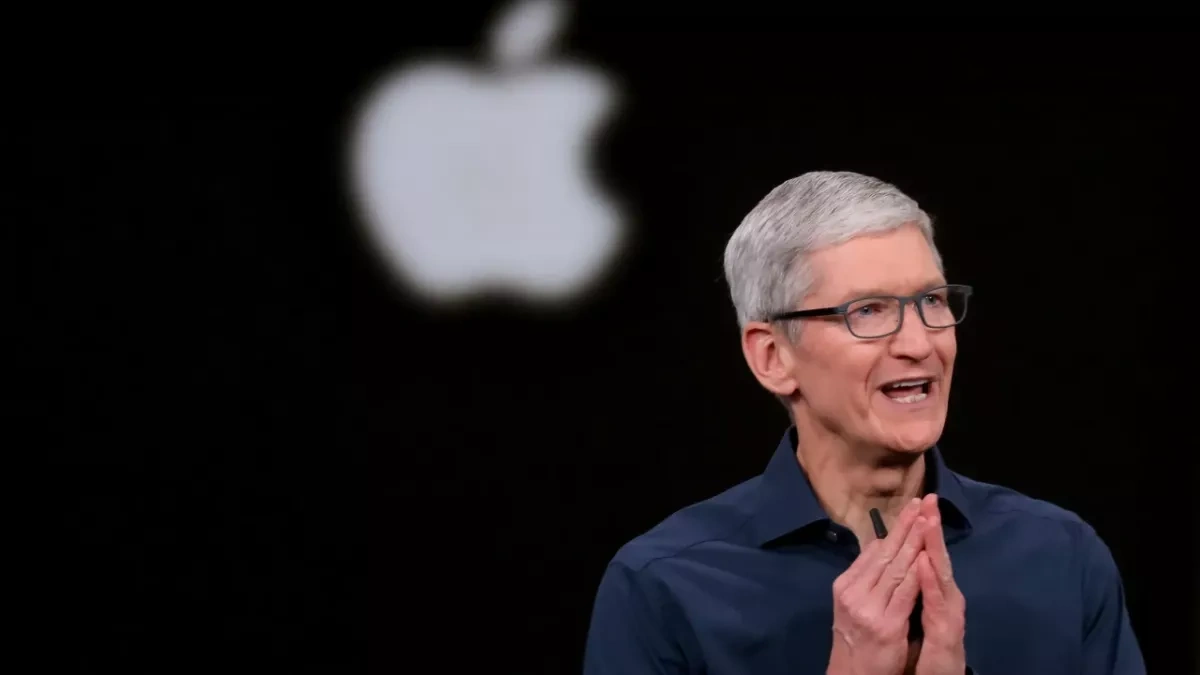
After 15 years at the helm of Apple, Tim Cook is stepping down as chief executive, marking the end of an era in which the company cemented its position as one of the world’s most valuable and influential technology groups.
He will remain as executive chair, while John Ternus, Apple’s senior vice-president of hardware engineering, will succeed him as CEO, Caliber.Az reports via foreign media.
Cook’s departure closes a tenure that saw Apple evolve from a successful consumer electronics firm into a global hardware-and-services ecosystem spanning hundreds of millions of users. He joined Apple in 1998, became chief operating officer overseeing global supply chains, and took charge of day-to-day operations in 2009 when co-founder Steve Jobs went on medical leave. In 2011, shortly before Jobs’ death, Cook formally became CEO.
In Apple’s announcement, Cook said he loves the company “with all of my being” and that leading it was the “greatest privilege of my life”. In a farewell message to customers, he added that he feels “a gratitude that I cannot put into words”.
Under Cook, Apple expanded and consolidated its product ecosystem, scaling the iPhone, iPad and Mac businesses while launching wearables such as Apple Watch and AirPods, alongside services including Apple Pay, Apple Music and Apple TV.
The company also achieved unprecedented financial growth, becoming the first publicly listed firm to reach a $1 trillion valuation and expanding from roughly $350 billion in 2011 to about $4 trillion today.
“Steve Jobs was never going to be an easy act to follow,” said Dipanjan Chatterjee, a principal analyst at Forrester. “Yet Tim Cook took Jobs’ legacy and transformed Apple into a durable, resilient financial powerhouse with explosive market-cap growth.”
Cook’s leadership style differed markedly from that of Jobs, emphasising operational discipline and ecosystem integration over product-stage theatrics.
“After a lot of initial questions about an operations guy becoming CEO, Tim Cook unquestionably brought Apple into a new era that was driven by his vision to build a connected ecosystem of billions of devices,” said Bob O’Donnell, president and chief analyst at Technalysis Research.
“He didn’t need to know exactly what products were required, but he did understand the interconnectedness of it all and that, ultimately, is what brought Apple to where it is today.”
However, Apple has faced criticism in recent years for lagging in generative artificial intelligence and for mixed results in new hardware categories, including the Vision Pro headset and its delayed push into foldable smartphones. The company also abandoned its autonomous vehicle project after years of development.
Despite these setbacks, Cook’s tenure is widely viewed as one of sustained expansion and operational stability. “While Cook has kept Apple’s growth trajectory moving at a steady clip, he has not overseen a step-change innovation that would reset Apple’s competitive position for the next two decades, as Jobs did with the iPhone,” Chatterjee said.
“Cook’s legacy will be defined by steady, disciplined operational stewardship–proof that a company can be more than just exciting and visionary; it can also be immensely valuable to all its stakeholders.”
By Aghakazim Guliyev