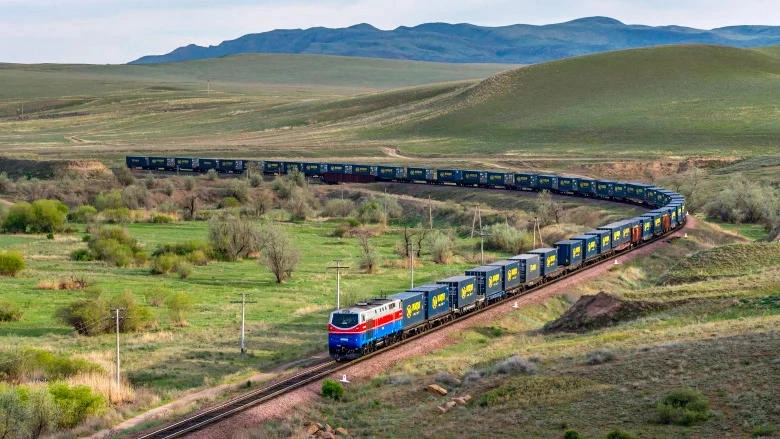
BAKU, Azerbaijan, March 16. The Middle Corridor
may become a key alternative for container transport if the Strait
of Hormuz, a strategic maritime chokepoint, is closed, Ziya
Mammadov, deputy head of the Marketing and Tariff Policy Department
at Azerbaijan Railways, wrote on his social media account, Trend reports.
Mammadov highlighted that disruptions in the Strait could delay
supply chains connecting Asia, the Middle East, and Europe while
raising logistics costs.
“In such a scenario, alternative multimodal routes gain
importance. One of them is the Middle Corridor, linking China and
Central Asia to Europe,” Mamedov noted.
Container transport along the Middle Corridor typically combines
rail and maritime segments, including a 4,256 km rail route through
Central Asia, an approximately 508 km maritime crossing of the
Caspian Sea, and a railway connection through the South Caucasus to
Türkiye and Europe.
“Critical regional infrastructure, such as the Port of Baku,
plays a central role in supporting multimodal container flows
across the Caspian region. The port currently handles around 15
million tonnes of cargo annually. A new phase of development is
underway, which, once completed, will expand its capacity to 25
million tonnes per year and allow for the handling of up to 500,000
TEU containers annually,” the report notes.
While maritime transport remains dominant in global container
trade, potential disruptions at strategic chokepoints like the
Strait of Hormuz underscore the growing importance of alternative
logistics routes. In this context, the Middle Corridor is gradually
emerging as a vital overland Eurasian route for container
shipping.
The Middle Corridor is a transport trade route passing through
several countries in the region and connecting Asia with Europe. It
serves as an alternative to the traditional Northern and Southern
corridors.
The route begins in China and passes through Central Asian
countries such as Kazakhstan, Uzbekistan, and Turkmenistan. It then
crosses the Caspian Sea, Azerbaijan, Georgia, and Türkiye before
reaching Europe. The Middle Corridor is a land-based route that
bypasses longer maritime paths, linking eastern parts of Asia,
including China, with Europe.
Stay up-to-date with more news on Trend News
Agency's WhatsApp channel