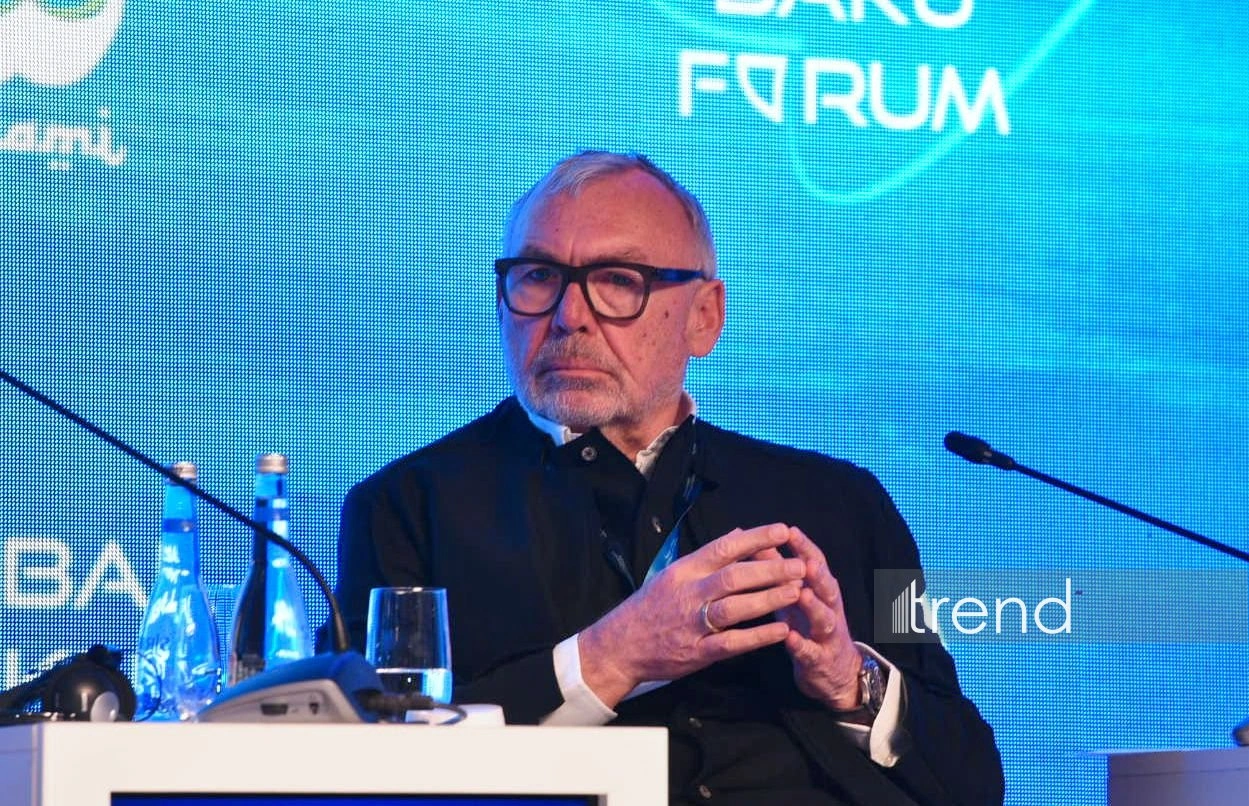
BAKU, Azerbaijan, March 12. Peace must be based
on legitimacy and the inviolability of borders, Former Federal
Chancellor of Austria Alfred Gusenbauer said at the panel titled
"Global security and balance of power: respect for international
law—new issues, new challenges" within the framework of the 13th
Global Baku Forum today, Trend reports.
"American strategic thinking focuses on agreements and
incentives, while conflicts are managed by creating workable
frameworks within which each side stands to gain more from
stability than from escalation," he noted.
According to Husenbauer, the primary focus in European thought
revolves around law, sovereignty, and integrity.
"Legitimacy and the inviolability of borders are foundational
concepts for peace, as their violation gives rise to instability.
Therefore, a lasting agreement for Europe is not limited to the
cessation of hostilities. It also requires a solution that respects
international law and the right of states to self-determination. In
contrast, Russian thinking takes a different approach. It focuses
on cultural elements, prestige, recognition, and strategic buffer
zones. Security is determined more by the degree to which other
powers accept Russia's status and influence than by legal
frameworks," he explained.
Gusenbauer pointed out that China is largely a mix of Russian
and European approaches but is less influenced by the American
model. The Chinese approach seems to be almost a combination of the
Russian and European models.
"When you compare these three concepts, the source of the main
tensions becomes clear because the American model believes that
incentives for national interests can shape the behavior of states.
The European model, on the other hand, accepts that stability is
derived from legal norms and sovereign equality. The Russian model
believes that security comes from power, recognition, and control
over the surrounding space," he said.
The politician emphasized that this is exactly the situation
observed in the discussions on Ukraine. The U.S. and Russia seem to
be closer to an agreement than Europe, and this is mainly due to
different frames of mind regarding the concept of security.
"Of course, in addition to differences in security concepts,
there is another situation at the moment. I'm not trying to judge
the current governments. However, looking at the U.S. national
security strategy and the statements of President Vladimir Putin,
one gets the impression that the common rival of both is the
European Union because the European Union seems to be the last
beacon of liberal democracy," he mentioned.
In his opinion, the mainstay of liberal democracy is currently
the European Union.
Stay up-to-date with more news on Trend News
Agency's WhatsApp channel