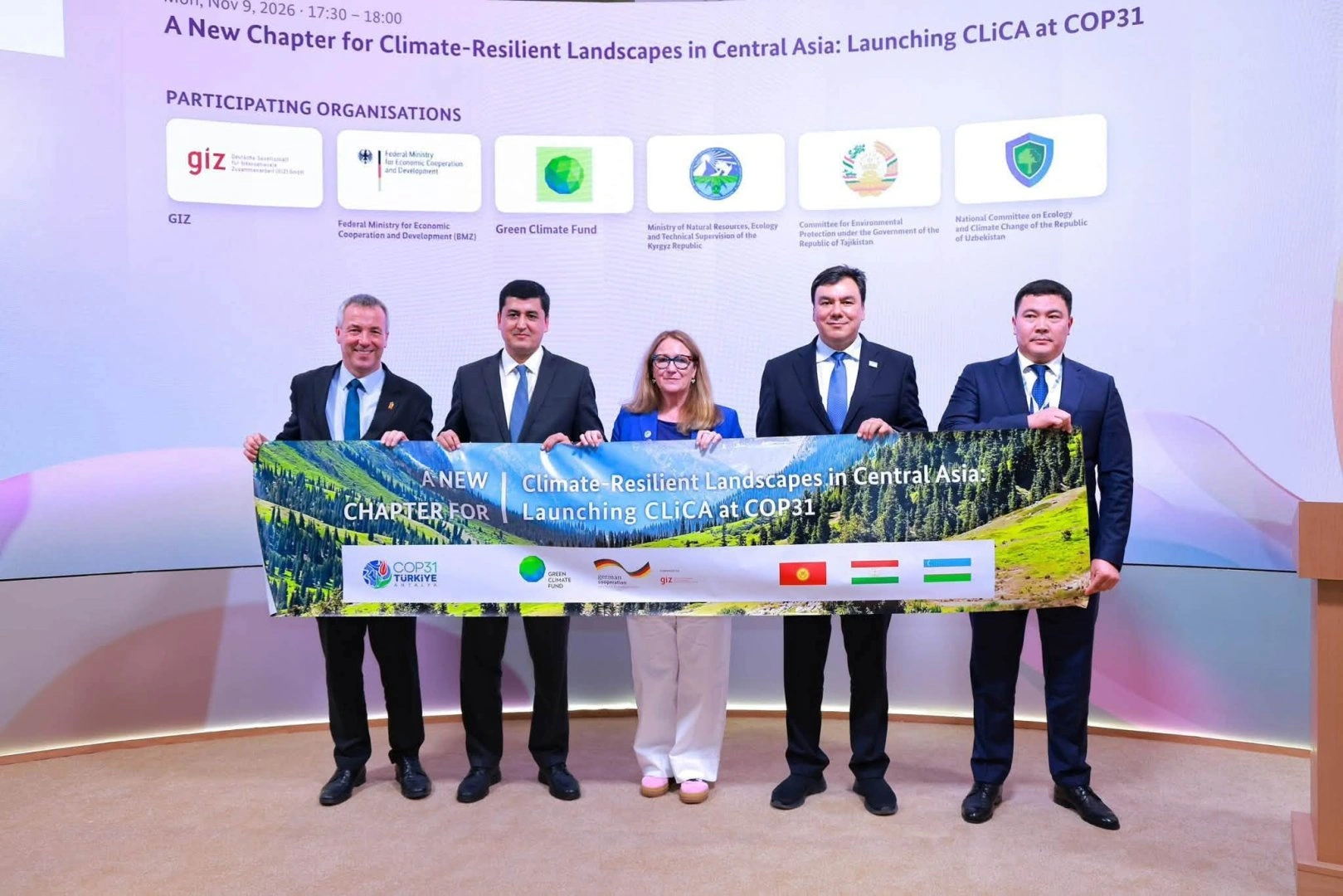
BAKU, Azerbaijan, November 16. Tajikistan,
Kyrgyzstan and Uzbekistan have launched a regional program to
restore degraded landscapes, improve water management and
strengthen communities' resilience to climate change in Central
Asia, Tajikistan's Committee for Environmental Protection
reported.
The launch of the “Climate-resilient Landscapes in Central Asia”
program, known as CLiCA, took place on the sidelines of the 31st
Conference of the Parties to the UN Framework Convention on Climate
Change (COP31).
Chairman of the committee Bahodur Sheralizoda attended the
high-level event and reaffirmed Tajikistan's commitment to regional
cooperation on climate change, ecosystem restoration and
sustainable landscape management.
The initiative was first proposed in 2021 during discussions
with the German Agency for International Cooperation (GIZ). Its
initial development was supported through the Green Climate Fund
Readiness Programme implemented in Tajikistan with GIZ's
assistance.
The CLiCA program focuses on restoring degraded land, improving
forest and pasture management, introducing climate-smart
agricultural practices and strengthening integrated river basin
management.
Sheralizoda noted that Tajikistan faces growing climate-related
challenges, including glacier melting, changing water availability,
droughts, floods and landslides, which affect ecosystems,
infrastructure and local communities.
He also highlighted the country's updated Nationally Determined
Contribution, which sets targets for reducing greenhouse gas
emissions by 10% by 2030 and 15% by 2035 compared with 1990 levels.
With sufficient financial and technological support, these targets
could reach 25% and 40%, respectively.
The committee estimated that implementing the measures under
Tajikistan's NDC 3.0 for 2026-2035 would require $20-22.5 billion,
depending on the implementation scenario.
The program's priority areas include coordinating investment in
landscape restoration and sustainable water management, as well as
developing systems to assess improvements in ecosystem health,
water access and local living conditions.