BAKU, Azerbaijan, November 11. Uzbekistan
intends to increase the share of electricity generated from
renewable energy sources (RES) to 54% over the next four years,
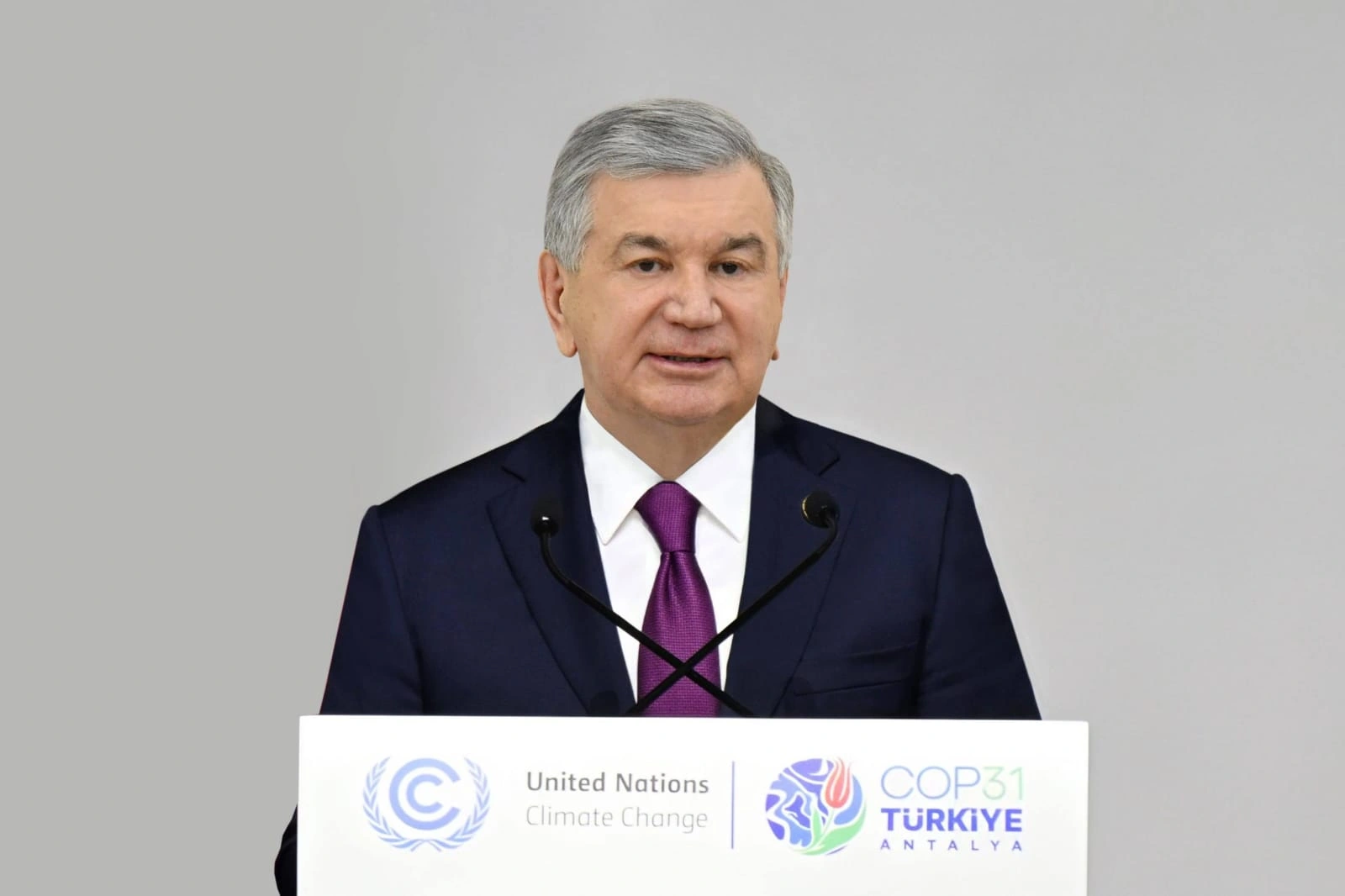
President Shavkat Mirziyoyev said at the 31st session of the
Conference of the Parties to the United Nations Framework
Convention on Climate Change (COP31), held in Antalya, Türkiye, on
November 11.
According to the press service of the President of Uzbekistan,
Mirziyoyev noted that the country is consistently developing a new
development model based on the rational use of natural resources
and the introduction of green technologies.
He said that Uzbekistan had achieved its previous target of
reducing greenhouse gas emissions per unit of GDP by 35% ahead of
schedule. The country has now set a new target of reducing this
indicator by 50% by 2035.
The President emphasized that increasing green energy generation
is essential to ensuring a balance between economic development and
environmental protection.
Particular attention in his address was devoted to the rational
use of water resources. Over the past ten years, the water
intensity of Uzbekistan's economy has nearly halved, while water
withdrawals have decreased by one-fifth. The introduction of
water-saving technologies has already covered more than 60% of
irrigated land.
Starting in 2027, Uzbekistan will assume the chairmanship of the
International Fund for Saving the Aral Sea (IFAS). Mirziyoyev
stated that the country intends to fulfill this important mission
at the highest level, with particular emphasis on transboundary
basin management.
As part of its land restoration efforts, Uzbekistan has
increased the area of forest plantations by 6 million hectares.
One-third of the newly planted areas are located in the Aral Sea
region.
In addition, Uzbekistan is implementing a Waste Management
Strategy, under which investment is expected to exceed $3
billion.
Mirziyoyev also identified environmental education for young
people as one of the priorities of state policy. According to him,
fostering a responsible attitude toward nature begins in the
family, mahalla (local community), and school, where children are
taught from an early age to conserve water, care for trees, and
keep their surroundings clean.
The President noted that one in every five people in the country
is a school pupil or university student. Thanks to a systematic
approach, three-quarters of Uzbekistan's population are expected to
receive nature-oriented education by 2050.
Thus, the country's environmental policy encompasses not only
the development of renewable energy and emissions reduction, but
also water conservation, land restoration, waste management, and
environmental education.