BAKU, Azerbaijan, October 29.
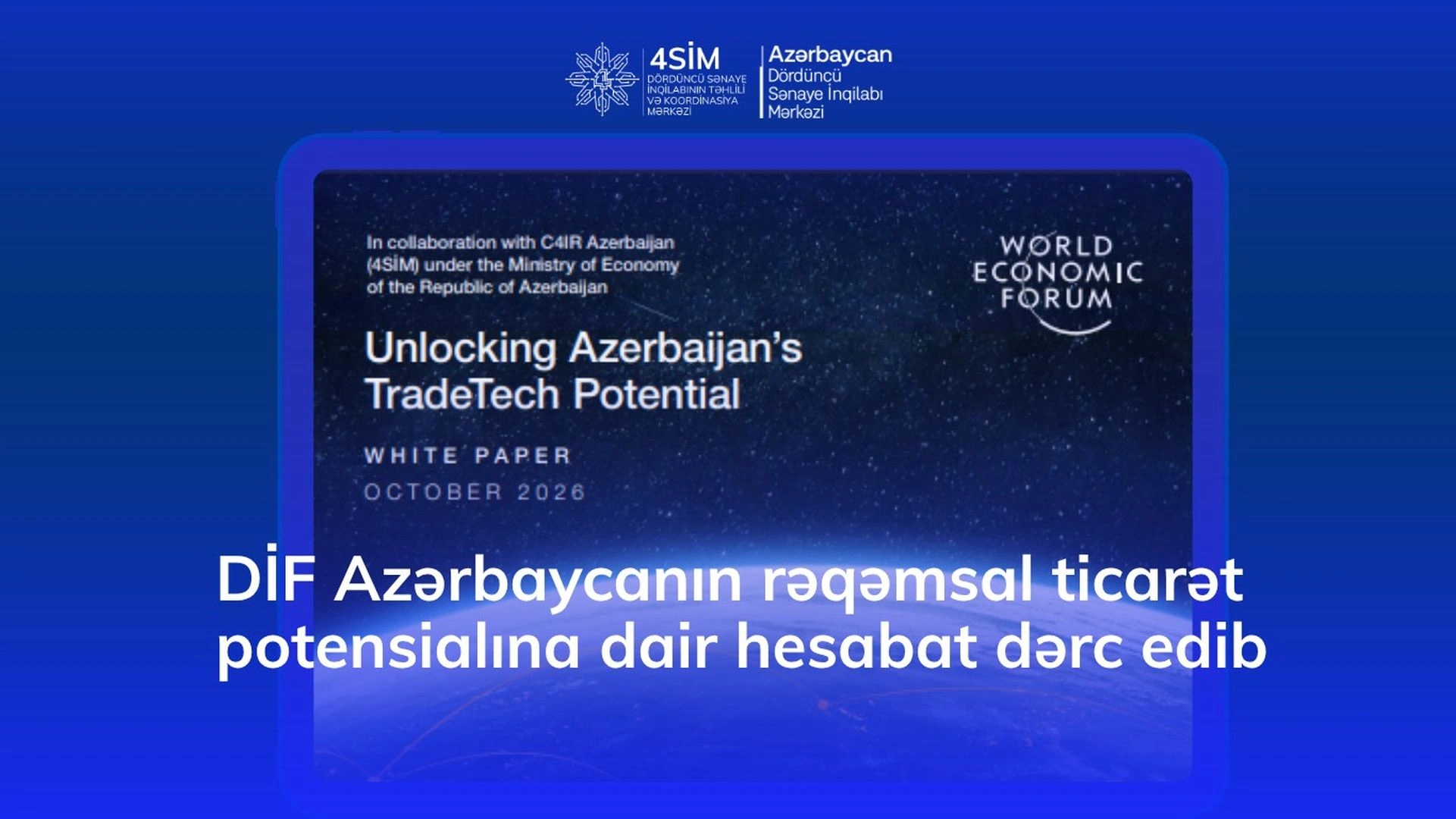
A report titled "Unlocking Azerbaijan’s TradeTech Potential," which
explores development opportunities for Azerbaijan’s digital trade
ecosystem, has been published through the collaboration between the
World Economic Forum (WEF) and the Center for the Analysis and
Coordination of the Fourth Industrial Revolution (C4IR) under the
Ministry of Economy.
The report presents the findings of an extensive analysis
conducted in Azerbaijan as part of the WEF’s "TradeTech"
initiative. It assesses the country’s existing capabilities and
development trajectories in the field of digital trade, offering
recommendations on expanding the use of innovative technologies in
international trade, enhancing the efficiency of trade and
logistics processes, and facilitating access to foreign markets for
small and medium-sized enterprises (SMEs).
The analysis was carried out from July 2025 through May 2026.
During this process, consultations were held with 28 stakeholders
representing 18 organizations, and both international best
practices and the existing legal and regulatory framework were
examined. The results of the analysis were presented and discussed
at an event held in Baku on May 7, 2026, attended by
representatives from government agencies, financial institutions,
logistics companies, and the innovation ecosystem.
The report noted that significant progress has been made in
Azerbaijan regarding digital public services, electronic
signatures, the modernization of customs systems, and logistics
infrastructure. To utilize these capabilities more effectively in
international trade, key priorities have been identified: expanding
the legal recognition of electronic trade documents, strengthening
data exchange between public and private sector digital platforms,
and developing an ecosystem that supports the implementation of
innovative trade solutions.
The WEF has put forward a total of 10 recommendations across
these areas. Initial proposals include forming a national
"TradeTech" community, establishing a specialized regulatory
environment ("sandbox") for testing digital trade solutions,
organizing innovation competitions, expanding international
cooperation, and strengthening dialogue between the public and
private sectors.
In the next phase, it was recommended to align the legal
framework for electronic trade documents with international
standards, integrate existing digital trade platforms, expand
electronic invoicing and reporting tools, develop financing
opportunities for technology startups, and promote the adoption of
digital trade solutions by SMEs.
The document also highlights the connection between the
priorities of the "Strategy for the Development of the Digital
Economy in the Republic of Azerbaijan for 2026–2029" and the
"TradeTech" initiative. The report noted that the implementation of
digital trade solutions can contribute to the development of the
non-oil sector, the expansion of export opportunities, the
improvement of trade and logistics processes along the Middle
Corridor, and the strengthening of Azerbaijan's position as a
regional trade and logistics hub. The WEF’s "TradeTech" initiative
is aimed at simplifying international trade processes, reducing
costs, and expanding digital trade opportunities through the use of
artificial intelligence, blockchain, digital payments, and other
innovative technologies.
Full text of the report is available on the
World Economic Forum's official website:
https://www.weforum.org/publications/unlocking-azerbaijan-s-tradetech-potential