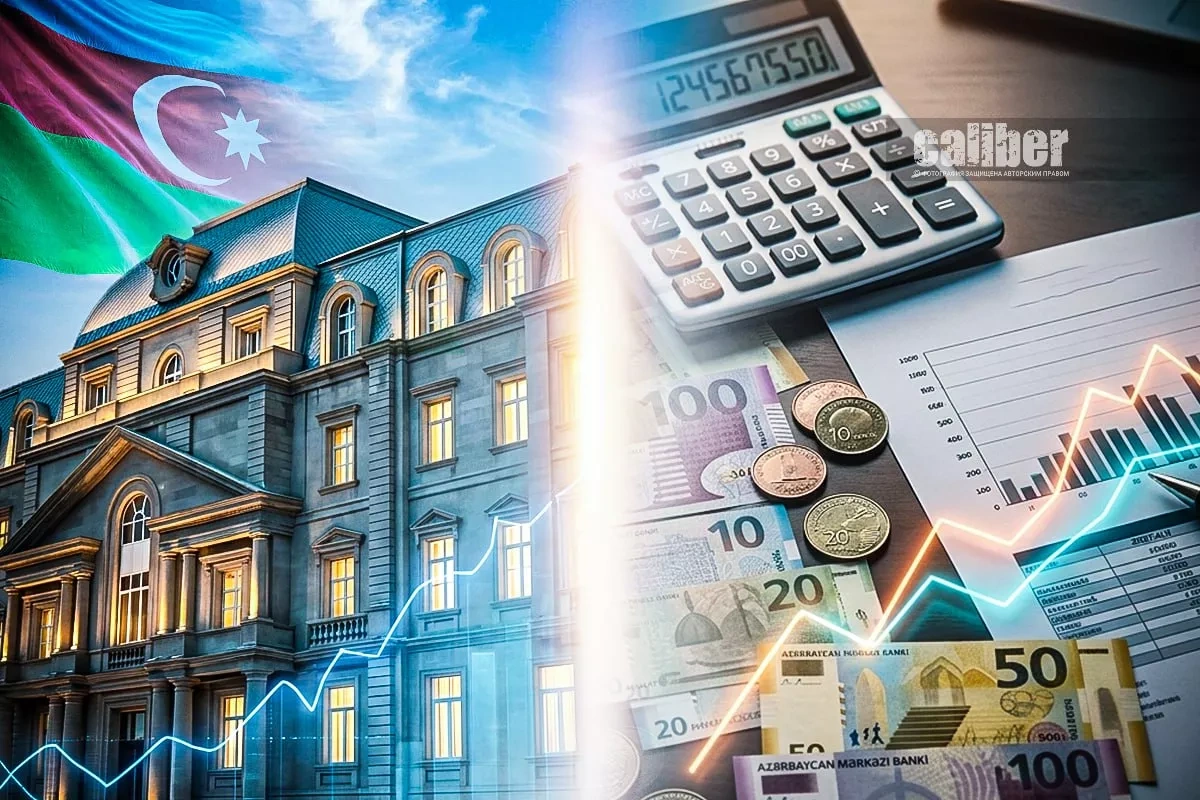
The Azerbaijani Ministry of Finance has presented preliminary forecasts for state budget revenues and expenditures for 2027. Alongside the key parameters of next year’s budget, the ministry has also provided projections for inflation and external debt, outlined the main priorities for economic development, and presented medium-term GDP growth forecasts.
Against the backdrop of continued geopolitical and geoeconomic uncertainty worldwide, the 2027 state budget is being drafted on the basis of a conservative scenario. At the same time, as in previous years, its main priorities include maintaining social and macroeconomic stability, supporting the non-oil sector and other key areas of the economy, and strengthening the country’s defence and security capabilities.
Over the past six years, the global economy has gone through an exceptionally difficult period, ranging from the coronavirus pandemic and supply-chain disruptions, hyperinflation and the food crisis to global recession and high volatility in oil and gas prices. The resulting knock-on effects have acted as a trigger for slower GDP growth in the United States and the EU, as well as a slowdown in China’s foreign trade, with these processes being further exacerbated by trade and tariff wars since last year.
This year, the accumulated contradictions have escalated into a large-scale war in the Middle East, resulting in the blockade of the Strait of Hormuz, which has now continued for seven months and has triggered a prolonged energy crisis in a number of countries around the world.
Against this backdrop, it is hardly surprising that in April this year, the International Monetary Fund revised its forecasts, lowering its projection for global economic growth in 2026 by 0.3 percentage points compared with last year’s figure of 3.4%.
In January and February of this year, the external negative factors described above were also felt in Azerbaijan. However, in the subsequent period, as a beneficiary of higher oil and gas prices, the country significantly improved its economic performance. In particular, since March, the foreign trade surplus has been growing, which has had a favourable impact on the dynamics of budget revenues. In addition, higher revenues from energy exports have partly offset the declining output from the country’s domestic oil fields. Overall, the Central Bank and the government have been steadily maintaining macroeconomic and monetary stability, adjusting, where possible, the impact of imported inflation on the economy and society.
These circumstances provide grounds to assume, with a high degree of probability, that economic dynamics in Azerbaijan in 2027 and beyond will allow the country to continue pursuing budgetary policy in a positive direction. This optimism is also supported by the data contained in the document On the Preliminary Indicators of the Consolidated and State Budgets of Azerbaijan for 2027, published by the Ministry of Finance of the Republic of Azerbaijan on Wednesday, September 16, and submitted for consideration by the Cabinet of Ministers.
It should be particularly noted that the country’s main economic document was drafted on the basis of National Spending Priorities, in line with medium-term resource potential, taking into account the challenges facing budgetary policy and current socio-economic objectives. In this regard, the key goals of budgetary policy for the coming year have been identified as accelerating the country’s economic development, strengthening competitiveness, and enhancing the attractiveness of the investment environment.
Budget revenues for next year are projected at 39.234 billion manats ($23.08 billion), up 1.6% from the amount approved for the current year. Of this, revenues collected by the State Tax Service (STS) are expected to reach 18.430 billion manats ($10.84 billion), accounting for 47% of total state budget revenues and representing a 9% increase over the figure approved for 2026. It is worth noting that the non-oil sector accounted for 75% of Azerbaijan’s tax revenues in January–August 2026, and this share is expected to increase further next year.
According to Finance Ministry forecasts, 14.850 billion manats ($8.74 billion), or 80.6% of all revenues collected by the STS, will come from the non-oil sector, while the oil and gas industry will account for the remaining 19.4%. This would mark a significant shift in Azerbaijan’s recent fiscal history, with more than four-fifths of tax revenues collected by the STS expected to be generated by non-resource-based businesses operating in trade, services, manufacturing and other sectors of the economy.
Revenues collected by the State Customs Committee are also expected to increase slightly next year, by 3 million manats, to 6.865 billion manats ($4.04 billion).
In addition, 11.9 billion manats ($7.00 billion), or 30.3% of total state budget revenues, will come from transfers from the State Oil Fund of Azerbaijan (SOFAZ). A further 855 million manats ($503 million), or 2.2%, will consist of dividends from enterprises in which the state holds a share of the authorised capital.
Another 599 million manats ($352 million), or 1.5%, is expected to come from the extra-budgetary revenues of budgetary organisations, while 585 million manats ($344 million), or 1.5%, will be generated from other sources.
Meanwhile, budget expenditures are projected at 42.400 billion manats ($24.94 billion), 1.7% higher than the amount approved for the current year. Despite this relatively modest increase in spending, the budget is expected to run a deficit of 3.166 billion manats ($1.86 billion) next year, equivalent to 2.2% of GDP and 2.3% higher than the corresponding figure for 2026.
However, experience in recent years has shown that, although the budget is initially drafted with a deficit, stronger-than-projected revenue collection during the year has generally helped cover expenditure shortfalls. At the same time, the government plans to finance most of the projected deficit through borrowing. According to the Finance Ministry, 2.751 billion manats ($1.62 billion) in borrowing is planned, accounting for nearly 87% of the total deficit.
The remaining 415 million manats ($244 million) is expected to be financed through 275 million manats ($162 million) from the projected balance of the single treasury account at the beginning of 2027 and 140 million manats ($82 million) in proceeds from the privatisation of state property.
These emerging trends in Azerbaijan’s budget policy are underpinned by the government’s intention to gradually reduce transfers from the State Oil Fund of Azerbaijan (SOFAZ) to the state budget in the coming years. According to the document State Budget Parameters for 2027 and the Following Three Years, SOFAZ transfers next year will be 935 million manats ($550 million) lower than the amount approved for 2026. Finance Ministry forecasts also indicate that by 2030, transfers will have fallen by 3.485 billion manats ($2.05 billion), or approximately 27.2%, compared with 2026, reaching an estimated 9.350 billion manats ($5.50 billion).
This trend points to a gradual reduction in the role of the resource sector in the economy and in budget formation, while also reflecting the government’s stated intention to accelerate the development of the non-oil sector, including agriculture, industry, digital technologies, green energy and other innovative areas. While oil accounted for 48% of state budget revenues in 2025, the Finance Ministry estimates that its share will decline to 42% in 2026 and, according to current projections, to just 30% by 2030. Over the five-year period, this would mean that approximately 70% of state budget revenues are expected to come from non-oil sources. Non-resource revenues are projected to exceed 44.236 billion manats ($26.02 billion) by 2030.
At the same time, it is noteworthy that, despite relatively high oil prices this year, the baseline scenario for 2027–2030 assumes an average annual export price of $65 per barrel. This further underscores the conservative approach adopted in drafting the budget and points to a gradual reduction in the economy’s dependence on the resource sector.
In the coming years, the structure of Azerbaijan’s gross domestic product (GDP) is expected to shift significantly towards the non-oil sector. By 2030, annual GDP is projected to reach 169.1 billion manats ($99.5 billion), of which 138.6 billion manats ($81.5 billion) is expected to be generated by the non-oil sector.
According to Finance Ministry estimates, real GDP growth is projected to average 3.3% annually over the medium term, while growth in the non-oil sector is expected to be stronger, averaging 4.4%. As a result, the non-oil sector’s share of total GDP is projected to rise to 82% by 2030, up from 71.5% in 2025.
To achieve these goals, Azerbaijan’s budgetary policy over the next four years will place greater emphasis on supporting industrial, agricultural, innovation, tourism and other projects, while expanding support for small and medium-sized enterprises (SMEs). Key priorities will include boosting domestic production and expanding exports. The digitalisation of the economy, adoption of artificial intelligence (AI) technologies and development of data centres will also be accelerated.
In addition, the government plans to extend tax incentives and relief measures while introducing new performance-based support mechanisms. Overall, 8.891 billion manats ($5.23 billion) has been allocated on the expenditure side of the 2027 state budget for the development of economic activity, representing a 13.2% increase. Meanwhile, spending on agriculture is set to rise by 12.5%, exceeding 1.379 billion manats ($811 million).
The Azerbaijani state’s key priorities remain strengthening defence capabilities, modernising the armed forces, rebuilding the liberated territories, enhancing social protection and improving citizens’ welfare, particularly that of the most vulnerable groups. These priorities are also expected to be reflected in the 2027 state budget.