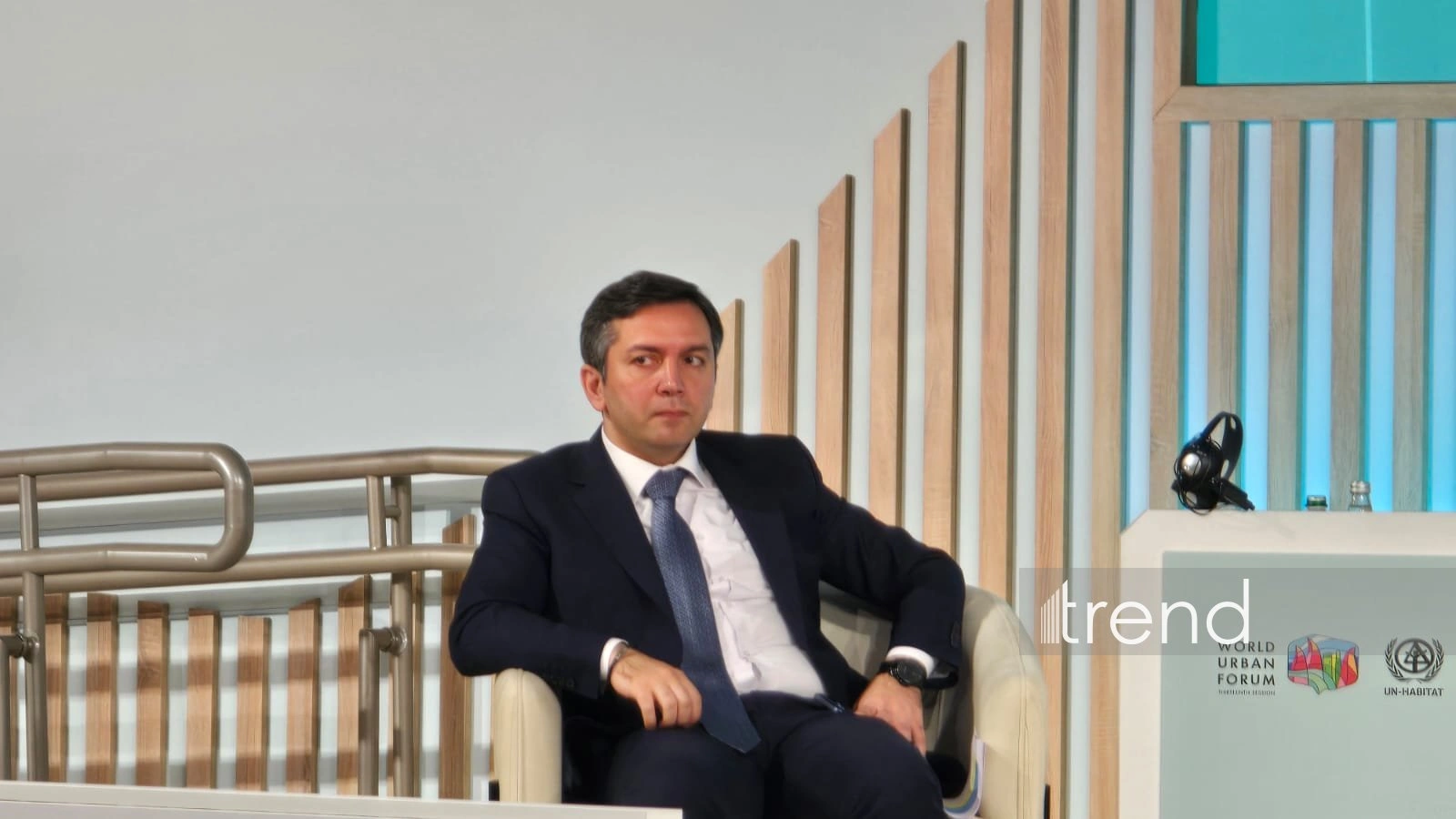
BAKU, Azerbaijan, September 9. Climate change
is no longer just an environmental problem, but a serious threat to
global peace and security, Azerbaijan's Deputy Foreign Minister and
COP29 Chief Negotiator Yalchin Rafiyev said during a roundtable on
"Peace-oriented climate action: urban solutions in fragile and
conflict-affected areas" held as part of the Baku Climate Action
Week, Trend's
correspondent reports from the event.
He noted that the growth in the frequency and intensity of
climate-related disasters, such as droughts, extreme weather
events, and sea level rise, is creating serious consequences,
especially for countries located in conflict-prone regions.
Rafiyev pointed out that, according to the World Bank, 40% of
the population of the relevant countries is exposed to
climate-related hazards. This is equivalent to 142 million
households or 527 million people. At the same time, fragile and
climate-vulnerable countries receive about $2.1 in adaptation
financing per capita, which is significantly less than the $18.1 in
non-fragile countries.
According to him, the fragmented and intermediary-dependent
architecture of the global climate finance increases operational
costs and slows down the delivery of support to communities that
need it most.
"In this context, the COP29 Presidency has launched the Baku
Climate Action Challenge for Peace, Relief and Recovery and
established the Baku Climate and Peace Action Centre as a practical
platform for developing cooperation on the
climate-peace-development nexus," said Rafiyev.
The COP29 Chief Negotiator noted that one of the key components
of the Centre's approach is the implementation of pilot projects to
test integrated climate and peace solutions in practice and create
scalable models for future investments.
He said that the implementation of pilot projects is coordinated
through Joint Working Groups. These groups strengthen national
ownership, facilitate coordination among stakeholders, and oversee
the implementation of projects. Joint Working Groups have already
been established with Gambia, Guinea-Bissau, and Chad.
Rafiyev highlighted the leadership and commitment of the
government of Guinea-Bissau. He announced that all necessary
documents for the pilot project in Guinea-Bissau have been
prepared, and the project will be submitted to the Green Climate
Fund Preparatory Program in the near future.
According to him, after COP29, the Baku Center has become a
co-initiator of two more important international initiatives.
One of them is the "Smart, Sustainable Settlements for Safe
Return Package (4SRP)" solutions initiative, which was put forward
by the Azerbaijan State Committee for Urban Planning and
Architecture, UN-Habitat, the International Organization for
Migration (IOM), and the Baku Center. The initiative serves to
translate a broader approach to the climate-peace-development nexus
into practical urban planning and recovery solutions.
Another initiative is the International Technical Assistance
Program for the Inclusion of Small Island Developing States of
Azerbaijan on the World Heritage List. Rafiyev said that the Baku
Center is a partner in this initiative. The initiative aims to
respond to the underrepresentation of Small Island Developing
States on the UNESCO World Heritage List and the growing threats
posed to their cultural and natural heritage by climate change and
environmental degradation.
He noted that the Baku Center will continue to support climate
action that takes into account peace and security issues and calls
on countries, partners, and other stakeholders to join the center’s
initiatives.