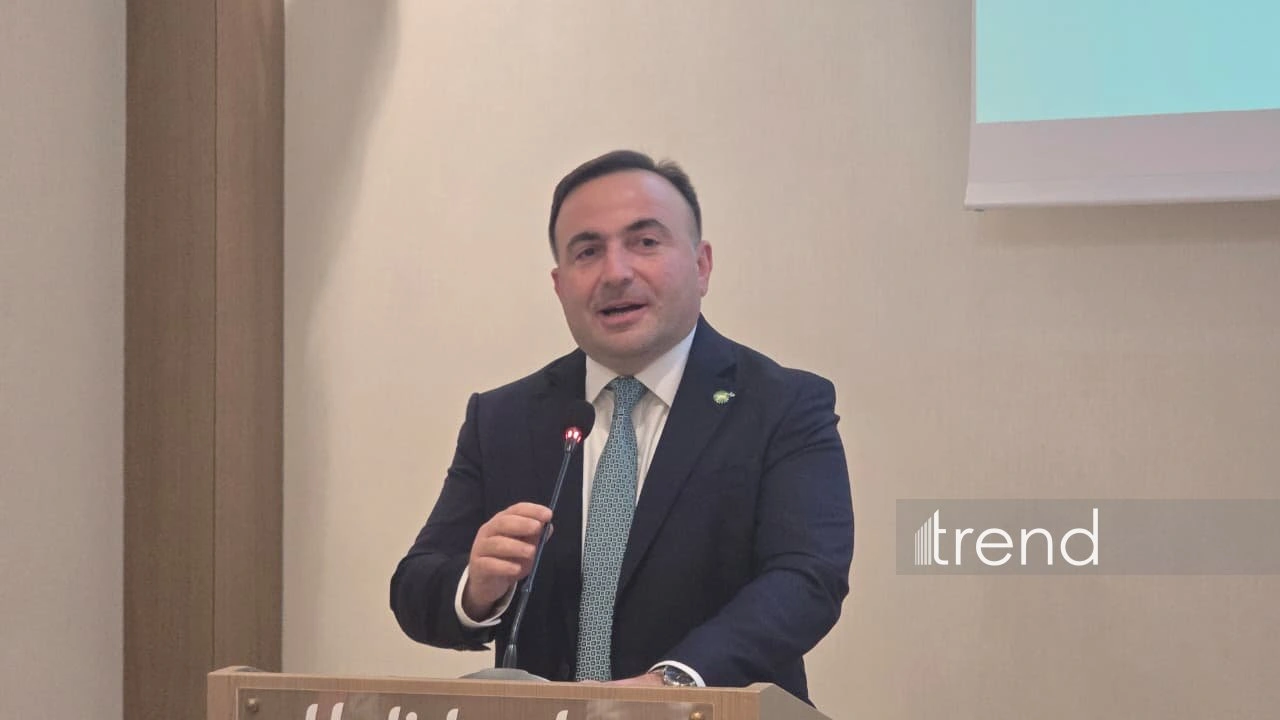
BAKU, Azerbaijan, September 9. The transition
to green energy is an irreversible process, bp's Vice President for
the Caspian-Central Asia-Türkiye region, Bakhtiyar Aslanbayli, said
at the presentation of a new social investment project by bp and
its partners to support the development of local specialists in the
field of renewable energy and energy efficiency, Trend's correspondent
reports from the event.
He noted that one of the skeptical approaches regarding electric
cars is the use of raw materials such as natural gas in the
production of the electricity they use.
"One of the skeptical thoughts regarding the use of electric
cars is the use of raw materials such as natural gas in the
production of the electricity they use. However, a comparison of
the emissions of traditional internal combustion engine cars and
the emissions resulting from the use of natural gas in the
production of electricity shows that the difference is many times
smaller," Aslanbayli explained.
He pointed out that a similar situation is observed in the
heating of buildings and apartments.
"There is a many times difference between the emissions
resulting from direct gas combustion at home and the emissions
resulting from the use of electricity, even if that electricity is
obtained from fossil fuels. This fact shows that the transition to
green energy is an inevitable and irreversible path," emphasized
the vice president.
Aslanbayli also noted that the formation of the country's human
capital is of particular importance in the process of energy
transition.
"Regardless of when the transition occurs, the formation of
specialized human capital, knowledge, skills and experience in this
area is part of the energy sector strategy and the country's
strategic security interests," he mentioned.
According to him, the historical experience gained by Azerbaijan
in the oil and gas sector shows the importance of planning
personnel training in the field of renewable energy in advance.
"After 1994, when the new oil strategy began to be implemented,
we didnət have enough local specialists familiar with modern
technologies, and we had to attract specialists from outside. In
order to avoid a similar situation in the field of renewable
energy, the personnel potential must be planned in a timely and
purposeful manner," Aslanbayli said.
He noted that the trainings, initiated by the Clean Energy
Center of the Economic Cooperation Organization, combine local
skills with international experience.
"Experienced international organizations such as the Renewables
Academy (RENAC) are involved in these trainings. The goal is to
form local trainers, disseminate international knowledge within the
country, and continue the program with the joint certification of
RENAC," he stressed.
Aslanbayli also briefed on other projects implemented in the
field of renewable energy and personnel training.
He noted that a Renewable Energy Center has been established at
the Azerbaijan State Oil and Industry University (ASOIU). With the
support of bp and the Ministry of Science and Education, a dual
diploma program at the master's level is being implemented between
the University of Warwick in the UK and ASOIU.
"There has already been one graduation under this program, and
admission will continue in the future," Aslanbayli said.
According to him, important work is also being done in the field
of vocational education.
"Workshops have been formed in two vocational schools with
partners to support new curricula on solar and wind energy," he
noted.
Aslanbayli also announced that the first textbook, "Introduction
to renewable energy" in the Azerbaijani language, has been prepared
and presented to the public jointly with the Baku Higher Oil
School.
According to him, a project to establish a new laboratory on
energy storage systems and renewable energy has also been launched
at Baku State University.
"As a traditional oil, gas, and energy company, steps are being
taken within the company to support the energy transition.
As an organization that has been operating in Azerbaijan for
more than 30 years and plans to continue its activities for the
next 25-30 years, we feel a corporate responsibility to society.
The formation of a new generation of specialists in the field of
renewable energy remains a priority goal," Aslanbayli added.