BAKU, Azerbaijan, August 18. Mutual trade in
agricultural products between Kazakhstan and Belarus reached $365
million in 2025, increasing by 31% compared with the previous
year.
This was announced by the press service of Kazakhstan's Ministry
of Agriculture, following the seventh meeting of the Council on
Agro-Industrial Policy of the Eurasian Economic Union, held in
Almaty.
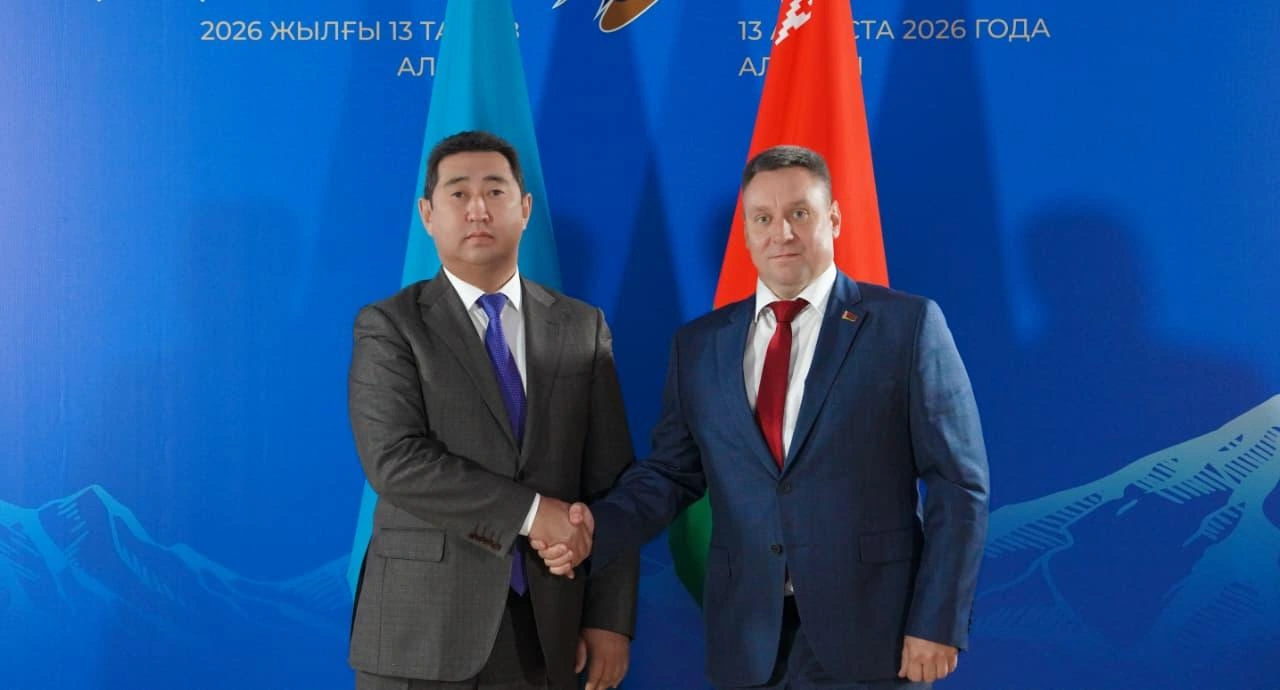
The figure was presented during the meeting between Kazakhstan's
Minister of Agriculture Aidarbek Saparov and Belarusian Minister of
Agriculture and Food Yuri Gorlov.
The sides discussed key areas for further development of
cooperation in the agro-industrial sector. Positive trade dynamics
have continued in 2026, with mutual trade in agricultural products
increasing by 18% in January-May, according to the ministry.
According to the ministry, one of Kazakhstan's key priorities
remains diversifying agricultural exports and increasing the share
of deeply processed products. Currently, more than 51% of
Kazakhstan's agricultural exports consist of processed
products.
In this regard, Kazakhstan is interested in expanding supplies
of value-added agricultural products to the Belarusian market.
Promising products include sunflower and safflower oils, prepared
grocery products, as well as grain and oilseed crops, including
rapeseed, sunflower and flax.
"We are consistently working to increase agricultural exports
and expand their structure through products with high added value.
Kazakhstan has the necessary raw material base, production capacity
and export potential to ensure stable supplies to the Belarusian
market," Saparov said.
Gorlov, in turn, expressed interest in expanding cooperation in
promising areas of the agro-industrial sector.
Particular attention was paid to crop production. The sides
proposed intensifying the exchange of experience in breeding and
seed production, the introduction of modern agricultural
technologies, digital solutions and innovations.
Livestock production remains another promising area of
cooperation. According to the ministry, Kazakhstan is ready to
share its experience in beef cattle production. The country has
implemented major projects to establish modern feedlots, including
facilities with a capacity of up to 50,000 head, while a network of
industrial facilities capable of holding 10,000 or more head at a
time is also expanding.
Practical coordination of bilateral cooperation is carried out
through the joint Kazakhstan-Belarus Working Group on Cooperation
in Agriculture.
Moreover, within the framework of the seventh meeting of the
Council, it was announced that agricultural trade turnover between
Kazakhstan and Kyrgyzstan reached $511.3 million in 2025,
increasing by 41.5% compared with the previous year.
According to the Ministry of Agriculture of Kazakhstan, the
country is demonstrating steady growth in the agro-industrial
sector. Over the past five years, the volume of concessional
financing for the sector has increased tenfold, reaching about $3
billion in 2025. Around $4 billion is planned for 2026.
In 2025, gross agricultural output increased by 5.9% to almost
$20 billion. At the same time, the strategic objective is to double
the volume of gross agricultural output.
Wheat production has consistently exceeded 18 million tons,
while total grain production stands at around 27 million tons. The
cattle population exceeds 8 million head; sheep and goats: 21
million; horses: 4.6 million; and poultry: 49.1 million head.
At the same time, Kazakhstan is expanding its export potential.
Over the past five years, agricultural exports have doubled and
exceeded $7 billion.
During the past marketing year, Kazakhstan exported 15.3 million
tons of grain, 70% more than in the same period of the previous
year and the highest figure recorded over the past 20 years.
As Kazakhstan strengthens its agricultural production and export
capacity, the country is also seeking to broaden cooperation beyond
its traditional markets, including by attracting investment and
technology from global partners.
In particular, Jeff Erlich, Executive Director of the American
Chamber of Commerce Kazakhstan, told Trend in an exclusive interview that AmCham
sees potential for new US investment in Kazakhstan's agriculture
and food processing.
"Kazakhstan has long been an attractive market for American
companies, with political stability, an educated and growing
population, significant natural resources, and a strategic location
between major global markets, and now we see increasing
diversification beyond oil and gas", he said.
Erlich noted that Kazakhstan is competing for investment not
only with its neighbors, but with countries around the world.
"Investors value predictability: if a company is committing
significant capital for the long term, it needs confidence that the
rules of the game will remain reasonably stable. We have a
constructive dialogue with the government and see continued
opportunities to strengthen consultation with business and make the
regulatory environment more predictable", he said.
Executive Director pointed out that there is significant
potential for new American investments in agriculture and food
processing, transport and logistics, mining and critical minerals,
IT and AI, healthcare, and education.
"Agriculture in particular remains underinvested relative to
Kazakhstan’s potential, and American companies can bring not only
equipment, but technology, data, expertise, and more efficient
approaches to production", he said.