BAKU, Azerbaijan, July 23. In the first half of
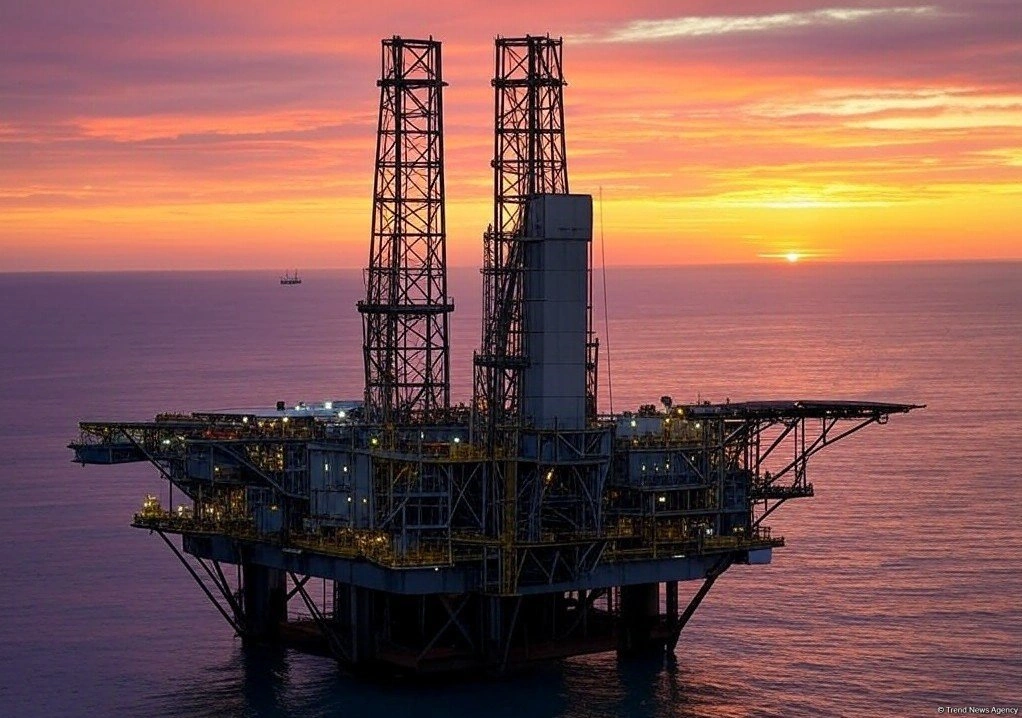
this year, Azerbaijan produced 13.270 million metric tons of crude
oil (including gas condensate).
This was reported by Azerbaijan's State Statistical
Committee.
According to the data, this figure is 421,800 metric tons, or
3.1%, lower than during the same period last year.
Of the total crude oil production for the reporting period,
13.236 million metric tons were marketable crude oil, which is
424,200 metric tons, or 3.1%, less than the same period last
year.
Overall, in the first half of this year, the total value of
production in Azerbaijan’s mining industry amounted to 19.3 billion
manat ($11.3 billion), which is 2.8% less than the same period last
year.
According to data from the Ministry of Energy, during the
reporting period, oil production in Azerbaijan totaled 7.9 million
metric tons at the Azeri-Chirag-Gunashli field, 1.7 million metric
tons at the Shah Deniz field, and 0.3 million metric tons at the
Absheron field. SOCAR’s oil production (including condensate)
totaled 3.4 million metric tons.
In addition, it is reported that 10.5 million metric tons of oil
(including condensate) were exported during this period. Of this
amount, 9.5 million metric tons were exported by the consortium,
0.7 million metric tons by SOCAR, and 0.3 million metric tons by
JOCAP.
In addition, it was noted that during the first six months of
this year, crude oil production averaged 61,000 metric tons
(449,000 barrels) per day, while condensate production averaged
12,000 metric tons (103,000 barrels). In total, oil production
averaged 73,000 metric tons (552,000 barrels) per day.
Oil refining during the reporting period totaled 2.9 million
metric tons.
In the period from January through June 2026, the country
produced 25.4 billion cubic meters of natural gas. The
Azeri-Chirag-Guneshli field accounted for 7.3 billion cubic meters
of the gas produced, Shah Deniz for 13.7 billion cubic meters, the
Absheron field for 0.8 billion cubic meters, and SOCAR for 3.6
billion cubic meters.
During this period, gas exports totaled 12.7 billion cubic
meters. Of this volume, 5.9 billion cubic meters went to Europe,
4.9 billion cubic meters to Turkey (including 3 billion cubic
meters via TANAP), 1.2 billion cubic meters to Georgia, and 0.7
billion cubic meters to Syria.
Since the Azeri-Chirag-Guneshli and Shah Deniz fields came
online, approximately 679.8 million metric tons of oil (including
gas condensate) and 529.6 billion cubic meters of gas had been
produced as of July 1 of this year. The Azeri-Chirag-Guneshli field
produced 625.6 million metric tons of oil and 251.1 billion cubic
meters of gas, while the Shah Deniz field produced approximately
54.2 million metric tons of condensate and 278.5 billion cubic
meters of gas.
In addition, the State Customs Committee reports that during the
first six months of this year, Azerbaijan exported 10.125 million
metric tons of crude oil and petroleum products derived from
bituminous rocks, worth 6.231 billion U.S. dollars, to more than 10
countries. Compared to the same period last year, the value of
exports of these products decreased by $177.9 million, or 2.3%, and
the volume decreased by 1.921 million metric tons, or 15.9%.
Against the backdrop of declining production and export figures,
Azerbaijan continues to pursue a policy of economic
diversification. In recent years, the development of the
non-resource sector has remained one of the main priorities of the
government’s economic policy. As part of this policy, investments
are being increased in industry, agriculture, information and
communication technologies, transportation and logistics, tourism,
and renewable energy sources, and measures are being taken to
diversify exports and expand access for non-resource products to
foreign markets. The goal is to gradually reduce the economy’s
dependence on oil revenues and ensure sustainable economic growth.
In this context, the country’s leadership emphasizes that the
non-resource sectors are the primary focus of development in terms
of investment.
Economy Minister Mikayil Jabbarov stated at a press conference
in Baku dedicated to the results of the 2026 annual meetings of the
Islamic Development Bank Group: "Azerbaijan’s primary focus is on
developing the non-resource sector, which has become the main
driver of the country’s economic growth over the past 5–6 years.
Investment opportunities mainly cover non-resource-based industrial
production, mining and critical minerals, agriculture and
agro-processing, as well as transportation and logistics."