BAKU, Azerbaijan, July 20. Economic cooperation
took center stage during Kazakh President Kassym-Jomart Tokayev's
working visit to China.
The negotiations, meetings with executives of China's leading
corporations, and participation in the World Artificial
Intelligence Conference (WAIC 2026) demonstrated that cooperation
between Astana and Beijing is moving well beyond traditional
commodity trade. The focus is increasingly shifting toward
technology, industrial development, the digital economy, and
transport infrastructure - sectors expected to shape Kazakhstan's
economic development for years to come. The steady expansion of
bilateral trade has created a solid foundation for this
transition.
China has remained one of Kazakhstan's largest trading partners
and a key source of foreign investment for several years. Bilateral
trade reached $43.8 billion in 2024, up 9% year-on-year, before
climbing to a record $48.7 billion in 2025. During the first five
months of 2026, trade expanded by another 27% to $22 billion. If
this pace continues, annual trade could approach $55-60 billion
this year. The two countries continue to pursue their long-term
objective of raising bilateral trade to $100 billion.
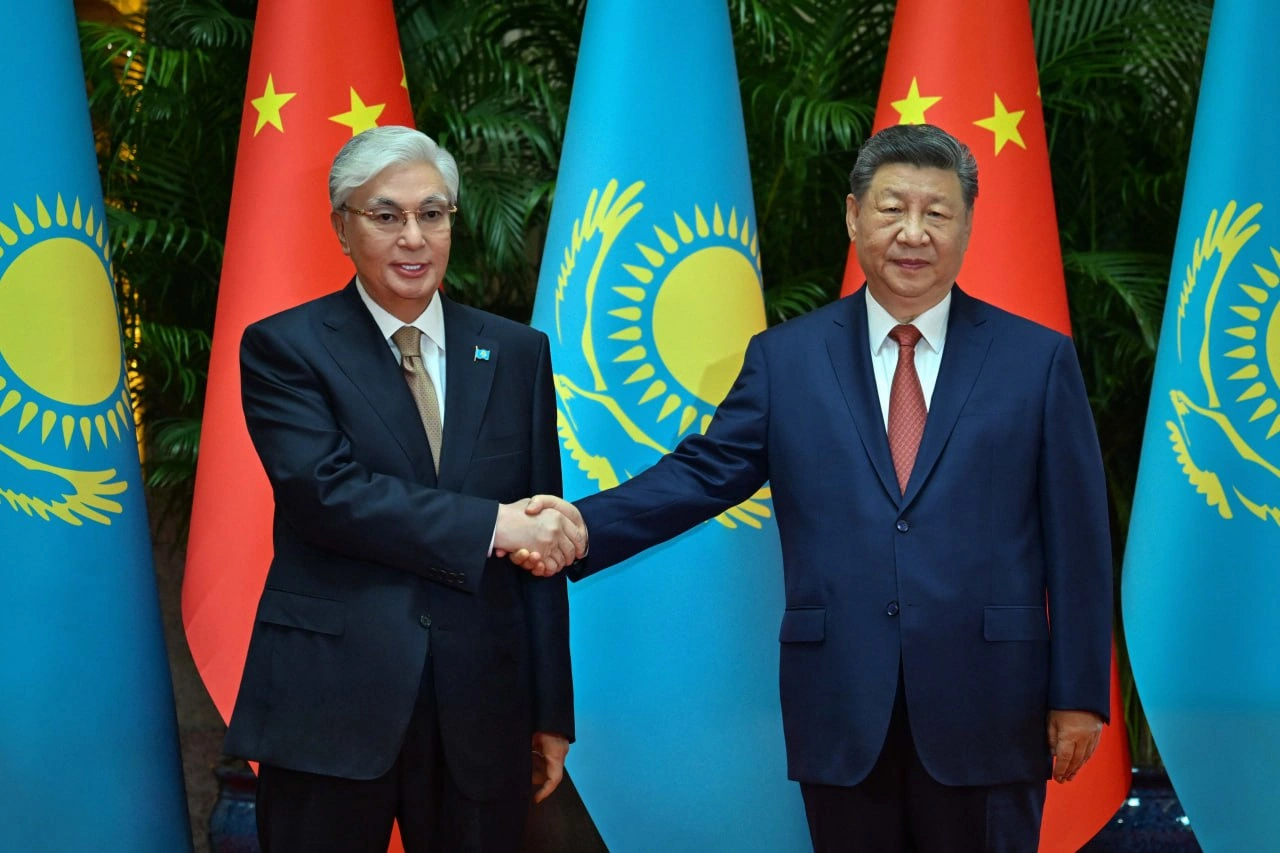
That target featured prominently during talks between President
Tokayev and Chinese President Xi Jinping in Shanghai. The two
leaders signed a Trade and Economic Cooperation Program and a
Roadmap for 2027-2030 designed to accelerate joint projects, expand
investment cooperation, and move bilateral trade closer to the
long-term goal.
At the same time, Kazakhstan increasingly views China not only
as its largest export market but also as a strategic partner in
technology cooperation and the joint creation of higher value-added
industries rather than simply expanding trade volumes.
"Kazakhstan is consistently interested in comprehensively
strengthening our permanent and strategic partnership with China.
In recent years, the political dialogue between our states has
significantly intensified," Tokayev said during the talks with
Xi.
Addressing representatives of Chinese businesses, the Kazakh
president highlighted the scale of bilateral economic ties.
"Last year, bilateral trade volume reached $49 billion, a record
high. China invested over $30 billion in Kazakhstan's economy.
Currently, more than 8,500 enterprises with Chinese capital are
successfully operating in Kazakhstan. Among them, such major
companies as CNPC, CITIC, and Huawei are particularly noteworthy.
We highly value the significant contribution of Chinese businesses
to the modernization of the Kazakh economy. In recent years, our
countries have successfully implemented numerous important joint
projects. As a result, we have created jobs, introduced advanced
technologies, and strengthened industrial cooperation," Tokayev
said.
The Kazakhstan-China Business Forum translated that agenda into
concrete outcomes. More than 70 commercial agreements worth over
$15 billion were signed, covering artificial intelligence, digital
infrastructure, transport, mechanical engineering, agriculture,
finance, and manufacturing.
Separately, Kazakhstan Temir Zholy (Kazakhstan Railways)
concluded industry-specific agreements worth approximately $400
million covering the digitalization of the transport sector, as
well as the development of port infrastructure, terminals, and
logistics facilities.
Transport remained one of the central themes of the visit as
Kazakhstan continues strengthening its position as one of Eurasia's
key transit hubs within China's Belt and Road Initiative.
"Currently, 13 international transport corridors pass through
the country. Approximately 85% of rail traffic between China and
Europe passes through Kazakhstan. Over the past fifteen years, the
government has invested over $35 billion in developing transport
and logistics infrastructure. We are building new railway lines and
expanding cargo capacity along the Trans-Caspian International
Transport Route, also known as the Middle Corridor," Tokayev
said.
He noted that work is continuing on new railway projects,
expansion of the Middle Corridor's capacity, and the development of
a unified digital freight ecosystem based on the Smart Cargo
platform.
Technology featured just as prominently throughout the visit.
Tokayev's participation in WAIC underscored Kazakhstan's ambition
to position itself not only as a transit hub but also as a regional
center for digital innovation. Speaking at the conference, he
proposed launching the Kazakhstan-China Digital Bridge initiative
and declaring 2027 the Year of Kazakhstan-China Joint AI
Initiatives. Kazakhstan also proposed hosting the inaugural meeting
of the World Artificial Intelligence Cooperation Organization
(WAICO) in Astana and establishing its Central Asia regional office
there.
In his address, Tokayev emphasized that artificial intelligence
should become a development tool accessible to all countries.
"No country should remain just a consumer of AI. Every state
must have the opportunity to build its own human capital, digital
infrastructure, and institutional capacity. It is once again a
matter of justice and fairness. Our common task is to ensure that
artificial intelligence serves the interests of the economy and
society, while remaining under the skillful and sensible control of
humanity," he said.
The technology agenda was reinforced during bilateral meetings
with leading Chinese companies. Kazakhstan discussed joint projects
with Huawei, Xiaomi, and CATL, the world's largest electric vehicle
battery manufacturer, which is considering building Central Asia's
first EV battery gigafactory in Kazakhstan. The parties also
explored expanding cooperation in cloud computing, AI
infrastructure, data processing capacity, electric vehicle
manufacturing, and intelligent transport systems.
Traditional sectors of the economy also remained firmly on the
agenda. Chinese companies continue expanding their presence in
Kazakhstan's oil and gas industry, petrochemicals, critical
minerals, and agriculture. Tokayev stressed that Kazakhstan aims to
become Central Asia's leading agricultural hub by integrating
artificial intelligence, robotics, and digital technologies into
the sector.
The outcomes of the visit suggest that bilateral cooperation is
evolving beyond the signing of individual contracts. The agreements
reached indicate that Kazakhstan and China are entering a new phase
of their strategic partnership, with technology, industrial
cooperation, and value-added production becoming its principal
drivers. For Astana, this reflects a broader effort to move beyond
an economy primarily driven by raw material exports and strengthen
its position as a regional center for logistics, advanced
technologies, and the digital economy.
The structure of the agreements - including the Trade and
Economic Cooperation Program, the 2027-2030 Roadmap, and
sector-specific packages covering artificial intelligence,
transport, and energy - suggests that both countries are seeking to
place bilateral relations on a more systematic and long-term
footing rather than relying on individual projects. If the
agreements reached in Shanghai are fully implemented, the visit
could mark the beginning of a new stage in Kazakhstan's economic
modernization.