BAKU, Azerbaijan, October 30. The total area of
agricultural land in Azerbaijan where modern irrigation systems are
applied has exceeded 155,000 hectares, and over the past year, this
figure has increased by 20,000–25,000 hectares, Azerbaijan’s
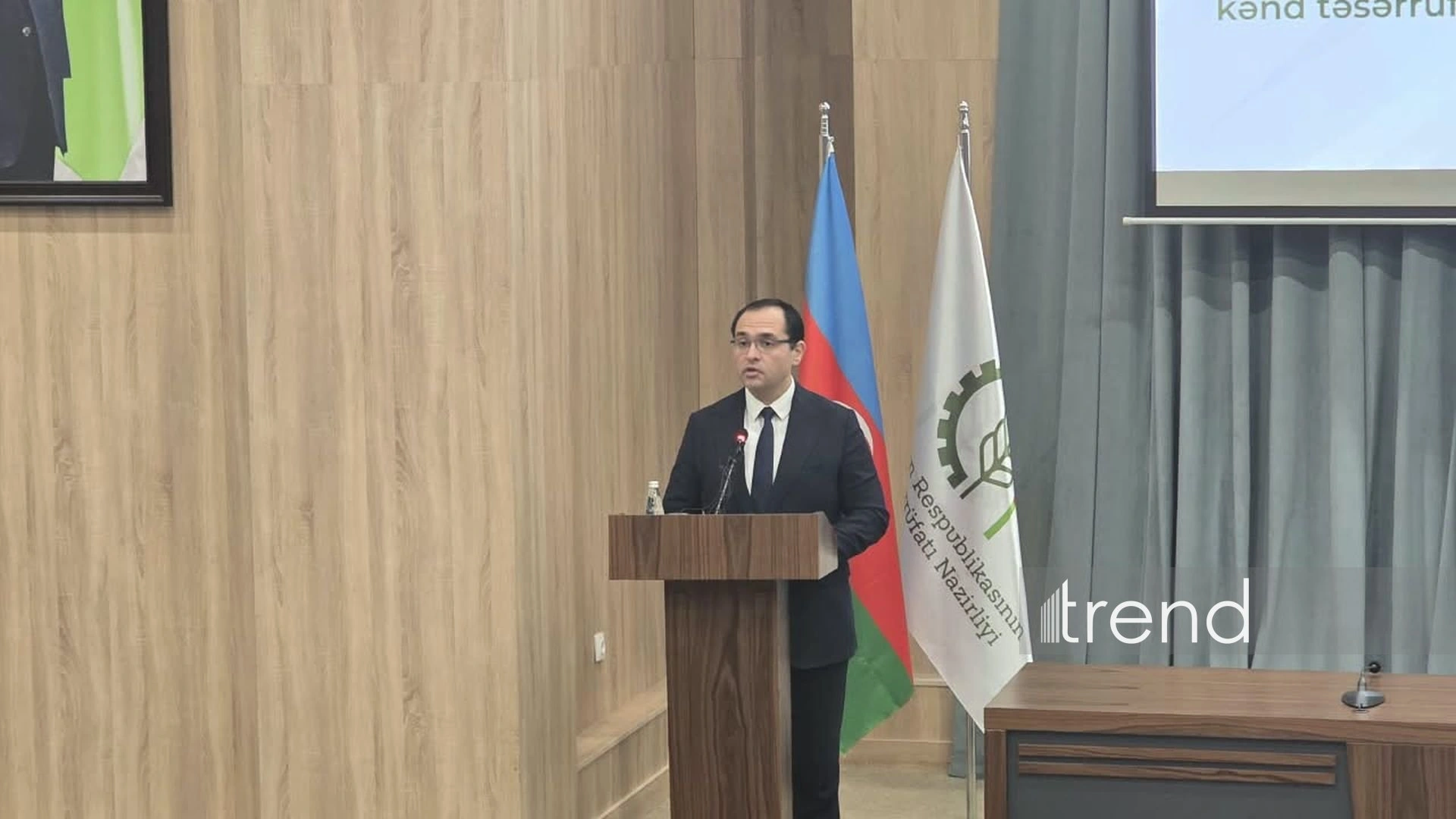
Minister of Agriculture, Majnun Mammadov, told reporters on the
sidelines of the event held at the ministry’s administrative
building to mark November 1 – Agriculture Workers' Day on Friday,
Trend’s
correspondent reports from the event.
The minister noted that agricultural workers, farmers,
entrepreneurs, mechanics, veterinarians, and agronomists play an
important role in ensuring food security in the country.
Mammadov remarked that the main goals of the state program for
the development of the production and processing areas of
agricultural, fishery, and aquaculture products for 2026-2030 are
to boost production using fewer resources, improve the welfare of
farmers, accelerate the development of the agrarian economy, and
increase productivity.
"Agriculture is impossible without science. In this regard, we
will pay special attention to agricultural education, science, the
application of innovative technologies, and increasing efficiency
in the field," the minister stressed.
He said that after the consultations held in the regions within
the framework of the state program, investment projects in various
directions were presented by farmers and entrepreneurs. Currently,
works are being carried out in the direction of the implementation
and planning of those projects.
Mammadov mentioned that it is planned to create greenhouse farms
in the liberated territories by the industrial method in a single
zone.
"Work has already been done to allocate 230 hectares of
greenhouse land in those areas, and entrepreneurs have shown
interest in almost all of these areas for the purpose of
investment. Further expansion of projects in this direction is
planned," he said.
The minister added that the expansion of modern irrigation
systems is of great importance for achieving the goals of the state
program. Specifically, while the total area equipped with modern
irrigation systems was 130,000 hectares by the end of 2025, this
figure has now surpassed 150,000–155,000 hectares.
Mammadov emphasized that the primary objective in grain farming
is not so much to expand cultivated areas, but rather to increase
productivity through the efficient use of existing land and water
resources.
He noted that increasing the production of food-grade wheat is
one of the key priorities of the state program. To this end, it's
planned to expand the support program for food-grade wheat
production.
According to the minister, while 126,000 tons of produce were
generated under the food-grade wheat program in 2025, this figure
exceeded 170,000 tons in 2026.
"A positive development is that, while the national average
grain yield stands at 33–34 centners this year, yields in areas
utilizing modern irrigation, under the food-grade wheat program,
exceed 54 centners," Mammadov said.
He pointed out that the implementation of modern irrigation
systems, the use of laser land-leveling technology, the planting of
higher-quality seeds, and the application of modern agrotechnical
practices are contributing positively to increased yields.
The minister added that the use of drones for fertilization and
crop treatment also enables agricultural tasks to be carried out
more efficiently and in a timely manner.
"Our next objective is not to expand the total cultivated area,
but rather to achieve higher yields, and consequently, greater
total production, from a smaller land footprint," he
emphasized.
Mammadov also noted that integrating the rich agricultural
potential of the liberated territories into the economic cycle is
of significant importance to the successful implementation of the
state program.