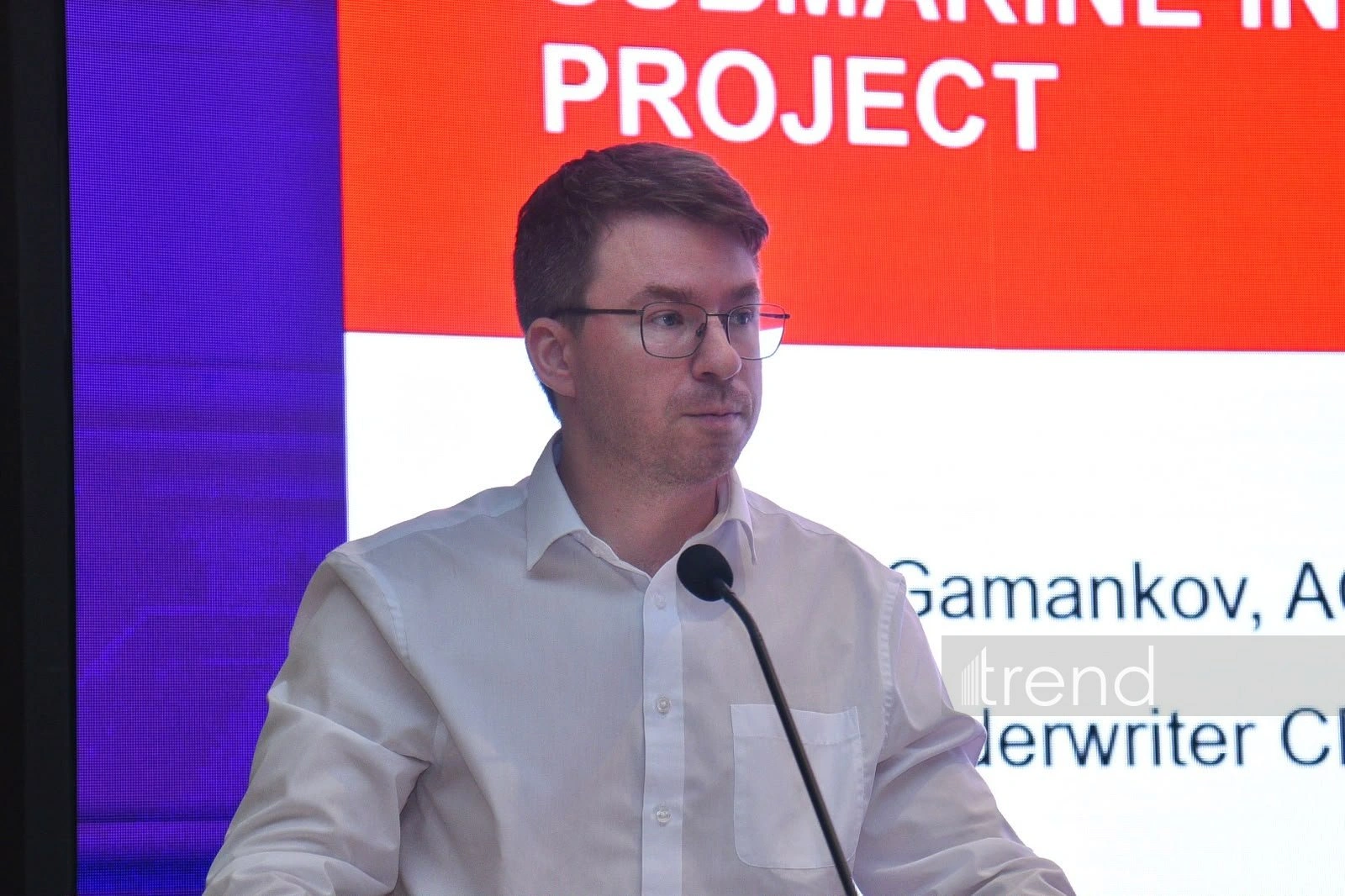
BAKU, Azerbaijan, June 24. Insurance plays a
central role in the development of the Black Sea and Trans-Caspian
energy corridors, said Dmytro Gamankov, Senior Underwriter for
Central and Eastern Europe and international markets at reinsurance
company VIG Re, at the Azerbaijan International Insurance Forum in
Baku, Trend's
correspondent reports from the event.
"Energy corridor projects across the Black Sea and Caspian Sea
are not only infrastructure initiatives — they require a robust
risk management and insurance framework. From the insurance and
reinsurance perspective, this is not just a story about energy,
sustainability and strategic ambitions. It is a story about risk,
resilience and trust. Projects like these are built not only
through engineering. They are built on trust — in legislation, in
counterparties, and most importantly, on the confidence that if
something goes wrong, the system will not suffer irreversible
damage. That is where insurance plays a central role," he said.
Gamankov noted that the Black Sea Energy Corridor concept
emerged against the backdrop of the European Union's drive to
diversify its energy supply and accelerate the green
transition.
"In 2023, the governments of Azerbaijan, Georgia, Romania and
Hungary decided to connect their power grids via an undersea cable
across the Black Sea to transmit renewable energy to Europe. The
cable will stretch approximately 1,200 kilometers. Upon completion,
it will be the world's longest high-voltage direct current cable
connecting the power systems of different countries," he said.
Gamankov also touched on the Trans-Caspian Energy Corridor,
noting that Kazakhstan, Uzbekistan and Azerbaijan are exploring a
similar project beneath the Caspian Sea.
"European demand for energy resources will persist in the long
term, which is why the feasibility of laying an undersea cable
across the Caspian is also being studied. The Black Sea energy
cable will have a transmission capacity of around one gigawatt upon
completion — comparable to a large power plant or a single nuclear
reactor unit. That is enough to power approximately 500,000
households," he said.
The VIG Re executive stressed that the project has already moved
beyond the conceptual stage, with key participants identified,
routes being mapped out, power grid integration being planned and
the need for clearer underwriting approaches growing.
"Recently, the governments of the participating countries have
been actively discussing the initiative's further development.
Kazakhstan's parliament has already ratified the relevant
agreements, while Georgia and Romania are exploring options to
expand the project, including the construction of additional
infrastructure alongside the energy cable," Gamankov said.