BAKU, Azerbaijan, June 19. On June 17, the
first meeting of the Turkmen-Slovak Joint Commission on Economic
Cooperation was held in Ashgabat under the co-chairmanship of
Hojamyrat Geldymyradov, Deputy Chairman of the Cabinet of Ministers
of Turkmenistan, and Vladimír Šimoňák, State Secretary of the
Ministry of Economy of the Slovak Republic. During the meeting, the
sides discussed prospects for expanding cooperation in trade and
economic relations, energy, industry, construction, transport and
communications, information technologies, agriculture, ecology,
healthcare, education, culture, sports, and tourism. The
participants confirmed their mutual interest in further
strengthening bilateral ties, developing contacts between business
communities, and using the newly established commission as a
permanent mechanism for promoting joint projects and new areas of
economic cooperation.
The holding of the first meeting of the commission was not
unexpected. In recent months, Ashgabat has consistently expanded
its contacts with the European Union and individual European
countries, designating the development of relations with the EU as
one of the priorities of its foreign policy for 2026. Since the
beginning of the year, a series of meetings has taken place
involving high-level representatives of EU institutions and member
states.
In February alone, more than ten joint events were held,
including a meeting between representatives of Central Asian
countries and Germany within the Z5+1 format in Berlin, a joint
briefing between Turkmenistan and the European Union held in
Ashgabat on February 17, as well as talks between Turkmen diplomats
and European officials in Brussels, during which the commitment to
further expanding cooperation with the EU was emphasized.
Later, this course was further reinforced at the first European
Union-Central Asia Economic Forum held on March 26, as well as
through meetings between representatives of European financial
institutions and the Turkmen side dedicated to investment,
transport connectivity, and the expansion of trade and economic
ties. Trend covered these developments in more detail in its
previous article titled “Bridging East and West: EU eyes Turkmen transit.”
Against this backdrop, as well as amid ongoing volatility in
global markets and growing uncertainty in international trade,
diversification of export revenue sources and expansion of sales
geography beyond traditional markets are becoming particularly
important for Turkmenistan. This position is also aligned with the
World Bank’s forecast published in its June edition of the Global
Economic Prospects report, which states that “for commodity
exporters, building fiscal resilience will also require strong
institutional frameworks and revenue diversification.”
In this context, Slovakia is seen not only as an independent
market but also as a potential gateway to the broader European
Union market. For Turkmen producers, working through the Slovak
channel may provide an opportunity to test demand for their
products, receive feedback from European consumers and businesses
regarding how well Turkmen goods meet their needs, adapt products
to EU requirements, and gradually prepare for expanding their
presence in other European markets.
However, interest in expanding cooperation is not limited to
Turkmenistan alone. For European countries, including Slovakia, the
Turkmen market is of interest against the backdrop of relatively
positive macroeconomic dynamics. According to official data,
Turkmenistan’s GDP grew by 6.3% in January-May 2026, while foreign
trade turnover increased by 8% compared to the same period of the
previous year.
At the same time, Turkmenistan’s significance for Bratislava
extends beyond strictly bilateral relations. Slovakia has been
simultaneously expanding its engagement with other countries of the
South Caucasus and Central Asia. In May, Slovak State Secretary of
the Ministry of Economy Vladimír Šimoňák visited Georgia, where an
economic cooperation agreement was signed providing for the
establishment of a joint intergovernmental commission.
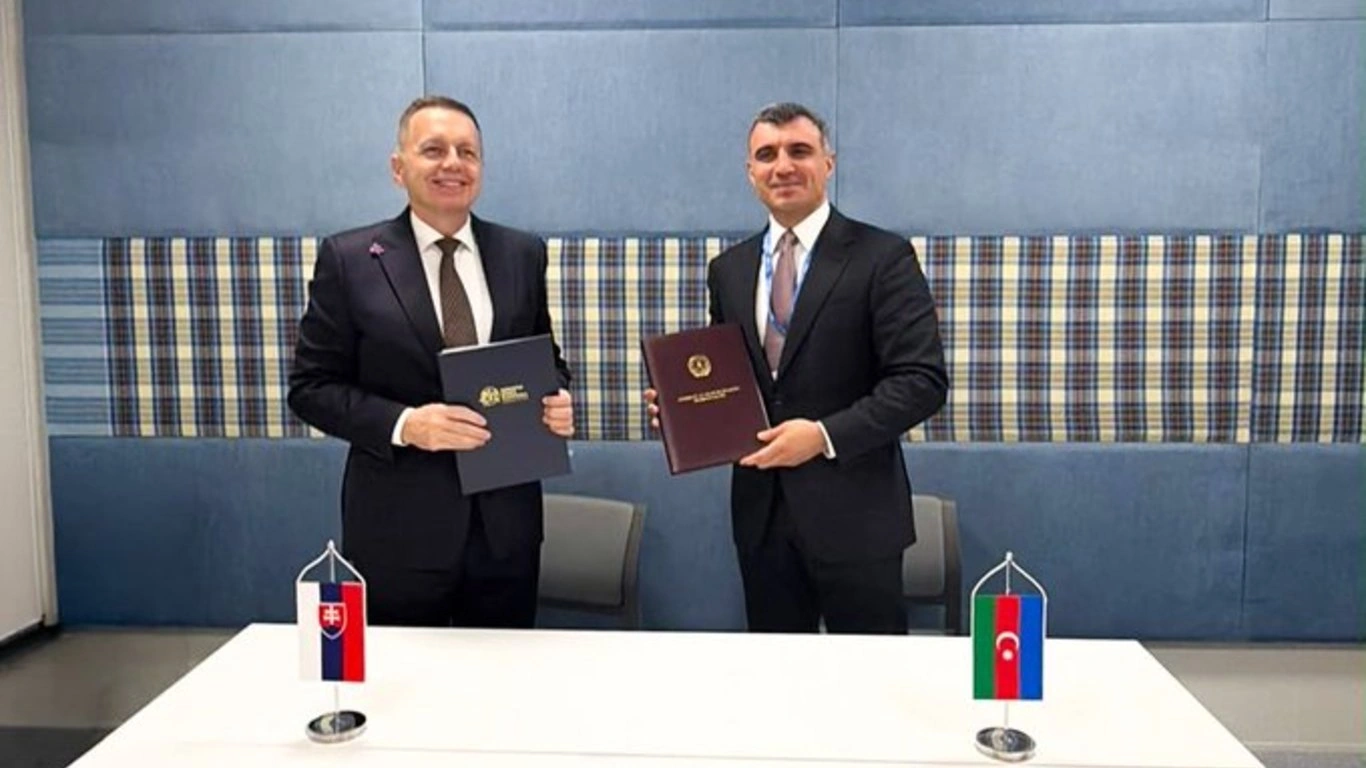
At the same time, Slovak-Azerbaijani dialogue has also been
developing: during the latest round of political consultations on
June 12, the sides discussed expanding cooperation in the fields of
economy, transport, and energy. Notably, the State Secretary of the
Slovak Ministry of Foreign Affairs, Marek Eštok, later stated: “We
are preparing further high-level visits; doors are fully opened to
expanding cooperation in transport, business, smart solutions,
energy, culture, and education.”
Looking at these processes as a whole, it can be observed that
Slovakia’s interest is not directed at individual countries in the
region separately, but rather at a broader space shaped by emerging
transcontinental transport routes. Georgia, Azerbaijan, and
Turkmenistan today effectively form a single geoeconomic corridor
linking the Black Sea with Central Asia via the Caucasus and the
Caspian Sea.
Trend previously highlighted this in its article “Turkmenistan pushes West via Georgia - with Azerbaijan as
linchpin.” The publication noted that, with the participation
of Azerbaijan, Georgia, and Turkmenistan, a vast space stretching
from the Black Sea to the Pamir mountains could be integrated, with
the three states - situated at the intersection of European and
Asian economic systems - potentially acting as a transport and
financial hub between them.
From this perspective, Slovakia’s simultaneous engagement with
Tbilisi, Baku, and now Ashgabat does not appear as a set of
isolated bilateral initiatives. All three countries lie along
routes connecting Western Europe with East Asia. Notably, over the
past two months, Bratislava has been steadily expanding its
interaction with each of these states, which may indicate growing
attention to routes and markets forming along the Middle Corridor
(Trans-Caspian International Transport Route).
Overall, the first meeting of the Turkmen-Slovak Joint
Commission on Economic Cooperation should not be viewed solely
through the prism of bilateral Ashgabat-Bratislava relations. It
fits into a broader context of gradually expanding economic
interaction between Europe and Central Asian countries, where
interest is increasing in routes passing through Georgia,
Azerbaijan, and Turkmenistan and connecting European space with
Asian markets.
At the same time, it is important to note that Vladimír Šimoňák,
who headed the Slovak delegation, has extensive experience in
European affairs, including his tenure at the Slovak Ministry of
Interior, where he headed the Department of Foreign and European
Affairs, as well as his work at the Permanent Representation of the
Slovak Republic to the EU in Brussels, where he served as head of
the Department of Internal Affairs from 2015 to 2021.
Such a background underscores that engagement with Turkmenistan
is part of Slovakia’s more systematic approach to economic
diplomacy across both European and Eurasian directions.
For Turkmenistan, participation in such formats opens an
additional opportunity to promote its products to the European
market through individual national gateways, including the Slovak
one. At the same time, as Turkmenistan’s production and export
potential develops, the emergence of new such “entry points” into
the European economy can be expected, gradually expanding the
geography of its external economic relations.