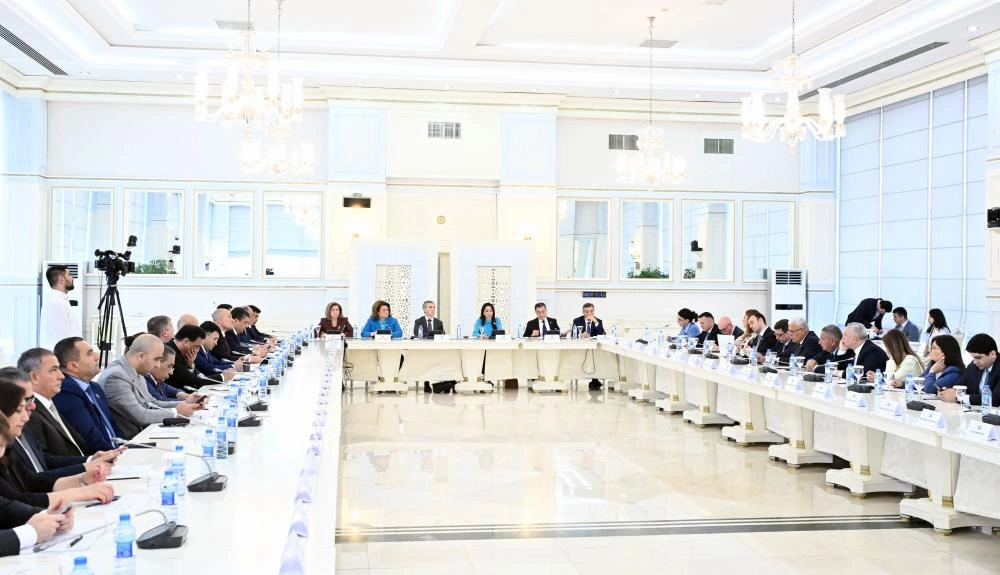
BAKU, Azerbaijan, June 8. A
joint meeting of the Azerbaijani Parliament's Human Rights, Family,
Women and Children's Issues, Legal Policy and State Building
Committees, and a public hearing were held on June 8, a source in
the parliament told Trend.
At the event, the draft law on amendments to the Code of
Administrative Offenses of Azerbaijan, the laws "On information,
informatization and information protection" and "On protection of
children from harmful information" were discussed in the first
reading.
Opening the meeting, the Chairman of the Human Rights Committee,
Zahid Oruj, expressed gratitude to the Speaker of the Azerbaijani
Parliament, Sahiba Gafarova, for the support and the conditions
created for the discussion of the issue in a broader format - in
the form of a public hearing, taking into account the significant
importance of the submitted draft law.
The committee chairman said that the discussion of the draft law
ensuring the protection of children's rights in the digital space
with parliamentarians, state and government representatives, media,
and relevant education and health authorities is commendable. He
noted that the Azerbaijani Parliament has adopted consistent and
systematic decisions in recent years to protect children from
harmful information in the digital environment, and the new draft
law presented today is a continuation of this policy. The chairman
highlighted the existing experiences of a number of countries
around the world regarding the legal regulation of the age limit
for joining digital platforms.
Moreover, it was noted that according to a report by the World
Health Organization, which shows statistics on children's social
media use around the world, 35 percent of adolescents spend an
average of more than 5 hours a day on their phones. The
organization has included gaming addiction as an official disease
on its list since 2019. Mentioning the indicators related to
Azerbaijani children, the committee chairman said that according to
a survey conducted last year, 89 percent of children between the
ages of 10 and 17 are smartphone users, 76 percent of them use
social media platforms daily, and that social media addiction also
affects the family budget.
Sharing his views on the draft law submitted for discussion,
Oruj said that the draft sets the minimum digital maturity age for
opening individual digital accounts on social networks at 16 years
of age to protect the physical and psychological health of children
under 16 years of age and protect them from various inciting and
provocative calls. According to the new norm, platform providers
must apply verification mechanisms, namely age verification methods
based on a bank card, email, and mobile number. A different - more
flexible, but controlled mechanism is defined for the 16-18 age
group. Teenagers in this age group can create accounts on platforms
with the consent of their parents. The transfer of personal data to
third parties is considered unacceptable. The chairman of the
committee emphasized that, according to the results of a survey
conducted in December 2025, 87.3% of people in our country support
proposals to regulate the use of social media by children under 16
years of age, which is a social order.
Then, the Chairperson of the Committee on Family, Women, and
Children's Issues, Hijran Huseynova, made a speech and noted that
information and communication technologies are one of the most
important requirements of our time. She said that, as the Head of
State, Ilham Aliyev stated in his speeches, the successful
development of every state is based on technological support. The
digital development and innovation policy implemented by our state
is one of the priority issues. Relevant strategic documents,
normative legal acts, and action plans are adopted in this area,
and institutional mechanisms are formed.
The chairperson emphasized that in Azerbaijan, child protection
is provided at a high level, opportunities are created for their
healthy development, education, and improvement of knowledge and
skills. Child care is always in the spotlight of President Ilham
Aliyev and First Vice-President Mehriban Aliyeva. Protecting
children from harmful influences, creating comprehensive conditions
for their healthy growth, and providing support are integral parts
of the state's social policy. At a time when social networks are an
integral part of life, preventing their uncontrolled use is an
important issue for the psychological health of children.
Huseynova noted that the draft law being discussed today aims to
protect children from cyber threats, violence, harmful content, and
negative effects on mental health. Saying that measures have been
determined to protect children from harmful information in
connection with the implementation of their right to
age-appropriate information in Azerbaijan, and that relations
arising in this area are being regulated, the chairperson spoke
about the importance of taking steps aimed at resolving these
issues on social networks in the current period, as a continuation
of this process.
Then, Chairman of the Committee on Legal Policy and State
Building, Ali Huseynli, said that the submitted draft law serves to
more effectively protect the rights and interests of children in
the digital environment, ensure the safe use of social network
platforms, and improve the legal regulation of the activities of
the platforms.
He noted that, according to the draft, it is proposed to add a
new Article 388-4 to the Code of Administrative Offenses on
violation of requirements related to the activities of social
network platforms with age restrictions. The chairman said that the
disposition provides for the application of fines for violation of
relevant legislation. He noted that the subjects of fines are
officials and legal entities, and the sanctions are adequate for
the offense that may be committed.
At the event, Human Rights Commissioner (Ombudsperson) Sabina
Aliyeva, Chairperson of the State Committee for Family, Women and
Children's Issues Bahar Muradova, Deputy Minister of Science and
Education Firudin Gurbanov, Deputy Minister of Health Ilgar
Gasimov, Deputy Minister of Digital Development and Transport
Rashad Hasanov, and Rector of the Medical University Garay
Garaybayli made speeches on the draft law, sharing their positions
on the draft law of their institutions, as well as their views on
the importance of the proposed changes.
The speeches noted that the rapid development and widespread
application of digital technologies expose children to harmful
effects and new risks and dangers to their health. Studies have
shown that social networks, interactive platforms, and online
games, which have become widespread among children in recent years,
can negatively affect their physical, psychological, and emotional
development.
The fact that age limits for children's use of the Internet are
often formal in nature, the lack of effective control mechanisms,
and other gaps increase the risk of violations of children's
rights. It was pointed out that these conditions necessitate the
creation of more effective legal and institutional mechanisms to
ensure the digital safety of children, protect them from harmful
content, and protect their health.
It was highlighted that the proposed draft law also serves these
purposes. The project envisages the regulation of the activities of
social network platforms, increasing their responsibility,
improving legal mechanisms related to the more reliable protection
of children's personal data, and preventing the spread of harmful
content.
It was noted that the submitted draft law also serves these
purposes. The project envisages the regulation of the activities of
social network platforms, increasing their responsibility,
improving legal mechanisms for more reliable protection of
children's personal data, and preventing the spread of harmful
content.
The speakers emphasized that various state agencies participated
in the preparation of the draft law, international experience was
studied, and the proposals of relevant agencies were taken into
account. It was noted that, as in many countries of the world, in
Azerbaijan, legislation and protection mechanisms aimed at
protecting children from harmful influences in the digital
environment are being improved in accordance with modern
challenges.
The discussions emphasized that in order to achieve the goals
set in this area, in addition to the joint activities of state
agencies, the active participation of parents, families,
educational institutions, and society as a whole is important. The
main goal is to protect children from the dangers of the digital
environment, as well as create conditions for them to safely and
effectively benefit from the opportunities created by modern
technologies. This can only be possible as a result of the
cooperation and responsible approach of all interested parties.
Later, during the relevant discussions, the Deputy Chairperson
of the Committee on Family, Women and Children's Affairs of the
Azerbaijani Parliament Jala Aliyeva, MPs Azer Allahveranov, Erkin
Gadirli, Head of the "Clean World" Women's Aid Public Union
Mehriban Zeynalova, Chairpersoan of the "Support to the Education
of Women and Children" Public Union Sevinj Abdullayeva, the head of
the "Promising Future" Social Initiatives Public Union, Kamala
Ashimova, chairman of the Azerbaijan Press Council, Rashad Majid,
deputy executive director of the Media Development Agency, Natig
Mammadli, head of the Legal Assurance Department of the State
Committee for Family, Women and Children's Issues, Taliya
Ibrahimova, made speeches and voiced their opinions and
suggestions.
Moreover, it was noted in the speeches that the document will
serve to ensure the protection of children from harmful content,
cyberbullying, online addiction, disinformation, and other negative
influences. It was underscored that this document will be an
important contribution to strengthening the safety of children in
the digital environment and to more reliable protection of their
rights and interests.
At the end of the discussions, Deputy Minister of Digital
Development and Transport Rashad Hasanov clarified the issues
raised.
In conclusion of the meeting, the draft law was recommended for
the first reading to the plenary session of the Azerbaijani
Parliament.
The event was attended by members of the Azerbaijani Parliament
Committees on Human Rights, Family, Women and Children's Issues,
and Legal Policy and State Building, representatives of the
Parliamentary Staff, representatives of relevant state bodies,
non-governmental organizations, and other officials.